10 Famous Dragons in Mythology and the Legends Behind Them
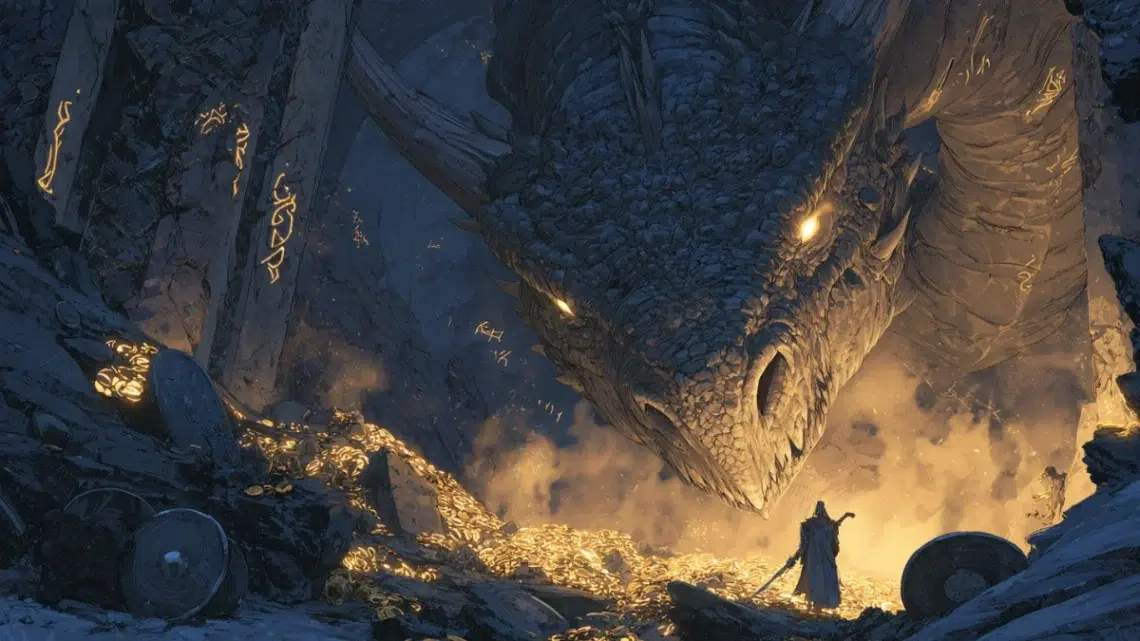
Dragons appear in myths across the world. Some guard treasure. Others destroy kingdoms. A few even shape the fate of gods and heroes.
Ancient cultures imagine dragons in many forms. Greek myths describe giant serpents that battle heroes and gods. Norse legends tell of cursed dragons guarding gold. In Asia, dragons often bring wisdom, rain, and power.
These creatures are not just monsters. Many dragons represent chaos, nature, or the struggle between order and destruction.
Stories about dragons appear in Greek, Norse, Chinese, Japanese, and many other traditions. Some dragons live beneath mountains. Others circle the oceans or guard sacred places.
This article explores ten famous dragons from mythology. Each one has a story that shows why dragons remain some of the most powerful creatures in legend.
Common Questions About Dragons
What Are Dragons in Mythology?
Dragons in mythology are powerful serpent or reptile like creatures that appear in legends across many cultures. They are often connected to nature, chaos, treasure, or divine power. Some dragons guard sacred places or treasures, while others battle heroes and gods. In many myths, dragons represent forces that must be overcome to restore balance to the world.
Why Do So Many Cultures Have Dragon Legends?
Many cultures have dragon legends because large serpents symbolize powerful natural forces. Storms, floods, volcanoes, and drought often appear in myth as dragon like creatures. These stories help explain dangerous parts of the natural world. Over time, dragons become symbols of chaos, wisdom, protection, or destruction depending on the culture.
What Are the Most Famous Dragons in Mythology?
Some of the most famous dragons in mythology include Fafnir from Norse legend, Jörmungandr the World Serpent, Yamata no Orochi from Japan, Vritra from Hindu myth, and Ladon from Greek mythology. Other well known dragon figures include Apep from Egypt and Quetzalcoatl, the feathered serpent of Mesoamerican mythology.
Which Dragon Is the Most Powerful in Mythology?
One of the most powerful dragons in mythology is Jörmungandr, the World Serpent from Norse myth. The creature is so large that it circles the entire world and grasps its own tail. During Ragnarök, it battles the thunder god Thor in a final battle that shakes the cosmos.
Are Dragons Always Villains in Mythology?
Dragons are not always villains in mythology. In many Asian traditions, dragons are wise and protective beings connected with rain, rivers, and prosperity. Chinese dragons often symbolize good fortune and imperial power. Western myths more often portray dragons as dangerous monsters that heroes must defeat.
Why Do Dragons Guard Treasure in Many Myths?
Dragons often guard treasure because they represent greed, power, and danger. In many stories, heroes must defeat a dragon to claim a valuable prize. The treasure can symbolize wealth, knowledge, or a reward for bravery. The dragon becomes the final obstacle that tests a hero’s courage.
What Do Dragons Symbolize in Mythology?
Dragons symbolize many things depending on the culture. They can represent chaos, power, wisdom, protection, or natural forces like storms and rivers. In Western myths they often represent danger and destruction. In Eastern traditions they are more commonly symbols of strength, prosperity, and balance in nature.
#1 Fafnir – The Cursed Dragon of the Volsung Saga (Norse Mythology)
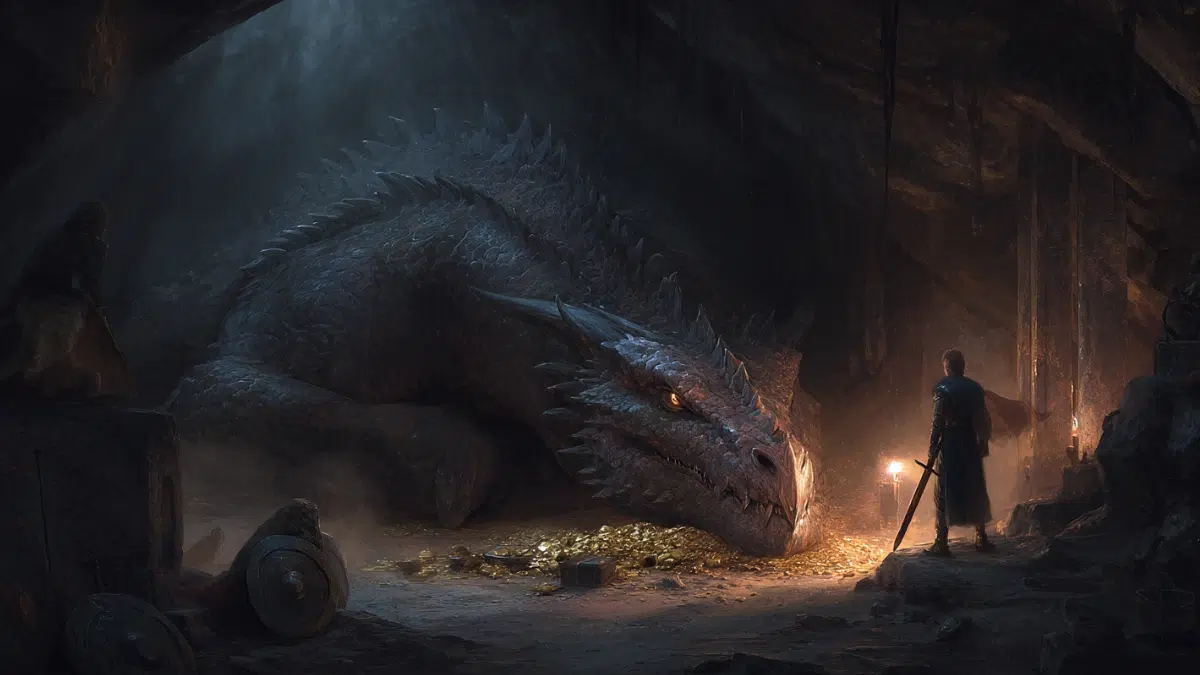
One of the most famous dragons in Norse mythology. Fafnir begins as a dwarf who turns into a dragon after greed corrupts him. He guards cursed treasure and is slain by the hero Sigurd.
Fafnir is one of the most famous dragons in Norse mythology. His story is not just about monsters and heroes. It is about greed and how power can change a person.
Fafnir starts life as a dwarf, the son of the powerful sorcerer Hreidmar. When the trickster god Loki kills Fafnir’s brother Otter, the gods must pay a huge ransom of gold to Hreidmar. Among the treasure is a cursed ring known as Andvaranaut.
The gold quickly brings disaster. Fafnir becomes obsessed with the treasure and murders his own father to claim it. His greed grows so strong that he transforms into a dragon. He hides in the wilderness and guards the cursed gold, allowing no one to approach.
Years later, the hero Sigurd seeks the treasure. Guided by the wise smith Regin, Sigurd digs a pit along the path where Fafnir crawls to drink water. When the dragon passes overhead, Sigurd thrusts his sword upward and kills the great beast.
Fafnir’s story warns that greed can corrupt even the strongest heart.
#2 Jörmungandr – The World Serpent (Norse Mythology)
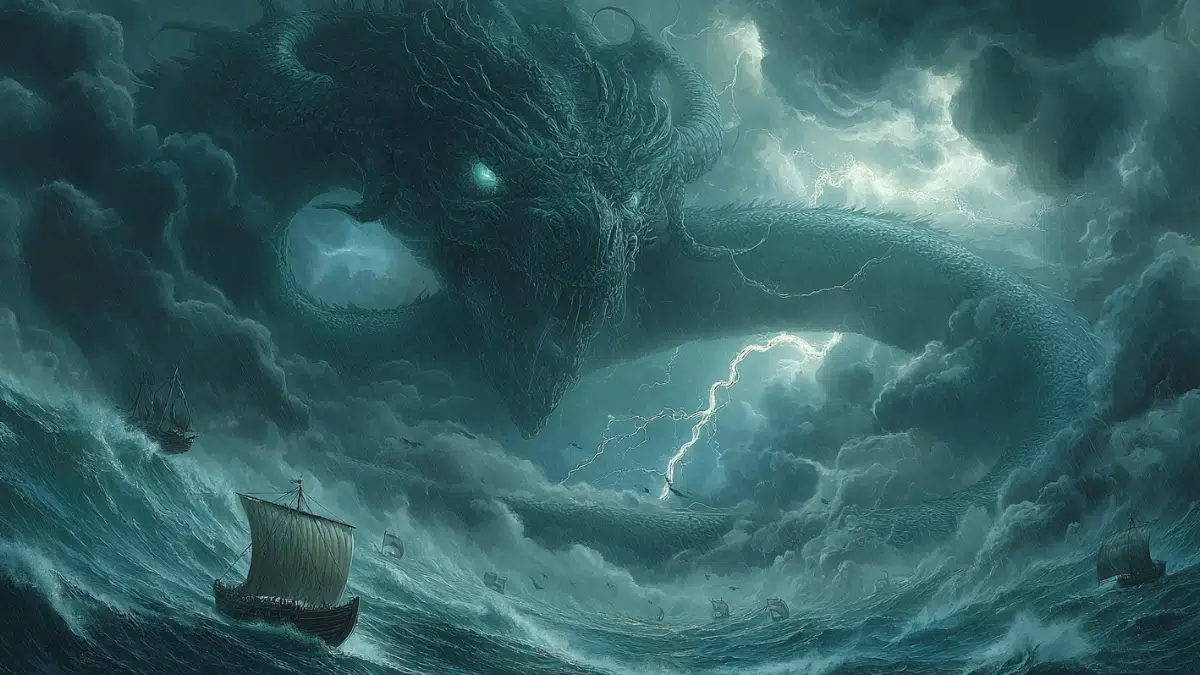
A gigantic sea serpent, Jörmungandr is the mortal enemy of Thor and plays a key role in Ragnarök.
Jörmungandr is one of the most powerful creatures in Norse mythology. He is known as the World Serpent, a giant sea dragon that surrounds the entire earth.
The serpent is the child of the trickster god Loki and the giantess Angrboda. Because the gods fear the power of Loki’s children, Odin throws Jörmungandr into the great ocean that encircles Midgard, the world of humans.
There the serpent grows larger and larger. Eventually Jörmungandr becomes so massive that he wraps his body around the entire world and grasps his own tail in his mouth.
Jörmungandr is the sworn enemy of the thunder god Thor. Their rivalry appears in several Norse myths. In one famous story, Thor tries to catch the serpent while fishing with the giant Hymir. Thor nearly pulls the creature from the sea before the line snaps.
Their final battle comes during Ragnarök, the end of the world. Thor slays the serpent with his hammer Mjölnir, but the serpent’s poison fills the air. Thor manages only nine steps before the venom kills him.
Jörmungandr represents the dangerous power of the sea and the cycle of destruction and renewal in Norse myth.
#3 Typhon – The Father of Monsters (Greek Mythology)
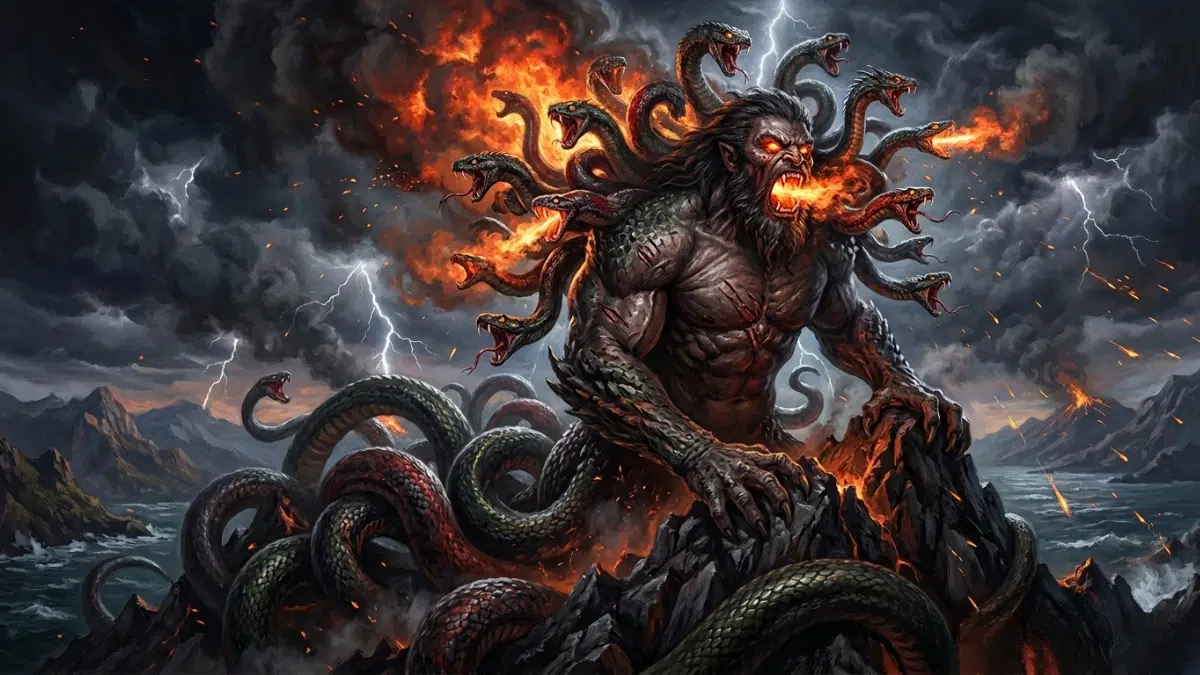
Typhon is one of the most terrifying creatures in Greek mythology. Many ancient writers describe him as the greatest threat the gods ever face.
According to myth, Typhon is born from Gaia, the earth goddess, after the Olympian gods defeat the Titans. Angry at how Zeus treats her children, Gaia creates Typhon to challenge the rule of the new gods.
Typhon is enormous and monstrous in appearance. He has the upper body of a man but the legs of a giant serpent. From his shoulders rise many dragon heads that breathe fire. His wings stretch across the sky, and his roar can sound like thunder, animals, or storms.
When Typhon attacks Olympus, the gods panic and flee to Egypt. Only Zeus stands and fights. The battle shakes the world as Zeus hurls thunderbolts at the monster.
Some myths say Typhon briefly defeats Zeus before the king of the gods regains his strength and strikes back. Zeus eventually overpowers the monster and buries him beneath Mount Etna in Sicily.
Ancient Greeks believe earthquakes and volcanic eruptions come from Typhon struggling beneath the mountain.
#4 Ladon – The Dragon of the Golden Apples (Greek Mythology)
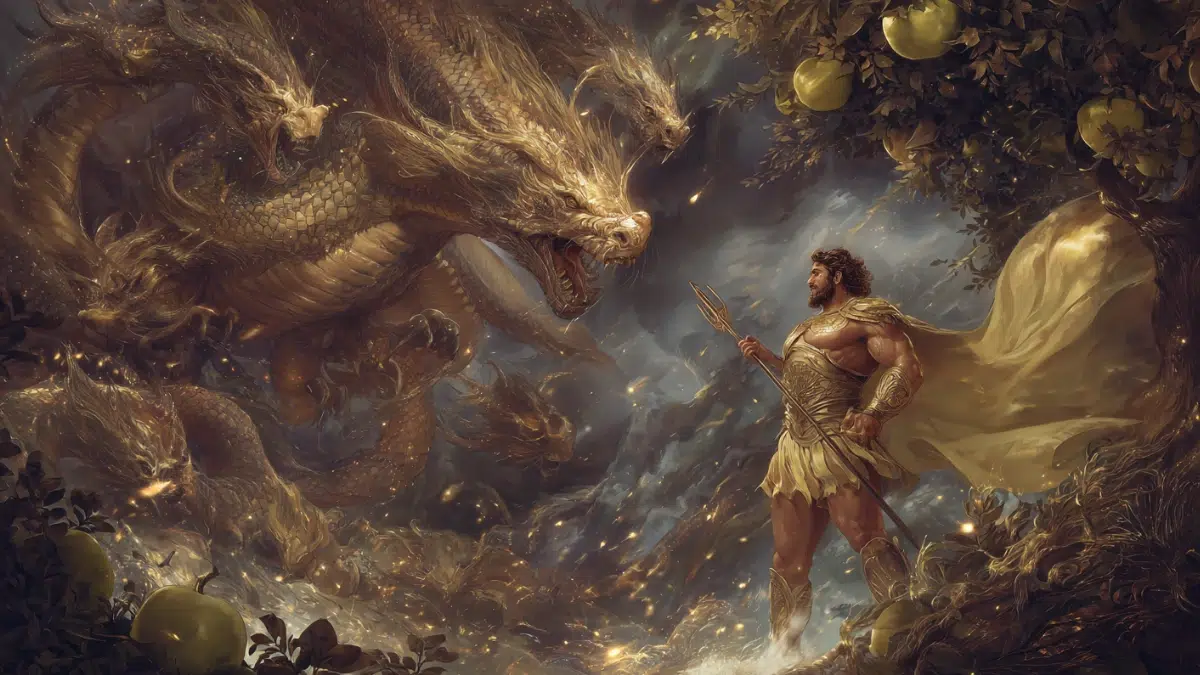
The hundred headed dragon that guards the golden apples in the Garden of the Hesperides until Heracles defeats him.
Ladon is the dragon that guards one of the most famous treasures in Greek mythology. He watches over the golden apples in the Garden of the Hesperides.
The garden belongs to Hera, the queen of the gods. The golden apples are a sacred gift from Gaia, the earth goddess. Because the fruit is so valuable, Hera places Ladon there as its guardian.
Ladon is often described as a massive serpent or dragon that coils around the tree of golden apples. Some ancient writers say he has many heads. This makes it nearly impossible for anyone to sneak past him.
The hero Heracles encounters Ladon during one of his famous Twelve Labours. His task is to obtain the golden apples.
Different versions of the story exist. In some myths, Heracles kills the dragon with a well aimed arrow. In others, he convinces the Titan Atlas to retrieve the apples while he holds up the sky.
Even after Ladon dies, the story does not end. Some myths say the gods place the dragon among the stars as the constellation Draco.
Ladon represents the powerful guardians often placed between heroes and sacred treasures.
#5 Yamata no Orochi – The Eight Headed Dragon (Japanese Mythology)
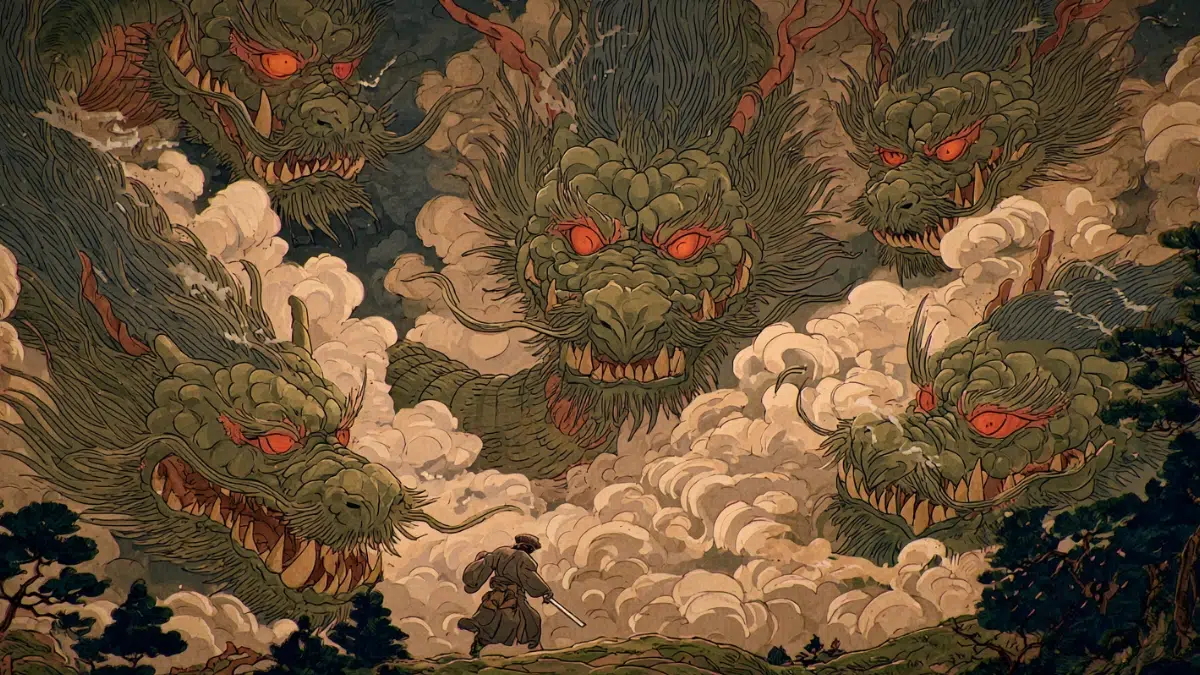
A massive eight headed serpent that terrorizes Japan until the storm god Susanoo defeats it.
Yamata no Orochi is one of the most famous dragons in Japanese mythology. The creature is a giant serpent with eight heads and eight tails.
Ancient stories describe the dragon as enormous. Its body stretches across valleys and mountains. Moss and trees grow along its back, and rivers of blood flow from its many heads.
The monster terrorizes a family who lives near its lair. Each year the dragon demands a terrible sacrifice. The family must give one of their daughters to the creature.
By the time the storm god Susanoo arrives, only one daughter remains. Her name is Kushinada-hime.
Susanoo promises to save her. First he turns the girl into a small comb and places her safely in his hair. Then he prepares a clever trap.
He brews strong sake and places eight barrels of the drink behind a large fence with eight gates. Each of the dragon’s heads drinks the sake and becomes drunk.
Once the monster falls asleep, Susanoo attacks. He cuts the serpent into pieces with his sword. Inside one of the dragon’s tails he discovers a sacred blade called Kusanagi, which later becomes one of Japan’s imperial treasures.
The story of Orochi shows how courage and clever planning can defeat even the most terrifying monster.
#6 Vritra – The Dragon of Drought (Hindu Mythology)
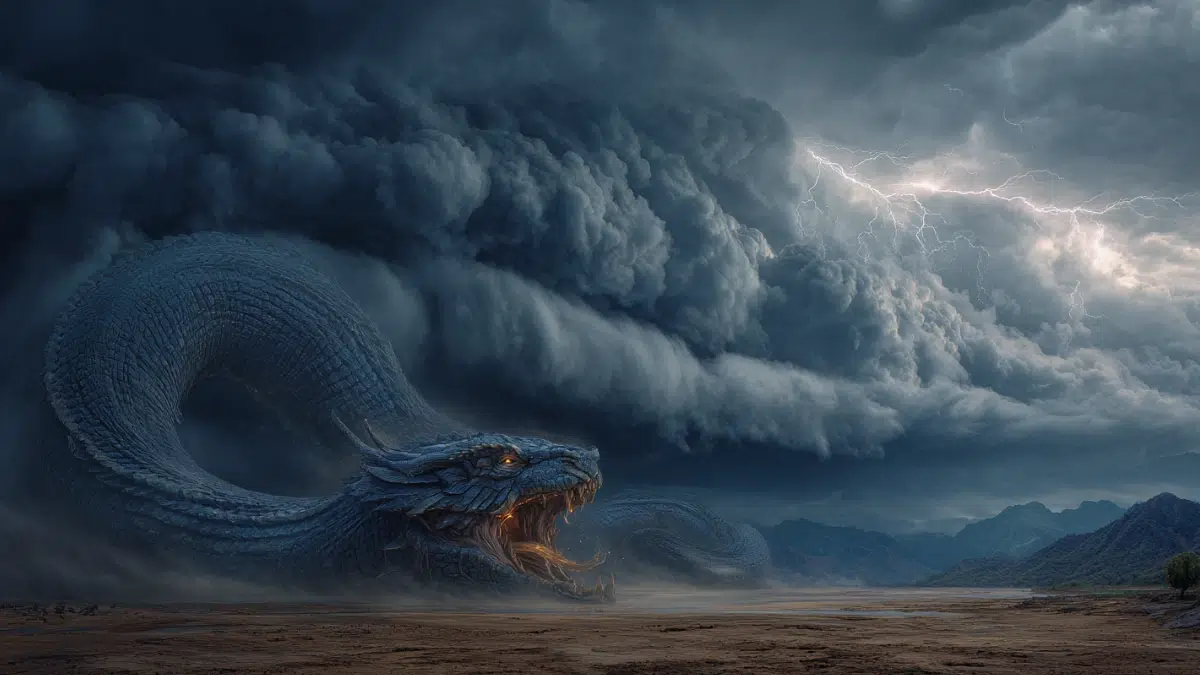
A powerful dragon who traps the world’s waters. The god Indra defeats Vritra and releases the rivers.
Vritra is one of the most powerful dragons in Hindu mythology. Ancient Vedic texts describe him as a massive serpent or dragon that holds back the waters of the world.
Vritra traps the rivers and clouds, causing a terrible drought across the land. Without water, crops fail and life begins to suffer. The world falls into fear as the great dragon blocks the life giving waters.
The storm god Indra becomes the only one strong enough to challenge him. Armed with the Vajra, a thunderbolt weapon forged by the divine craftsman Tvastar, Indra rides into battle.
The fight between Indra and Vritra is fierce. Lightning crashes and storms shake the sky. In the end, Indra strikes the dragon with the Vajra and defeats him.
When Vritra falls, the rivers burst free and water flows across the earth again. Rain returns, and life is restored.
Because of this myth, Vritra often represents drought, chaos, and obstacles that block the natural flow of life. Indra’s victory symbolizes the power of storms and rain to bring balance back to the world.
#7 Apep (Apophis) – The Serpent of Chaos (Egyptian Mythology)
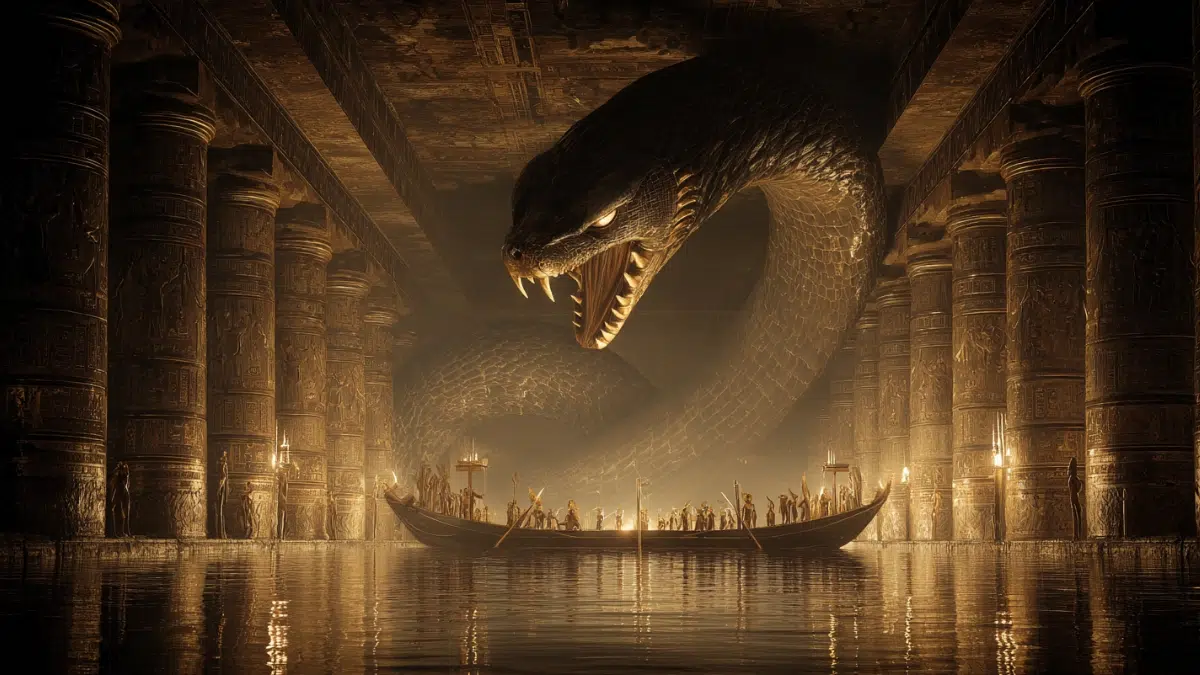
A massive serpent that attacks the sun god Ra each night as he travels through the underworld.
Apep, also called Apophis, is one of the most dangerous creatures in Egyptian mythology. He is a giant serpent that represents chaos, darkness, and destruction.
Unlike many dragons in myth, Apep is not just a monster that appears once in a story. He is an eternal enemy of the sun god Ra.
Each night, Ra travels through the underworld in a solar boat. As the sun god journeys through the darkness, Apep waits in the shadows. The serpent rises from the depths of the underworld and tries to stop the sun from rising again.
The battle happens every night. Apep coils around the boat, attacks the gods, and attempts to swallow the light of the sun.
Ra does not fight alone. Other gods help defend the solar boat and drive the serpent back. In some stories, the god Set helps strike the creature with a spear.
Although Apep is defeated each night, he is never truly destroyed. The struggle repeats again and again.
For the ancient Egyptians, this battle explains why the sun rises each morning. Order defeats chaos, and light returns to the world.
#8 Quetzalcoatl – The Feathered Serpent (Mesoamerican Mythology)
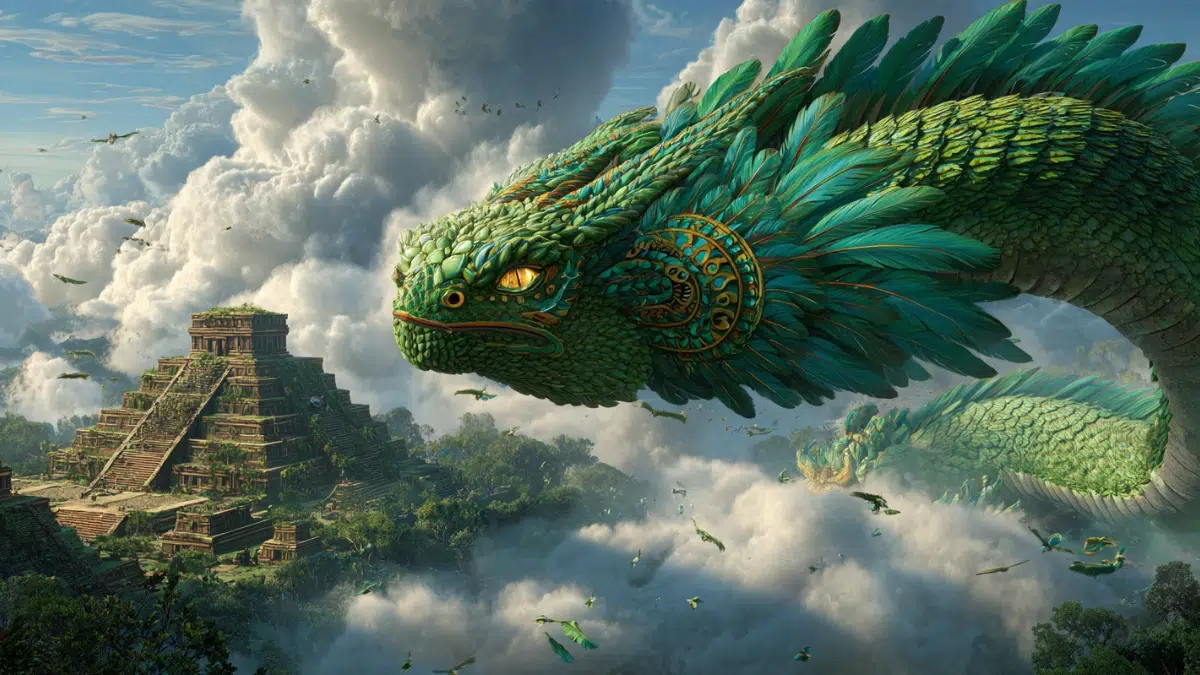
A feathered serpent deity connected with creation, wisdom, and the wind. One of the most important gods in Mesoamerican myth.
Quetzalcoatl is one of the most important figures in Mesoamerican mythology. His name means “Feathered Serpent,” combining the image of a powerful serpent with the beauty of a bird.
Unlike many dragons in myth, Quetzalcoatl is not a monster. He is a god connected with wisdom, knowledge, and creation. Ancient cultures across Mexico and Central America worship him for centuries.
Quetzalcoatl is often linked with wind, learning, and the movement of the stars. In some myths he helps create humanity by recovering the bones of earlier people from the underworld. The bones are mixed with divine blood to form new humans.
He is also known as a protector of civilization. Stories say he teaches people farming, crafts, and the calendar. Because of this, many cultures view him as a bringer of knowledge and order.
Quetzalcoatl is usually shown as a serpent covered in bright green feathers, often linked to the sacred quetzal bird.
His legend spreads across many civilizations, including the Toltec and Aztec. Even today, the Feathered Serpent remains one of the most famous dragon like beings in mythology.
#9 The Azure Dragon – Guardian of the East (Chinese Mythology)
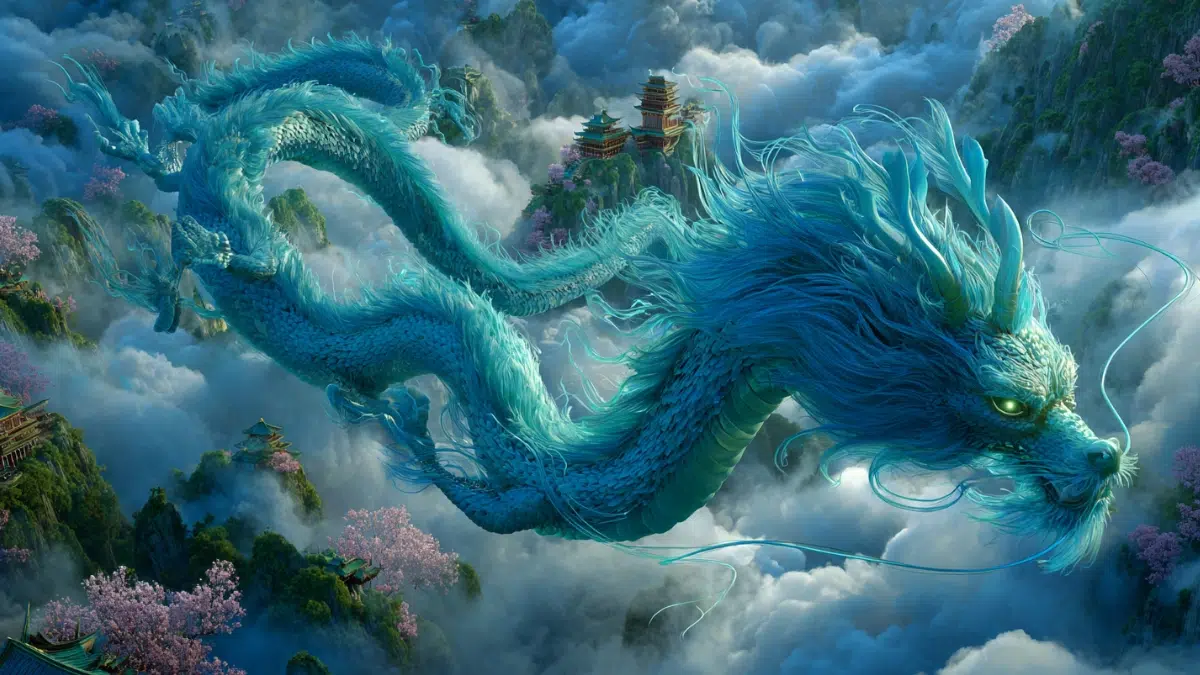
A sacred dragon associated with spring, the east, and protection. It is one of the Four Symbols of Chinese mythology.
The Azure Dragon is one of the most important dragons in Chinese mythology. It is known as Qinglong, the Dragon of the East, and serves as a powerful guardian of the heavens.
Unlike many dragons in Western myths, the Azure Dragon is not a monster. It is a sacred creature connected with protection, wisdom, and natural balance.
In ancient Chinese belief, the sky is divided into four regions, each protected by a powerful creature. These are known as the Four Symbols. The Azure Dragon guards the eastern sky, while the White Tiger, Vermilion Bird, and Black Tortoise protect the other directions.
The Azure Dragon is closely linked with spring, growth, and renewal. When it rises in the sky, it signals the return of warmer weather and the beginning of the growing season.
Chinese dragons often control rain, rivers, and storms. Because farming depends on rain, dragons are seen as powerful forces of life and prosperity.
The Azure Dragon also appears in Chinese astronomy, where groups of stars form its long body across the sky.
For centuries, it symbolizes strength, good fortune, and the protective power of the heavens.
#10 Zmey Gorynych – The Three Headed Dragon (Slavic Mythology)
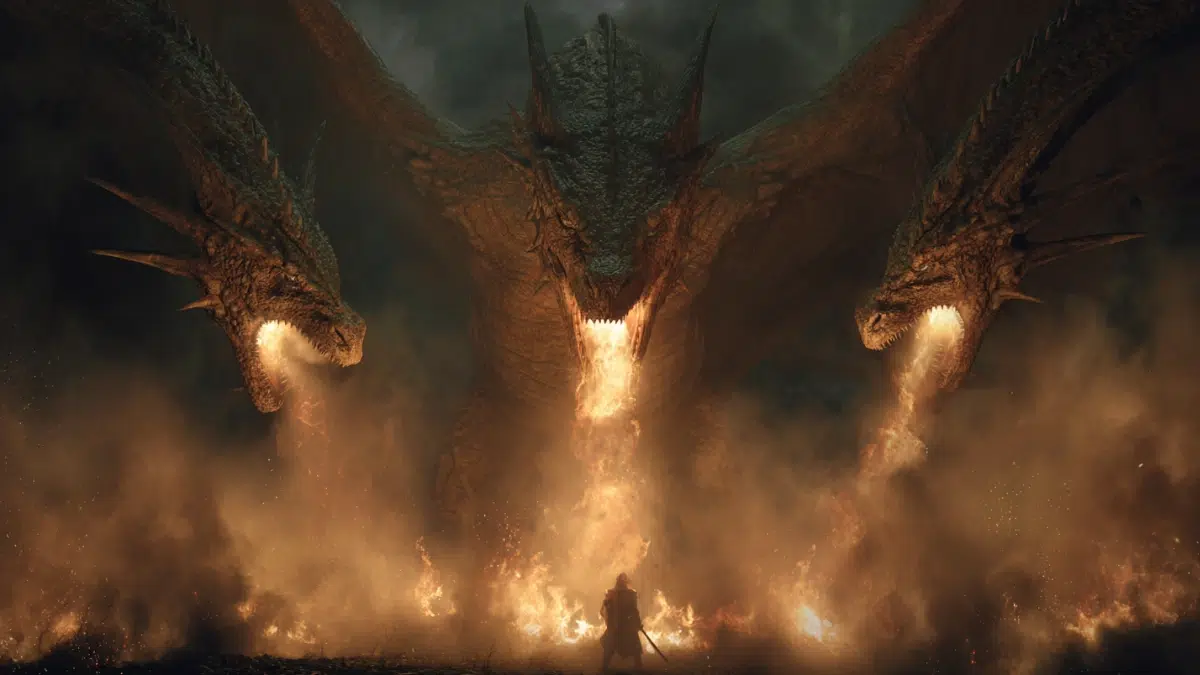
A fire breathing dragon from Slavic folklore that battles legendary heroes.
Zmey Gorynych is one of the most famous dragons in Slavic mythology. He is a terrifying creature known for his three heads and powerful fire breathing attacks.
In many legends, Zmey Gorynych lives in dark caves, mountains, or deep forests. He often guards treasures or kidnaps princesses, forcing heroes to face him in battle.
Each of the dragon’s heads can breathe fire, making him extremely dangerous. In some stories, if one head is cut off, another can grow back. This makes the creature even harder to defeat.
Slavic heroes such as Dobrynya Nikitich are often the ones who challenge the dragon. These warriors represent courage and strength as they fight to protect their people.
The battles between heroes and Zmey Gorynych are dramatic and fierce. The dragon’s fire shakes the land while the hero strikes with sword or spear.
Stories of Zmey Gorynych appear in Russian and Eastern European folklore for centuries. Like many dragon legends, the tale shows the struggle between brave heroes and destructive forces.