

Boudica: Celtic Warrior Queen Who Defied Rome
Queen Boudica is a legendary figure in British history. She was a fierce leader of the Iceni people.
Her story is one of courage and defiance against oppression.
Boudica became queen after the death of her husband, King Prasutagus.
Under her leadership, the Iceni people initially tried to live peacefully under Roman rule.
However, the Romans’ harsh treatment and exploitation led to tension and unrest.
In 60-61 AD, Boudica led a major revolt against the Roman Empire.
This uprising was sparked by the Romans’ failure to respect the will of her late husband and their brutal actions towards her family and people.
Boudica’s leadership inspired thousands from various peoples to join her.
Together, they fought fiercely for their freedom.
Boudica’s revolt is remembered not just for its immediate impact but for its lasting legacy.
It highlights the courage of the Britons and their desire for justice and autonomy.
Though eventually defeated, Boudica’s fierce resistance left a mark on history, symbolizing the struggle for freedom and justice.
Background of Boudica and the People of Iceni
Roman occupation of Britain
The Roman occupation of Britain began in 43 AD under Emperor Claudius.
The Romans aimed to expand their empire and control key resources.
They brought advanced technology, built roads, and introduced Roman laws and culture.
However, the invasion also meant heavy taxes and strict control over the local people.
One of these people was the Iceni, who lived in what is now eastern England.
Initially, the Iceni were not directly controlled by the Romans. They were allies, which meant they could keep some independence while benefiting from Roman trade and military protection.
This peaceful coexistence worked well at first. The Iceni could maintain their way of life without too much interference from Roman officials.
Death of Boudica’s Husband King Prasutagus

However, the situation changed when Boudica’s husband, King Prasutagus, died.
He was the ruler of the Iceni and had tried to secure a future for his kingdom through a diplomatic approach.
In his will, Prasutagus left his kingdom jointly to his daughters and the Roman emperor, hoping this would protect his family and maintain peace with Rome.
He believed that by including the emperor in his will, he would show loyalty and perhaps preserve some autonomy for his people.
Unfortunately, the Romans ignored Prasutagus’s wishes.
Instead of honouring the will, they saw his death as an opportunity to fully annex the Iceni lands.
Roman soldiers seized property, and Roman officials took over the governance of the region. This betrayal marked a significant turning point for the Iceni.
The annexation was harsh and sudden.
Roman officials disrespected the local customs and laws, which deeply offended the Iceni people.
Their response was a mixture of shock, anger, and betrayal. The Iceni’s peaceful coexistence with the Romans broke down completely.
The mistreatment of her family by the Romans, coupled with the aggressive annexation of Iceni territory, pushed Boudica and her people to the edge.
They were no longer willing to accept Roman domination and were ready to fight for their freedom and dignity.
The stage was set for one of the most famous rebellions in history, where Boudica would lead her people against the mighty Roman Empire.
The Circumstances Leading to Boudica’s Rebellion

Annexation of Iceni Territory
The Romans captured lands that the Iceni people owned.
Before, they had agreed to let the Iceni live freely.
When Boudica’s husband, the king, died, he left his kingdom to both his daughters and the Roman emperor.
He hoped this would protect his family and keep peace with Rome. Instead, the Romans saw it as a chance to take control.
Ignoring the late king’s wishes, they took over the lands.
They did not treat the Iceni as allies but as people they had conquered.
This betrayal was not just about taking land.
It showed that the Romans did not respect the Iceni’s rights at all. It proved that the Romans would break promises to gain more power.
The Romans’ actions angered the Iceni and other nearby people.
They felt tricked and mistreated. This pushed them toward the idea of rebellion.
They no longer trusted Roman promises and wanted to fight for their freedom and dignity.
Brutal Treatment of Boudica and Her Daughters
After Boudica’s husband passed away, the Romans did not honour his last wishes.
Instead, they attacked Boudica and harmed her daughters severely. This brutal act shocked everyone.
Boudica’s husband had hoped that leaving part of his kingdom to the Roman emperor would protect his family. Unfortunately, it led to their suffering.
The Romans beat Boudica publicly and abused her daughters.
These actions were not only cruel but also a clear message to the Iceni people.
The Romans wanted to show that they had total control. This mistreatment deeply angered the Iceni people and other local groups.
By disrespecting Boudica, the Romans ignored the laws they themselves had set.
This injustice made many question Roman authority and lose respect for Roman rule.
The cruelty Boudica and her daughters faced became a rallying point for rebellion.
It united many peoples against Rome, who were now fighting not just for land, but for honour and justice.
Economic Exploitation and Plundering of Wealth by Roman Officials
Roman leaders placed heavy taxes on the Iceni people.
They demanded more money than the people could afford.
These high taxes hurt the Iceni, making it hard for them to survive. The Romans didn’t stop there.
They also took money and land from Iceni leaders. This was their way of taking control and showing power.
By seizing property, the Romans made life difficult for the Iceni.
Families lost their homes and lands that they had farmed for generations.
This greed showed the Romans’ disregard for the well-being of the Iceni people.
The constant pressure to pay taxes and the loss of land left the Iceni desperate and poor.
They struggled to feed their families and keep their community alive.
The harsh economic demands fueled anger and resentment towards the Roman rule.
This exploitation was one of the main reasons the Iceni joined Boudica in her rebellion.
They wanted to fight back against the injustice and reclaim their rights and resources.
The Rebellion
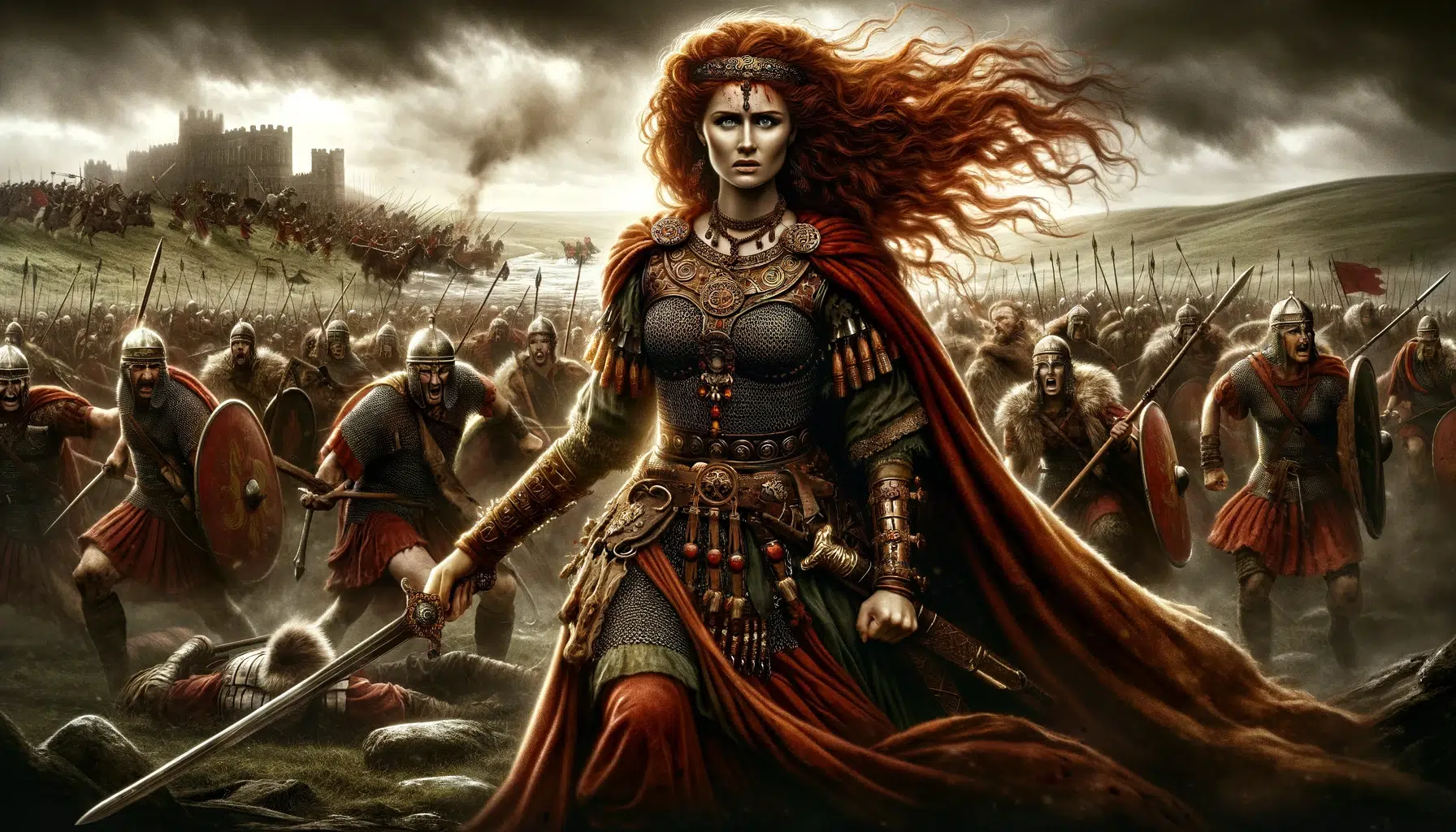
Progression of the Uprising by Queen Boudica
In 60-61 AD, Queen Boudica led a massive rebellion against Roman rule.
Her uprising is one of the most famous in British history.
The revolt started after the Romans broke their promises and mistreated her family. This led Boudica to rally her people and others who felt oppressed.
Impact on Roman Britain
The rebellion targeted key Roman cities, which were symbols of Roman power and oppression.
The first city they attacked was Camulodunum (now Colchester). This city was a major Roman outpost and a former capital of Roman Britain.
Boudica’s forces laid siege to it, overwhelming the defenders with sheer numbers and fierce fighting.
They destroyed the city, tearing down statues and buildings, leaving it in ruins.
Next, Boudica’s army moved towards Londinium (modern-day London), a thriving trade center.
They managed to capture and destroy Roman cities, including Londinium (now London), which was a significant center of Roman administration.
Knowing they could not defend the city, the Romans evacuated Londinium.
Boudica’s forces burned it to the ground, making it a symbol of their defiance against Roman control.
After Londinium, they attacked Verulamium (St. Albans). Like the previous cities, Verulamium was sacked and burned.
These attacks showed Boudica’s strategic approach to weaken Roman power by targeting important economic and cultural centers.
This uprising sent shockwaves through Roman Britain, with the Romans realizing the intensity of the opposition they faced.
| City | Resulting Destruction from Boudica’s Army |
|---|---|
| Camulodunum (Colchester) | Burned to the ground |
| Verulamium (St. Albans) | Reduced to ashes |
| Londinium (London) | Ravaged by flames |
Boudica’s Battle Tactics
Boudica used guerrilla tactics, taking advantage of her forces’ knowledge of the local terrain.
This allowed them to make swift attacks and retreat quickly before Roman reinforcements could arrive.
Her strategy also involved rallying support from various peoples, uniting them with a common cause.
This widespread support was crucial, as it brought together a large, motivated force to stand against the Romans.
The initial successes of Boudica’s rebellion were remarkable.
They managed to unite various British people against a common enemy and inflicted significant damage to the Roman infrastructure.
However, these victories were not just military.
They boosted the morale and confidence of the people, showing that the Romans could be challenged.
Boudica’s leadership and the initial victories of her forces inspired awe and fear.
Her ability to gather a large army and her success in attacking major cities were pivotal in the scale and impact of the uprising.
While the rebellion ultimately faced a harsh Roman response, its early successes remain a powerful testament to Boudica’s leadership.
| Boudica’s Archery Skills | Boudica’s Battle Tactics |
|---|---|
|
|
Boudica’s Archery Skills
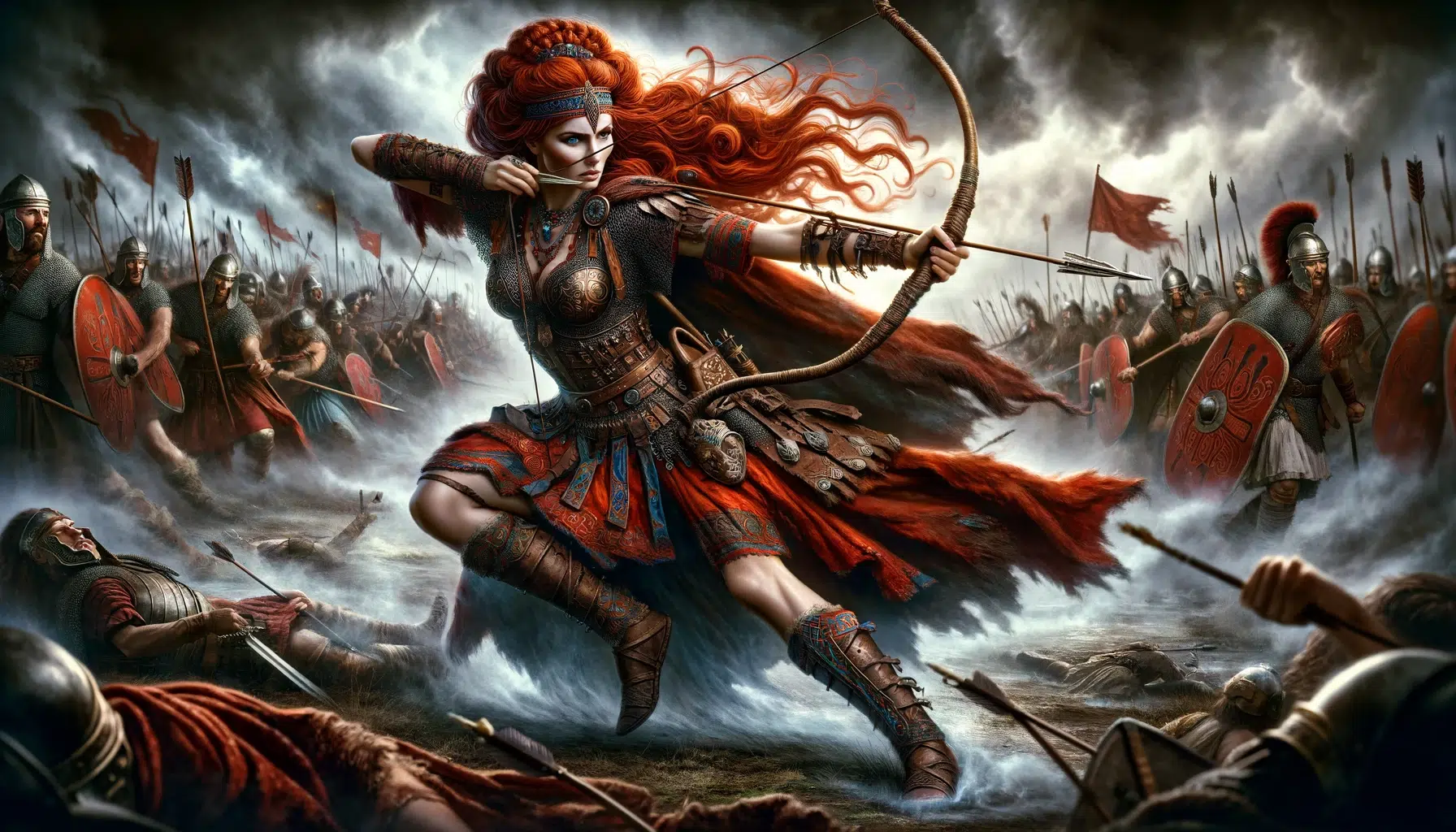
During battles, Boudica’s adeptness with the bow allowed her to target key Roman soldiers and weaken their formations.
Her archers would rain arrows down upon the enemy, causing chaos and panic.
This strategy gave her forces an initial advantage, allowing them to close in and engage in hand-to-hand combat.
By strategically positioning her archers and using hit-and-run tactics, she was able to disrupt enemy formations and create confusion.
Her use of terrains, such as forests and hills, provided cover for her forces and allowed them to launch surprise attacks.
Overall, Boudica’s archery skills and battle tactics played a crucial role in her revolt against Rome.
They demonstrated her strategic acumen and ability to adapt to different situations on the battlefield.
With her skillful command and use of archery, Boudica proved to be a formidable opponent to the mighty Roman Empire.
The Battle of Watling Street

The Battle of Watling Street was the final and most decisive confrontation of Boudica’s rebellion against the Roman Empire.
This battle took place on an unknown location along Watling Street, a major Roman road.
Governor Suetonius Paulinus led the Roman forces.
He was a seasoned military leader who made a strategic decision to confront Boudica’s much larger army.
He chose a narrow gorge with a forest behind him.
This positioning prevented the Britons from using their superior numbers to surround the Romans.
It forced Boudica’s forces to attack head-on, where the disciplined Roman soldiers had the advantage.
Boudica’s army, fueled by a desire for revenge and freedom, charged into battle with great ferocity.
However, they faced well-trained Roman legions who were prepared for their assault.
The Romans used tight formations and heavy shields to protect themselves from the Britons’ weapons.
| Battle Statistics | Roman Army | Boudica’s Army |
|---|---|---|
| Number of Soldiers | Approximately 10,000 | Estimates vary, but approximately 100,000+ |
| Armament | Advanced weaponry and armour | Primarily handmade weapons and shields |
| Tactics | Disciplined formations and coordinated attacks | Guerilla warfare and ambush tactics |
| Outcome | Decisive victory for the Romans | Defeat for Boudica’s forces |
Tactical Disadvantage Leads to Boudica’s Downfall
Historical estimates suggest that Boudica’s forces numbered up to 230,000, while the Romans had about 10,000 troops.
Despite their numbers, the lack of discipline and tactical disadvantage led to Boudica’s downfall.
The narrow battlefield limited the effectiveness of her large army, allowing the Romans to use their superior tactics to devastating effect.
The battle resulted in a heavy loss for Boudica’s forces.
It is estimated that over 80,000 Britons were killed compared to only 400 Roman casualties.
The disparity in losses showcases the effectiveness of Roman military strategy.
And the challenges faced by Boudica’s army in overcoming a well-entrenched enemy.
Boudica’s Rebellion Ends in Defeat

The defeat at Watling Street effectively ended the rebellion.
Boudica’s whereabouts after the battle are unknown.
Some sources claiming she took her own life as she was faced with the prospect of capture and humiliation.
Boudica and her daughters made the difficult decision to take their own lives.
This battle marked the end of one of the most significant revolts against Roman Britain.
It also highlighted the tactical brilliance of the Roman military and the fierce determination of the Britons under Boudica’s leadership.
Boudica’s revolt was unable to achieve its desired outcome.
However her legacy as a symbol of resistance and the struggle for justice and independence lives on.
Her courageous stand against Roman rule continues to inspire generations.
Through her defeat, Boudica demonstrates unwavering determination and a refusal to submit to oppression.
Her story serves as a lasting testament to the indomitable spirit of those who dare to challenge the status quo and fight for what they believe in.
Boudica’s Enduring Legacy
Boudica’s rebellion against Rome left a lasting impact on English mythology and history.
She became a symbol of resistance and defiance against oppressive forces.
Boudica’s story, with its elements of heroism and bravery, has been passed down through generations, solidifying her place as a legendary figure in English folklore.
Her story also highlights the ancient British belief in the power of their gods in guiding and supporting their cause.
One can see the enduring legacy of Boudica in various aspects of English mythology.
She is often depicted as a fearless warrior queen who fought valiantly against the Romans.
Her tale is woven into the fabric of English folklore, inspiring countless tales of heroism and rebellion.
The Gods’ Influence

In English mythology, the gods play a significant role in supporting and guiding Boudica’s cause.
The ancient Britons believed that their gods provided them with strength, courage, and divine protection.
Boudica’s unwavering belief in the power of their gods fueled her determination to stand up against Roman oppression.
The gods, such as Andraste, the goddess of victory, favoured Boudica and aided her in her quest for freedom.
This belief in the divine intervention of gods added a mythical element to Boudica’s story and solidified her status as a legendary figure.
The legacy of Boudica’s defiance and her reliance on the gods has resonated throughout English history, influencing subsequent tales and shaping the perception of heroism and resistance.
Great Women Warriors Compared to Boudica

Boudica has often been compared to other legendary women warriors who stood out in history for their courage and leadership.
- Joan of Arc – the French heroine who led her nation during the Hundred Years’ War. Like Boudica, Joan of Arc rallied large armies against invading forces and became a symbol of national pride and resistance.
- Artemisia I of Caria – a naval commander during the Greco-Persian Wars. Artemisia was known for her strategic brilliance and her role in the Battle of Salamis, where she fought for the Persians against the Greeks.
- Lozen – a warrior and prophet of the Chiricahua Apache of the Americas, mirrors Boudica’s spirit. Lozen was known for her military skills and her dedication to protecting her people during the Apache Wars in the 19th century.
- Penthesilea – one of the most famous Amazonian queens, led her warriors to Troy’s aid in the Trojan War. Her bravery in battle was legendary, showing parallels to Boudica’s own heroic stand against the Romans. Both leaders fought courageously against overwhelmingly powerful enemies.
- Hippolyta – another celebrated Amazon queen, was known for her magical girdle, given by her father Ares, the god of war. She ruled her people with a combination of strength and wisdom, traits that Boudica also embodied as she led the Iceni people.
All these women are remembered not just for their prowess in battle but also for their ability to inspire and lead in times of great adversity.
They each challenged the norms of their times, leading their people against formidable opponents and leaving behind stories of heroism.
They highlight the theme of female empowerment and challenge the traditional views of leadership and combat roles in their respective cultures.
Boudica’s comparison to these figures enhances her status as not just a warrior but also a symbol of female power and resistance.
Learn more about:
Conclusion
Boudica, the warrior queen of the Iceni people, remains a captivating figure in history.
Her courageous revolt against the mighty Roman Empire showcases her unwavering determination and defiance in the face of oppression.
Boudica’s story serves as a powerful testament to the indomitable spirit of those who dare to challenge oppressive forces.
As the queen of the Iceni people, Boudica’s legacy resonates through the ages.
Her rebellion stands as an inspiration to those who fight against injustice and tyranny.
Boudica’s unwavering belief in her cause and her tenacity in leading her people in the face of overwhelming odds have immortalized her as a symbol of strength and resistance.
The impact of Boudica’s uprising is still felt today.
Her story has captured the imagination of countless individuals who admire her bravery and unwavering spirit.
Boudica’s legacy as a queen, warrior, and symbol of defiance continues to inspire those who seek independence, justice, and the preservation of their cultural identity.