
Atalanta: Fabled Archer to Legendary Heroine
Introduction to Atalanta: The Fleet-Footed Maiden of Myth
Atalanta, a notable figure in Greek mythology, is renowned for her swiftness and unmatched agility.
Born wild and raised by a she-bear, her life featured extraordinary events and achievements.
Her myth includes adventure, challenges, and defiance of women’s traditional roles in ancient myths.
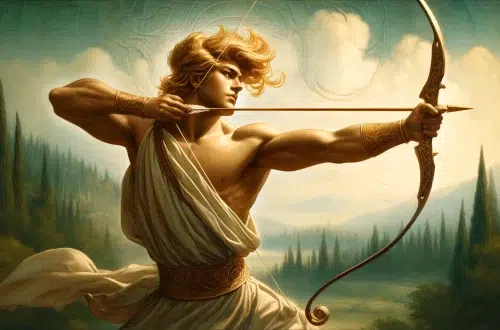
A formidable huntress, she often appears with a bow and arrows, unmatched in speed by any mortal.
Despite societal expectations, Atalanta stayed fiercely independent and loyal to her convictions, securing her place among Greek lore’s legendary heroes.
Atalanta’s Lineage: Birth and Early Life
Atalanta, shrouded in Greek mythology, is King Iasus and Queen Clymene of Arcadia’s daughter.
Despite her noble birth, her father, wanting a son, felt disheartened at her arrival.
Disappointed and bound by tradition, Iasus left Atalanta on a mountaintop to fate’s mercy.
However, Atalanta’s story did not end there.
A she-bear, either sent by Artemis or through divine providence, found and nursed the abandoned infant with compassion.
Raised by the wild under Artemis’s protection, Atalanta became a formidable hunter and swift runner, her skills sharpened by the forest.
Her prowess eventually drew hunters and kings’ attention, transforming her from a forsaken child into a legendary heroine.
Her feats of strength, speed, and spirit secured her place in Greek mythology.
The Prophecy and its Fateful Implications for Atalanta
Legend describes a prophecy that Atalanta, the skilled huntress, would be the cause of her own downfall were she to marry.
Born with a warrior’s heart and unparalleled prowess with a bow, she valiantly secured her independence.
Atalanta took a solemn vow of perpetual chastity, intending to avert the prophecy’s outcome.
Yet, her resolve set the stage for a series of events filled with perilous challenges and suitors eager to claim her hand.
Each contender risked a fatal end, as Atalanta decreed that marriage would only come to he who bested her in a footrace—failure signifying death.
The ominous prediction thus entwined Atalanta’s destiny with love, loss, and a fateful race that would echo through the ages.
Atalanta’s Upbringing and Her Skill with the Bow

A father, desiring a son, abandoned Atalanta on a mountaintop.
A she-bear, sacred to Artemis, defied her expected fate and saved her.
Nurtured by the she-bear and hunters, Atalanta learned from the wild, becoming an unparalleled huntress.
Her precocity with the bow marked Atalanta’s prowess.
As Artemis’s devotee, she rigorously honed her skills, mastering archery to a degree that impressed even seasoned warriors.
Her swift and true arrows never missed, making her name synonymous with archery excellence and paving her way to legend.
Learn more about other women in Greek mythology:
- Artemis: Ancient Greek Goddess of Archery
- Diana: Goddess of Hunt in Roman Mythology
- Legacy of Archers: Women in Greek Mythology
- Hippolyta: Queen of the Amazons in Greek Mythology
- Penthesilea: Amazon Queen Who Died in Trojan War
The Calydonian Boar Hunt
In the rugged wilds of ancient Greece, a boar of monstrous size terrorized Calydon.
Orchestrated by Artemis, the hunt for this boar drew the bravest warriors, desiring glory and triumph.
Among them was Atalanta, the only female hunter, whose presence was met with ridicule by some.
However, her unrivaled swiftness and skill with the bow quickly silenced doubters.
In a display of formidable archery, Atalanta was the first to draw blood from the fearsome beast. Thus earning respect and solidifying her status within the annals of myth as a revered heroine.
Atalanta in the World of Men
In a time when ancient Greek society imposed restrictive roles upon women, Atalanta emerged as a figure defying convention.
Unlike her female contemporaries, she was not content with domesticity; instead, Atalanta excelled in pursuits typically reserved for men: hunting, athletics, and combat.
Her exceptional skills and swift feet not only earned her a place among heroes but also challenged societal expectations.
- Atalanta participated in the boar hunt of Calydon, an activity strictly dominated by male heroes.
- Her presence in the famous Argonauts expedition further exemplified her acceptance in realms usually off-limits to women.
- By winning races against suitors, Atalanta usurped a tradition where female autonomy was often compromised for matrimony.
Atalanta’s story resonates as an early call for gender equality, illustrating that prowess and virtue are not confined by gender.
Learn more about Greek mythology:
- Achilles: Greek Warrior Hero’s Journey from Glory to Grief
- Apollo: Exploring the Archer God’s Myths and Legends
- Gods and Archery in Greek Mythology Books
- God of Archery: Norse, Greek & Roman Mythology
- Hector of Troy: Legendary Trojan Warrior
- Paris: Tragic Hero, Villain or Pawn of the Gods
- Philoctetes: The Legendary Greek Archer and Healer
The Race for Atalanta’s Hand
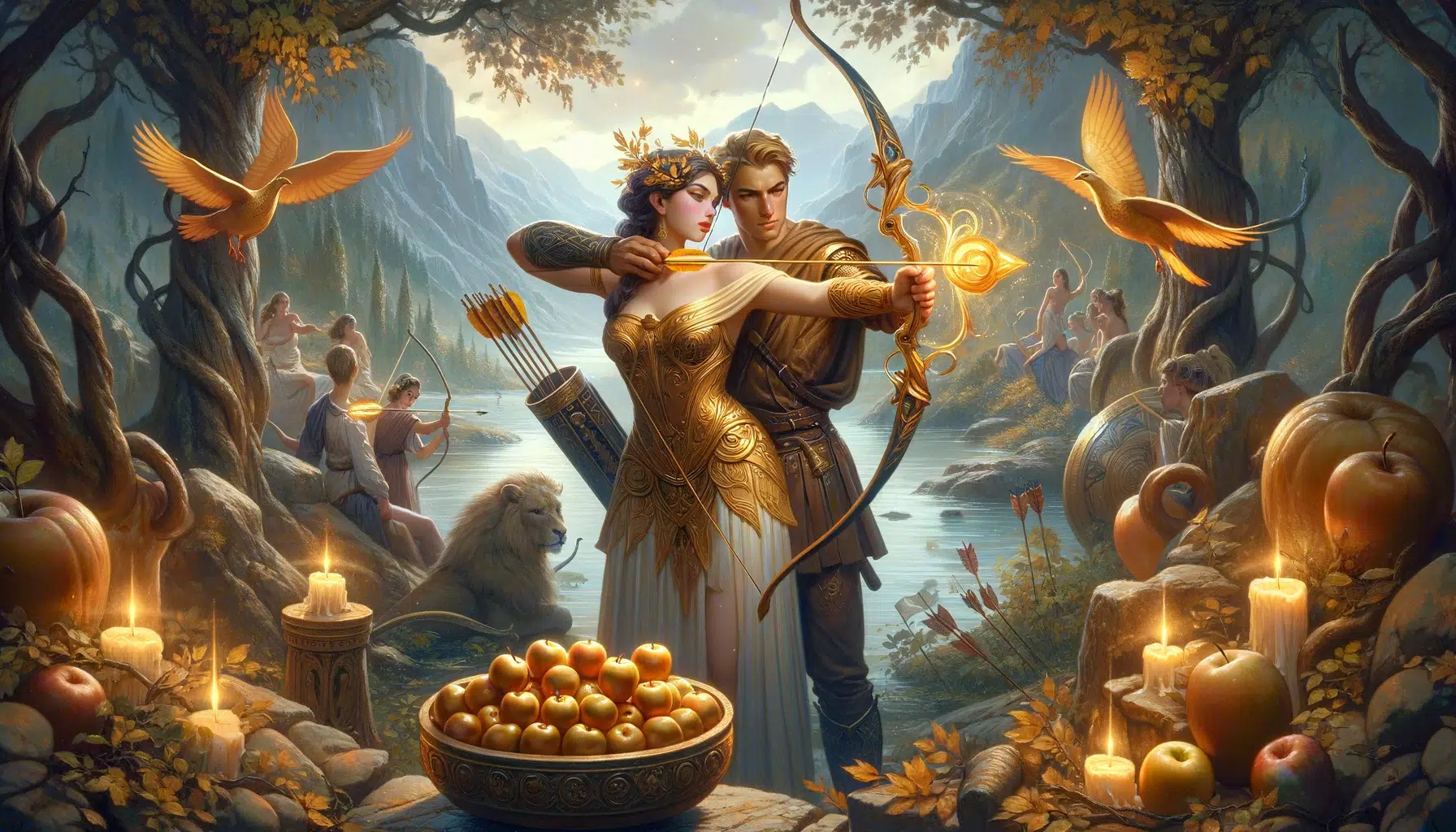
In ancient mythology, Atalanta was a prized huntress, known for her swiftness and avowed chastity.
Her father, keen on marrying her off, declared that any suitor must first defeat her in a footrace to win her hand.
Failure meant death.
Eager competitors failed, as Atalanta’s speed was unmatched.
However, love-struck Hippomenes sought help from the goddess Aphrodite, who provided him with three irresistible golden apples.
During the race, he cunningly tossed them, each stray fruit tempting Atalanta off her path, slowing her enough for Hippomenes to triumph.
This blend of love’s desperation, celestial trickery, and mortal swiftness made their story legendary.
Mythology and a Reluctant Marriage
Atalanta, a fierce huntress and beloved Greek mythology character, vowed to stay single, standing out among her peers.
Her unmatched athleticism and prowess made her a desirable bride, but she had no interest in marriage.
Despite this, her father insisted she marry.
Atalanta agreed to marry only if a suitor could outrun her.
Many tried, but only Hippomenes (or Melanion) succeeded, not through speed but by cleverly using three golden apples from Aphrodite to distract her and win.
Despite her reluctance, Hippomenes’s strategy led to their marriage, entwining their fates.
Atalanta’s Adventures with Jason and the Argonauts
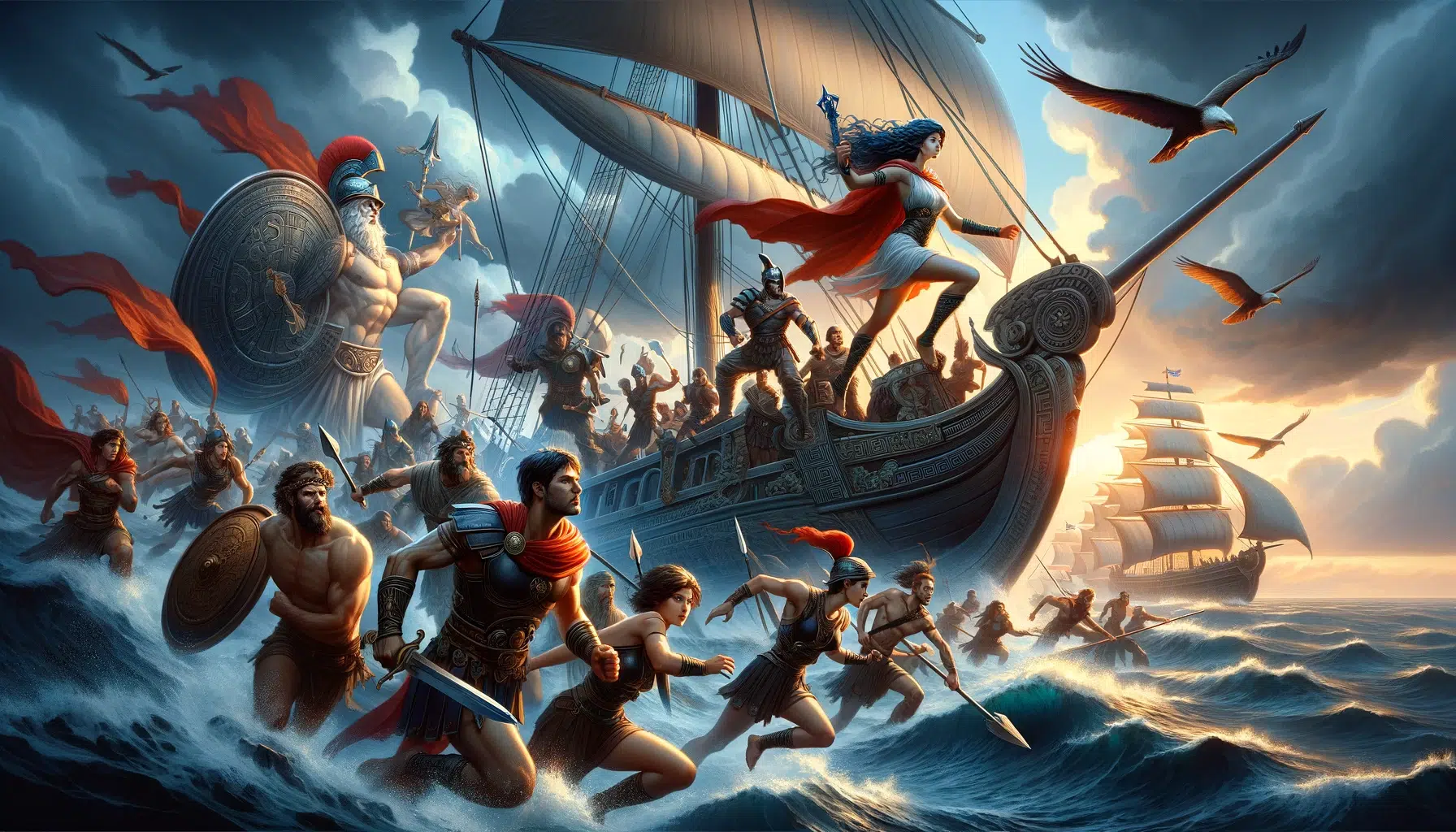
The fabled archer Atalanta was among the celebrated heroes who accompanied Jason on his quest to find the Golden Fleece—a symbol of authority and kingship.
Few women took part in such arduous quests, yet Atalanta was no ordinary maiden.
Upon the Argo, she stood shoulder to shoulder with the men, swift and skilled in the art of hunting and battle.
- She faced the harrowing trials on the Isle of Lemnos, ruled by women who had scorned Aphrodite.
- In the land of the Doliones, Atalanta proved crucial in the defense against the aggressive locals.
- During the encounter with the enormous bronze guardian Talos, Atalanta’s dexterity and courage were pivotal to the Argonauts’ survival.
Atalanta’s participation in such perilous journeys solidified her status as an exceptional hero in ancient Greek lore.
Her presence on the Argo was proof of her peerless prowess and intrepid spirit.
The Myth of Atalanta’s End
The myth of Atalanta concludes with a paradoxical blend of personal transformation and profound tragedy.
After achieving glory through various adventures, Atalanta marries.
Yet, this union is marred by a curse placed upon the couple. It impels them to consummate their love in a sacred area, angering the gods.
- They are transformed into lions as a punishment.
- The Greeks believed lions could not mate with their own species, symbolically ending Atalanta’s lineage.
- The transformation signifies both loss of her renowned independence and a divine retribution for hubris.
In this, Atalanta’s tale reflects an arc from formidable prowess to a humbling downfall, embodying the volatile interplay of human achievement and the whims of fate.
Atalanta’s Legacy Through Time
Over centuries, Atalanta’s myth has been reinterpreted, reflecting changing societal norms and values.
In art, she has been depicted with themes of strength and independence, inspiring numerous works from Renaissance paintings to modern feminist installations.
Literature saw her evolve from a fierce warrior in Ovid’s “Metamorphoses” to a complex character challenging gender roles in more contemporary retellings.
Theater and cinema have brought her to life with varying emphasis on her femininity and athleticism.
Even in sports, her name symbolizes women’s agility and endurance.
Atalanta’s legacy continues to shape the portrayal of female heroism and empowerment.
Atalanta’s Role in the Context of Greek Mythology
Atalanta occupies a unique position in Greek mythology.
As a formidable huntress, she reflects themes of independence and female empowerment, divergent from the period’s traditional gender roles.
Significantly featuring in the Calydonian Boar Hunt, Atalanta symbolizes the potential for women to rival male heroes in bravery and skill.
Moreover, her involvement in the Argonauts’ quest emphasizes the contribution of women in mythic adventures, traditionally a male domain.
Atalanta’s tales also raise questions about predestined roles and the complexities of identity, as her narrative weaves through love, companionship, and the tension between civilization and the wild.
Learn more about other women archers: Women in Archery in Different Cultures