
The Fascinating World of Medieval Archery
Introduction to Medieval Archery and its History
Medieval archery holds a prominent place in the tapestry of history, capturing the essence of bygone warfare, culture, and survival.
This period, stretching roughly from the 5th to the late 15th century, saw the bow and arrow serve as pivotal tools in conflict and hunting.
Archers played a crucial role in military victories, with famed battles often hinging on their skill and equipment.
Moreover, archery evolved over time with technological advances, leading to improvements in bow design and arrow lethality.
Thus, understanding medieval archery equipment unlocks insights into the era’s societal and technological progression.
Key Takeaways
| Aspect | Detail |
|---|---|
| Historical Evolution | Understanding the transformation of archery from medieval times to present. |
| Equipment | Deep dive into the medieval archery equipment: bows, arrows, and armor. |
| Archery in Warfare | The role and tactics of archers in medieval battles. |
| Cultural Impact | Archery’s influence in literature, art, and modern culture. |
| Archery Today | How medieval archery influences modern practices and equipment. |
The Evolution of Medieval Archery Equipment
The medieval era witnessed significant advancements in archery equipment. The longbow, a symbol of medieval warfare, was revered for its power and range, far surpassing the capabilities of earlier bows.
These bows, often made of yew wood, were about 6 feet in length and required considerable strength to operate, a skill cultivated from a young age among English archers.
The arrows, typically around 2 to 3 feet in length, were crafted from wood shafts with feather fletchings and featured various arrowheads like broadheads for hunting and bodkin points for piercing armor.
Discover more about the evolution of archery equipment in our detailed guide on Archery Equipment & Skills.
The Evolution of Shortbows to Longbows

Medieval archery saw the transformation from the compact, swift shortbow to the mighty longbow.
Initially, the shortbow prevailed due to its portability and easier handling, favored for skirmishes and hunting.
Bows crafted from single wood staves, such as yew or elm, characterized this period.
As warfare evolved, demand for longer range and greater penetration led to the development of the longbow.
Standing up to six feet in height, the longbow significantly surpassed the shortbow in range and hitting power.
Primarily made from yew, these longbows exploited their elastic properties to launch arrows over vast distances, profoundly altering medieval warfare.
Its prominence was marked by the crushing English victories at battles like Crécy and Agincourt, showcasing the longbow’s transformative impact on military tactics and equipment during the Middle Ages.
Arrows of Antiquity: Materials, Crafting, and Design
In medieval times, arrows were pivotal in warfare and hunting. Craftsmen, known as fletchers, employed various materials:
- Wooden Shafts: Often crafted from ash, birch, or oak.
- Feather Fletchings: Typically goose or eagle feathers were used for stability.
- Metal Points: Forged from iron or steel, arrowheads were diverse, with designs like broadheads for combat and bodkin points for armor penetration.
The crafting process was intricate, balancing the arrow’s flight characteristics. Design advancements, such as adding longer fletchings or refining arrowhead shapes, improved accuracy and effectiveness.
The Quiver and its Variations
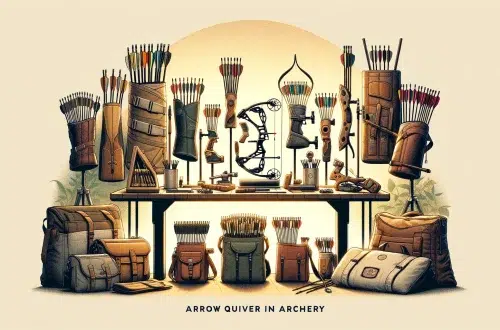
Medieval archers relied heavily on quivers for arrow storage and transportation. Quivers came in various forms:
- Hip quivers, attached to the belt, allowed for easy access during mobile skirmishes.
- Back quivers, strapped across the shoulder, provided a larger carrying capacity.
- Ground quivers, staked into the earth, offered stationary convenience for archers holding a position.
Materials ranged from leather, which was durable, to cloth and woods for lightweight options.
Quivers sometimes featured decorative elements indicating the archer’s status or affiliation.
The practical design of a quiver was integral to an archer’s dexterity and efficiency on the battlefield.
What Archers Wore in Battle
In medieval battles, archers typically wore lighter armor than melee combatants, prioritizing mobility over heavy protection.
They often donned:
- Padded Gambeson: A quilted coat worn under armor for comfort and additional protection.
- Bracers: Leather or metal forearm guards to prevent injury from the bowstring.
- Helmet: Some archers opted for a simple helmet, like a kettle hat, to protect their head while allowing visibility.
- Boots: Sturdy boots provided foot protection and stable footing when aiming.
- Finger Guards: Leather or cloth wrappings protected fingers from the bowstring’s continuous wear.
Archers’ attire was a calculated balance of defense and dexterity, ensuring agility for shooting and some safety from enemy blows.
Archery Accessories: Bracers, Finger Guards, and Bowstrings
In medieval times, the art of archery extended beyond the bow and arrow.
Essential accessories provided both protection and precision to the archer.
- Bracers crafted from leather, protected the inner forearms from the snap of the bowstring upon release.
- Finger guards also known as shooting gloves or tabs, shielded fingers from blisters and cuts caused by the drawstring’s pull.
- Bowstrings demanded careful selection, with materials like hemp, flax, or silk being common choices, waxed for durability and strength.
Together, these accessories formed the archer’s arsenal, enhancing both performance and safety.
The Role of Archers in Medieval Warfare

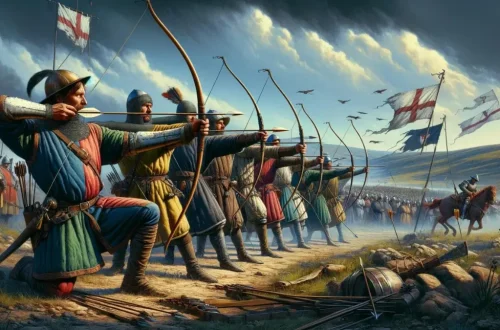
In medieval battles, archers were a formidable force.
Their ability to unleash volleys of arrows from a safe distance gave them a strategic advantage.
The English longbowmen, for example, proved their might in the Hundred Years’ War, where their long-range attacks decimated heavily armored French knights.
The training and skill required for this were immense, often starting from a young age.
Archers were strategically positioned in the vanguard or on the flanks, allowing them to disrupt enemy formations before close combat ensued.
For a deeper understanding of medieval archery in warfare: Journey of Archery from Combat to Recreation
Archery Competitions and Cultural Significance
Medieval archery wasn’t just about warfare; it was also a competitive and recreational activity.
Various competitions like clout shooting, target shooting, and flight shooting showcased different aspects of an archer’s skill.
These competitions were not only a test of ability but also played a significant role in cultural events and festivals.
Discover the cultural impact of medieval archery: Famous Archers in History: Legends of the Bow and Arrow
The Transition to Modern Archery
As we moved into the modern era, the use of archery in warfare diminished with the advent of firearms.
However, its legacy in sports and recreation continued to grow.
Today, modern archery equipment, like recurve and compound bows, incorporates technological advancements, making the sport more accessible.
Yet, the fascination with medieval archery remains strong, often reflected in popular culture and historical reenactments.
Conclusion
The history of medieval archery is a tapestry of skill, innovation, and cultural significance.
From its origins as a crucial tool in warfare to its current status as a revered sport and hobby, archery continues to captivate enthusiasts around the world.
The influence of medieval archery equipment on contemporary archery cannot be overstated.
By examining the remnants and reconstructing the technologies of the past, one unearths the roots of equipment design and archery mechanics still in use today.
The longbow, for example, has inspired modern flatbows, and the crossbow’s mechanical principles resonate in today’s compound bows.
Medieval innovation in arrow design also persists, with modern arrows reflecting historical balance between speed, stability, and accuracy.
This enduring legacy highlights the medieval era’s significant, yet often undervalued, contribution to the evolution of archery practices.
Such reflections underscore the importance of historical knowledge in appreciating and further developing modern equipment and techniques.