
Sif Norse Mythology Goddess
Introduction to Sif: The Norse Mythology Goddess
In Norse mythology, Sif shines as a figure of elegance and strength. Traditionally known for her golden hair and ties to fertility and the earth, her association with archery is less documented but equally fascinating.
Sif’s role extends beyond her hair’s symbolism, touching on themes of protection, skill, and the warrior spirit. Sif, the wife of Thor, holds a unique place in the Norse pantheon.
Her golden locks, cut by Loki, symbolize not only fertility but also the preciousness of harvest. When Thor demands its restoration, Loki commissions dwarfs to craft hair of gold.
This tale, while highlighting her beauty, also subtly points to Sif’s resilience and significance.
Sif’s Archery Connection
The history of Norse mythology doesn’t explicitly cast Sif as an archer. However, exploring her connection to archery opens a window into understanding her multifaceted nature. Archery, in Norse culture, was a skill of survival and warfare, embodying precision, patience, and power.
It’s plausible that Sif, akin to other deities, possessed prowess in archery, symbolizing her protective qualities and warrior essence. Sif’s role as Thor’s consort and a mother figure brings depth to her character.
She embodies the nurturing aspect of the earth, yet her potential as an archer hints at a protective, warrior side. This duality enriches her persona, reflecting the balance between nurturing and defending.
Archery in Norse Society
Archers were revered for their skill, playing critical roles in battles and hunts. For Sif, wielding a bow could represent her commitment to safeguarding her realm and loved ones, an extension of her nurturing and protective instincts.
In imagining Sif with a bow, we envision a goddess who stands ready to defend the natural world she embodies. Her arrows, like her hair, become symbols of fertility and life, flying forth to ensure the continuation of cycles and seasons.
Each shot echoes her dedication to growth and protection.Though not traditionally depicted as an archer, Sif’s potential inclusion in this role highlights the adaptability and breadth of Norse mythology.
Figures like Sif remind us of the complexity of deities, embodying multiple aspects of existence—creation and protection, beauty and strength.
Learn more about Norse Mythology:
- Exploring Norse Mythology Gods and Legends
- Freya: The Enigmatic Goddess of Norse Mythology
- God of Archery: Norse, Greek & Roman Mythology
- Norse Mythology Symbols in Archery
- Odin: The Allfather in Norse Mythology
- Skadi: Norse Goddess of Winter and Mountains
- Ullr: The Norse God of Archery and Winter
Norse Pantheon and its Deities
Norse mythology, rooted in Old Norse religion, hosts an enthralling pantheon with diverse deities. The Aesir and the Vanir are two main groups of gods who inhabit the nine worlds connected by Yggdrasil, the cosmic tree.
Major Aesir include Odin, the Allfather; Thor, the thunder god; and Freya, the goddess of love. The Vanir deities are associated with fertility and prosperity, with notable members like Njord and his children Freyr and Freya.
Among these celestial beings stands Sif, Thor’s wife, famed for her lustrous golden hair, which symbolizes fertility and the golden wheat fields.

Sif’s Golden Hair: Symbolism and Tales
In the rich tapestry of Norse mythology, Sif’s resplendent golden hair represents many things. Traditionally, gold signifies wealth, beauty, and fertility, three attributes frequently attributed to Sif.
Her hair also symbolizes the vitality of the earth’s crops, thus aligning her with the nurturing aspects of nature.
The loss and regrowth of Sif’s hair in the myths, courtesy of Loki’s mischief and the talents of dwarven craftsmen, can be seen as an allegory for the seasonal cycle of growth and harvest, reinforcing her role as a goddess of fertility and the earth’s bounty.
The tale of Sif’s shorn hair further cements her husband Thor’s ironclad role as a protector of gods and humankind alike, as he seeks reparation for the offense against his wife, underlining the intertwined fortunes of the deities.
The Marriage of Sif and Thor
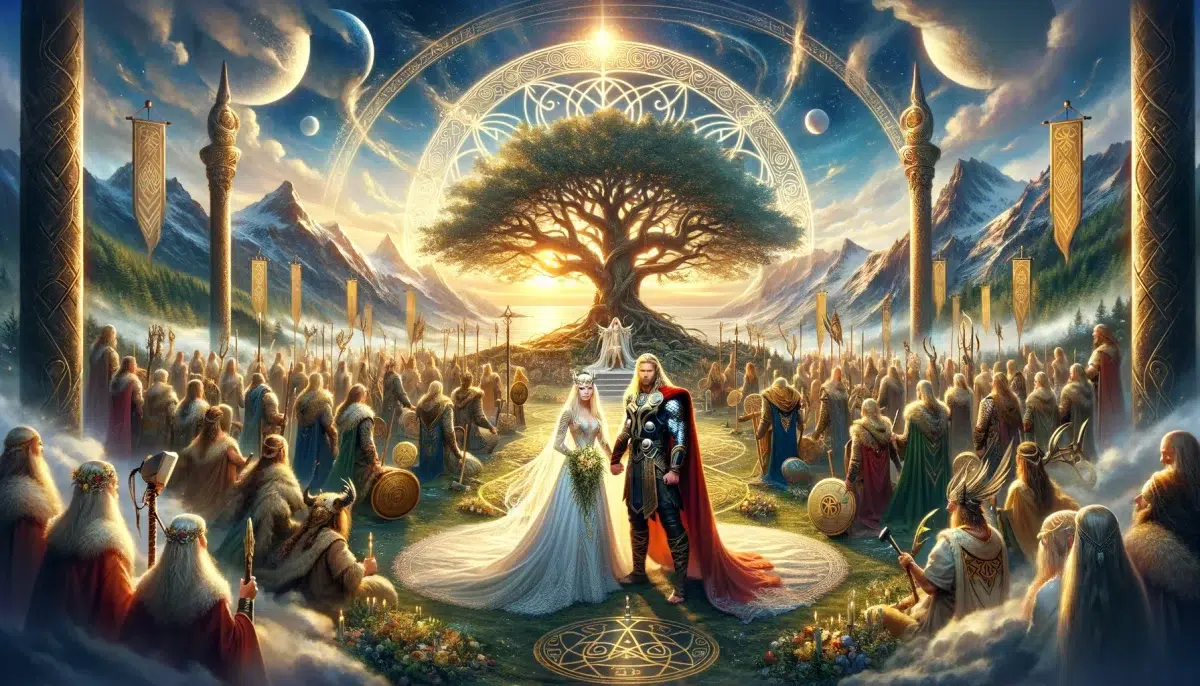
In Norse mythology, the marriage between Sif and Thor is symbolic of a powerful alliance between natural forces.
Sif, with her lustrous golden hair, embodies the fertility of the earth and its crops, while Thor, the god of thunder, represents the might of the skies and the protector of Asgard and Midgard.
Their union is not just a romantic association; it is illustrative of the harmonious blend of earth’s fecundity and the heavens’ vitality, safeguarding the cosmos and humanity. The narratives often depict Thor as passionately defending his wife, highlighting the unwavering bond they share within the pantheon.
Their marriage transcends personal commitment and becomes a cornerstone in the stabilizing structure of Norse cosmology.
Sif’s Role and Significance in Norse Lore and Rituals
Sif, a prominent figure in Norse mythology, is often overshadowed by her husband, Thor. Nonetheless, she holds her own importance, particularly symbolizing fertility and familial bonds.
Her most notable myth involves Loki shearing her golden hair, which represents thriving crops and the earth’s bounty. The subsequent crafting of her magical, golden locks by dwarves underscores her influence over growth and renewal.
In Norse rituals:
- Sif was likely invoked for harvest blessings.
- She may have played a part in matrimonial customs, given her role in fostering harmony.
- Her golden hair could symbolize the sun’s life-giving energy, critical in agrarian societies.
Sif’s character exemplifies the divine’s integral relationship with the natural and domestic spheres of Norse life.
The Shearing of Sif’s Hair and its Consequences

Within Norse mythology, Sif is known for her wondrous golden hair, symbolizing fertility and the golden wheat fields. Loki, the trickster god, was often driven by a compulsion for mischief.
On one fateful occasion, Loki’s irrepressible mischievousness led him to stealthily shear off Sif’s magnificent tresses as she slept. Awaking to her shorn locks, Sif was distressed, and her husband Thor was furious with Loki.
Thor’s rage demanded retribution, and so Loki promised to amend his wrongdoing. He sought the skills of the dwarves, master craftspeople of the gods, to forge hair of gold that would grow as natural hair.
This would not be their only creation, as the dwarves went on to craft magical treasures for the gods, including Thor’s mighty hammer, Mjolnir. Loki’s prank, while initially destructive, inadvertently brought about the creation of some of the most legendary artifacts in Norse mythos.
The Restoration of Sif’s Golden Mane
In Norse mythology, the Dvergar, or Dwarves, were renowned for their exceptional skills in crafting. One tale highlights their artistry through the restoration of Sif’s golden mane, which holds significant symbolism.
Sif, wife of the thunder god Thor, possessed luscious locks that represented fertility and the harvest.
- Loki, the trickster god, out of malice or mischief, sheared Sif’s beautiful hair.
- Sif’s desolation was immense, as her hair was not merely an attribute of beauty but also symbolized earthly bounty.
- Thor, enraged by this act, demanded Loki to rectify the atrocity.
- Understanding the severity of his prank, Loki approached the Dvergar to commission a magical replacement.
- The Dwarven brothers, Eitri and Brokkr, crafted hair from gold that would grow like natural locks.
This act of the Dvergar not only restored Sif’s mane to its former glory but also created an artifact of legendary status that glorified their unmatched craftsmanship in the realms of the gods.
Her Children and their Impact on Norse Myths
Sif is renowned in Norse mythology as the mother of two significant deities. Her union with Thor bore Thrud, a mighty goddess whose name signifies strength.
Meanwhile, Ullr, her son through a prior marriage, is a skilled archer and the god of winter, hunting, and single combat. Not only do they contribute to the rich tapestry of Norse myths, but they also embody traits reflecting Sif’s association with earth’s fertility.
Their stories intersect with various sagas, reinforcing themes of courage, martial prowess, and the natural cycles.
Learn more about: Legendary Archery Mythology
The Goddess’ Presence in Poetry
Sif, Thor’s consort, is prominently featured in several key texts of the Old Norse corpus. In the Eddic poem Grímnismál, Thor’s abode, Bilskirnir, is mentioned, where Sif likely resided alongside her husband.
Although Sif herself is not the focus, her presence is implied within the domestic sphere of the gods.
In Lokasenna, another Eddic poem, Sif’s character becomes more tangible as she interacts directly with the trickster god Loki, offering him mead in a diplomatic effort to soothe the tension-filled atmosphere.
Loki’s sharp retort references Sif’s extramarital affair, exposing her character to scrutiny and revealing elements of her personal mythos. Skaldic verses, though more fragmentary and intricate in their allusions, also acknowledge Sif.
Skalds were court poets who often composed verses in honor of their patrons, integrating mythological references into their praises.
These poets echoed the themes found in Eddic poetry, celebrating Sif’s radiant beauty and fecundity, enhancing her divine image within the Norse pantheon.
Interpreting Sif: Goddess Archetypes and Modern Pagan Perspectives
Sif, in Norse mythology, embodies the archetype of fertility and the Earth mother. Modern paganism often draws on such archetypes to form personal connections with the divine.
Sif’s golden hair, which symbolizes bountiful harvests and the nurture of nature, resonates profoundly with those who honor the Earth’s cycles.
Practitioners may see in Sif a stewardship model, emphasizing sustainability and reverence for the land.
Pagans might invoke Sif in rituals for abundance, or to foster personal growth and resilience, seeing her strength in quiet forbearance and her regenerative power.
Sif in Popular Culture
- Sif’s iconic golden hair has been a recurring motif in various forms of art, from classical paintings to modern digital illustrations.
- In literature, she often embodies the archetypal Earth Mother, with numerous books and poems celebrating her fertility and connection to the land.
- The character gained mainstream attention through Marvel Comics, where she appears as a fierce Asgardian warrior and love interest of Thor, deviating from her mythological roots.
- Marvel’s Sif stepped onto the screen in live-action films and television series, portrayed by actress Jaimie Alexander.
- Toy manufacturers have capitalized on her popularity, producing Sif action figures and collectibles.
- In video games, such as “Marvel: Future Fight” and “Marvel Ultimate Alliance,” Sif is a playable character, showcasing her combat skills and warrior spirit.
- The resurgence of Norse mythology in popular culture has further solidified Sif’s status as a symbol of beauty and strength.
The Shrines and Worship of Sif
Sif, the Norse goddess with lustrous golden hair, has left limited archeological evidence to detail the precise nature of her worship.
Unlike deities like Odin or Thor, whose veneration is confirmed by various artifacts, Sif’s specific worship practices remain elusive. Few tangible relics have been directly attributed to her cult.
Historical texts and mythological sources imply that she was honored for her associations with earth’s fertility and as Thor’s consort. Rituals likely included offerings of grain, reflecting her links to agriculture.
However, without substantial archeological findings, the full picture of Sif’s worship is yet to be completely understood.
Reflecting on Sif’s Enduring Legacy in Norse Mythology
Sif’s legacy in Norse mythology is a composite of fertility, family, and the unyielding force of nature. A figure central to mythic narratives, Sif represents more than just her golden locks.
Her hair, symbolic of bountiful harvests and the sun’s radiant energy, reminds us of nature’s cycles and the prosperity they can bestow. As Thor’s partner, Sif’s role extends into themes of kinship and the safeguarding of the divine realm.
Through the tales that survive, Sif’s endurance in cultural memory underscores her importance and her lasting imprint within the rich tapestry of Norse lore.