Genghis Khan and the Mongol Empire
Genghis Khan, born as Temüjin around 1162, emerged from the harsh and tumultuous plains of Mongolia. He would go on to establish one of the largest empires history has ever witnessed.
His origins, shrouded in the myths and legends of the steppes, tell a tale of hardship, survival, and ambition.
Born into the Borjigin people, he would face adversity early in his life.
His father, the chieftain Yesügei, was poisoned by rival Tatars, thereby thrusting his family into the brutality of steppe politics.
Strategically Marries Börte to Advance His Status

Börte was the first wife of Genghis Khan.
As she was the first wife of Temüjin, she was the most influential. She had a large dowry which brought her independent wealth. Börte also had an intelligent mind.
She was crowned the Grand Empress once Temüjin was named Genghis Khan. Around 1179, Börte’s had her first child, a son, Qojin.
Börte had nine children. Her five daughters would go on to marry key allies to ensure ongoing diplomatic relationships. Her four sons were quite influential in building the empire.
Horseback and Archery Training
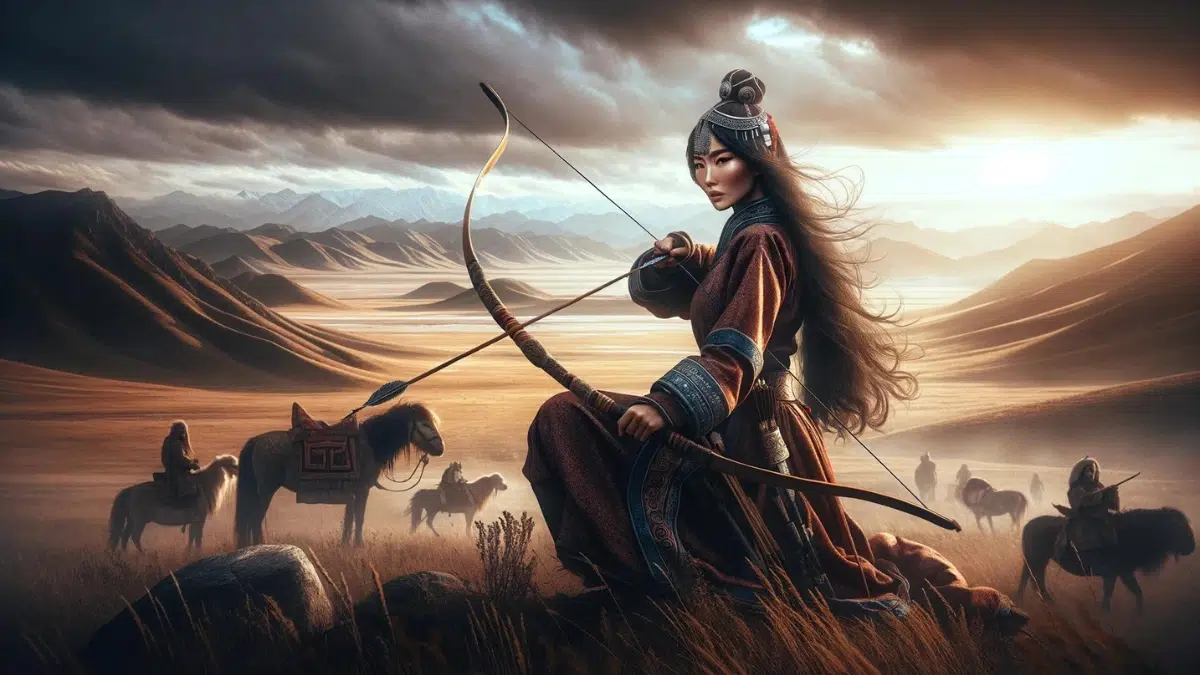
Genghis Khan, the founder of the Mongol Empire, is renowned for his military strategies and leadership, but his connection to archery is particularly notable.
From a young age, Mongols, including Genghis Khan, were trained in horseback riding and archery, skills vital for survival and warfare in the vast steppes of Central Asia.
This training was integral to their nomadic lifestyle, which revolved around hunting and combat.
Genghis Khan’s expertise in archery was not just a personal skill; it was a cornerstone of the Mongolian military might.
Mongol Archer Technique Known as “Parthian Shot”
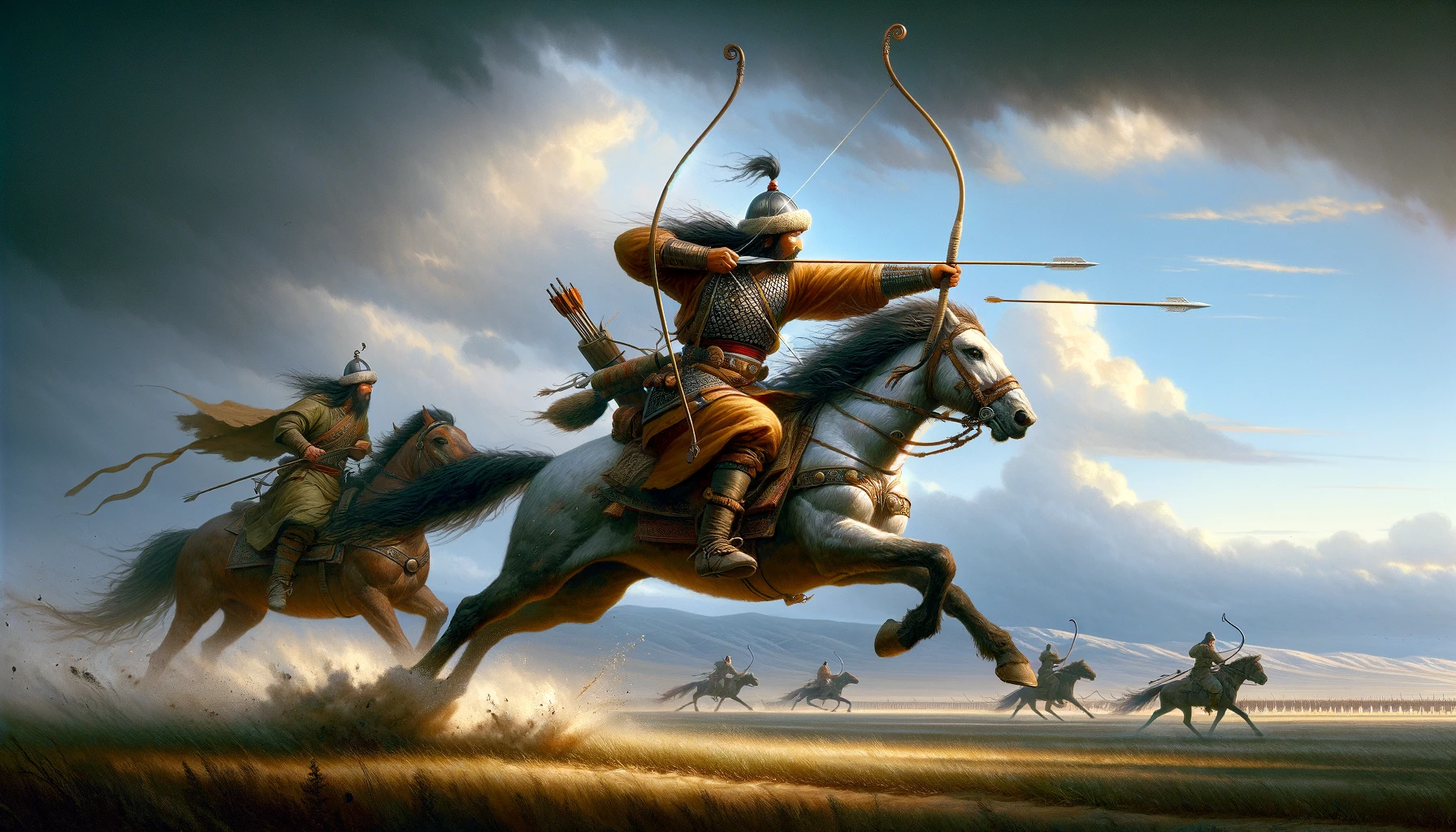
Mongol archers were famed for their ability to shoot accurately while riding at high speeds, a technique known as “parthian shot.”
This skill, combined with the mobility of their horses, made the Mongol army exceptionally formidable.
Genghis Khan harnessed these archery skills to develop innovative military tactics.
His archers could rain arrows down on enemies with precision, often deciding the outcome of battles before close combat could ensue. The psychological impact of this relentless archery barrage was immense, often breaking enemy morale.
Genghis Khan’s connection to archery, therefore, goes beyond personal proficiency.
It represents a pivotal element of the Mongol military system, a reflection of their culture, and a key to their unprecedented success in expanding the Mongol Empire.
He adopted innovative military tactics and promoted men based on merit rather than birthright, a stark departure from the aristocracy-driven society of his time.
This ethos cultivated fierce loyalty among his warriors, forging them into a formidable force capable of swift and devastating attacks that would later be the hallmark of the Mongol military machine.
Recognized as “Genghis Khan” by the Mongol Assembly
In 1206, after a series of conquests and consolidations, the Mongol tribal assembly recognized Temüjin as “Genghis Khan,” meaning “universal ruler.”
This significant milestone marked the birth of the Mongol Empire. It represented not only unification under one banner but also the beginning of an expansion that would spread the Mongol DNA across continents.
As Genghis Khan’s empire grew, so did his lineage.
His children and descendants would inherit not just his empire but his strategic acumen and appetite for conquest, each leaving their mark on the history of the vast territories he had subdued.
Genghis Khan’s Conquests
Genghis Khan would rise to power in the early 13th century marked the beginning of one of the largest contiguous empires in history.
His military campaigns extended across Asia into Europe and the Middle East. His conquests began with the subjugation of Mongolian peoples, leading to the consolidation of the Mongolian Plateau.
Recognizing the potential of a disciplined, mobile cavalry, he honed an army capable of swift, brutal strikes, which became his tool for expansion.
The Mongol army, though smaller, utilized superior tactics and psychological warfare to conquer larger, more established states.
Genghis Khan’s Military Invasions

Genghis Khan’s military invasions were marked by:
- Harsh and tactical battles across Central Asia
- The capture of the prominent Silk Road city-state of Bukhara
- A relentless sweep through Persia, destabilizing the Khwarezmian Empire
- The thrust into Eastern Europe that reached as far as the Kievan Rus’ and Poland
Each conquered territory was integrated into his empire, with local administrative systems often left intact to ensure a stable rule, a testament to his strategic governance.
Genghis Khan encouraged trade, communication, and cultural exchange, fostering an environment where ideas could traverse across the vast stretches of his dominion.
Key invasions led by Genghis Khan
| Approx. Year(s) | Campaign/Invasion | Result/Significance |
|---|---|---|
| 1207-1209 | Invasion of Western Xia | First major conquest; Western Xia becomes a vassal state |
| 1211-1214 | Invasion of the Jin Dynasty | Significant territorial gains in Northern China |
| 1218-1220 | Conquest of Central Asia | Destruction of the Khwarezmian Empire; expansion into Persia |
| 1219-1221 | Invasion of Khwarezmia | Massive destruction; pivotal in the expansion of the Mongol Empire |
| 1220-1223 | Raids in the Caucasus and Kievan Rus’ | Opening of Eastern Europe to Mongol influence and control |
| 1226-1227 | Conquest of Western Xia (renewed) | Complete destruction of Western Xia as a political entity |
These invasions under Genghis Khan’s leadership were instrumental in the rapid expansion of the Mongol Empire.
They are characterized by strategic military tactics, swift mobility, and often brutal methods of warfare.
The impact of these invasions was profound, leading to significant geopolitical changes and influencing the course of history in the regions affected.
The legacy of Genghis Khan’s conquests
The legacy of Genghis Khan’s conquests is a tale of both ferocious military might and remarkable cross-cultural interaction, laying the groundwork for a pan-continental empire that would be carried forward by his descendants for generations.
His conquests reshaped the world map and established Mongol rule across continents, echoing his name through history as one of the most formidable conquerors of all time.
Genghis Khan is renowned for orchestrating some of the most extensive military invasions in history.
His campaigns during the early 13th century laid the foundations for an empire that would eventually span from Eastern Europe to the Sea of Japan, becoming the largest contiguous land empire in history.
Born in the Mongolian steppes, he united the Mongol people through a combination of charismatic leadership and military prowess.
By 1206, he was proclaimed “Genghis Khan,” which means “universal ruler.”
This marked the beginning of an aggressive expansion that would reshape the world.
Genghis Khan’s Military Strategy
One of the defining features of Genghis Khan’s military strategy was his use of speed and surprise.
The Mongol army, primarily composed of cavalry, was highly mobile and could cover vast distances quickly, often catching enemies off guard.
The Mongols were adept at using a variety of tactics, such as feigned retreats, to lure opponents into traps.
Genghis Khan’s invasions were also characterized by their brutality. Conquered territories were often subjected to widespread slaughter and destruction. These tactics that were partly aimed at instilling fear and securing swift surrenders in future campaigns.
The invasion of Khwarezmia (in present-day Iran and Central Asia) from 1219 to 1221 was marked by extensive destruction and mass killings, following the Khwarezm Shah’s execution of Mongol envoys.
Mongol Empire: Integration and Administration
Moreover, his military campaigns were not just about conquest but also about integration and administration.
The Mongol Empire was known for its religious tolerance and for incorporating local administrators into its governance structure, which helped in maintaining control over vast territories.
Genghis Khan’s invasions had a profound impact on the world.
They facilitated the exchange of goods, ideas, and technologies between the East and West, contributing to the development of the Silk Road as a major trade route.
However, these invasions also led to the devastation of cities, cultures, and populations, with long-lasting effects on the regions involved.
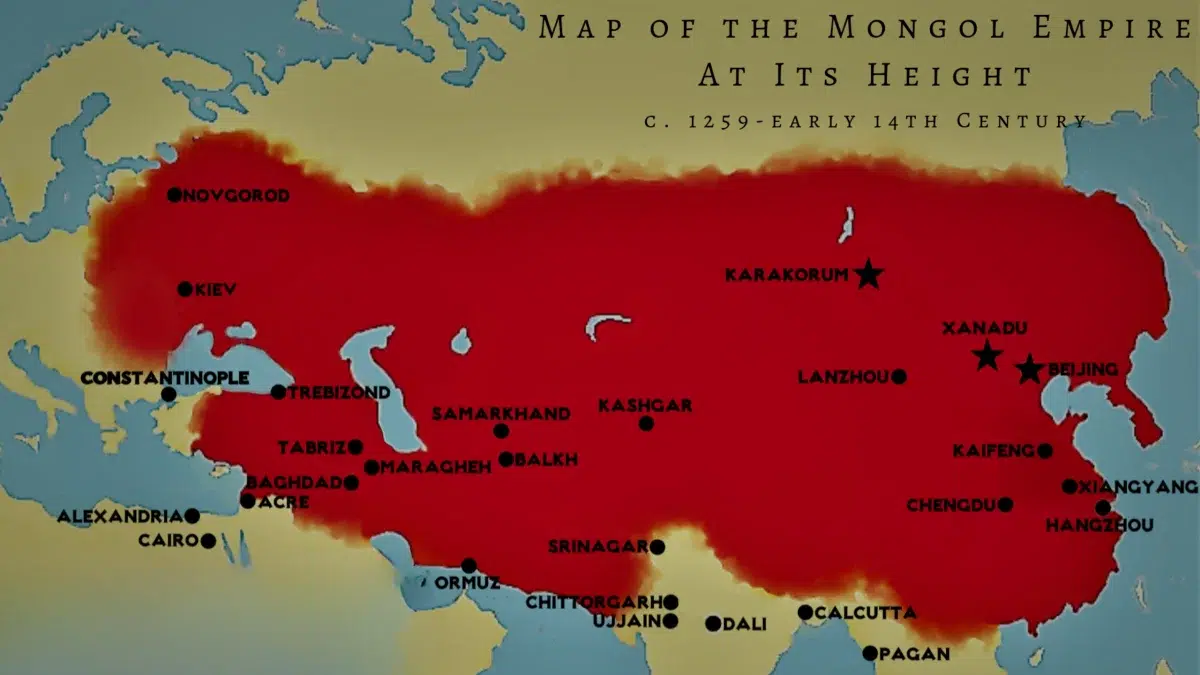
Map of the Mogul Empire
This map provides a visual representation of how extensive the Mongol Empire was, stretching across a significant part of Eurasia, including major cities and capitals.
The Mongol Dynasty: Genghis Khan’s Descendants
Genghis Khan’s empire would sprawl from the Korean peninsula to the edges of Europe.
It was not only a testament to his military prowess but also to his strategic planning in governance.
After his death in 1227, his descendants carried forward the Mongol legacy.
They would expand and manage an empire that was the largest contiguous land empire in history.
The Dynasty he founded was known as the Yuan Dynasty in China.
However, across the vast territories it controlled, it manifested in various khanates, each ruled by his progeny.
The Mongol rulers were not just conquerors but also patrons of trade, art, and culture, facilitating the exchange of ideas and goods along the Silk Road.
They implemented a novel system of governance that included religious tolerance, a meritocratic bureaucracy, and efficient postal relay systems.
The legacy of Genghis Khan’s empire was a complex tapestry of cultural amalgamation and political diversity, manifesting a blend of local customs with Mongol administrative practices across his descendants’ territories.
Learn more about:
- Subutai: Mongol General for Genghis Khan
- Kublai Khan: Emperor & Grandson of Genghis
- Khutulun: Mongolian Warrior Princess Legend
Cultural Influence: Genghis Khan’s Legacy
Genghis Khan’s influence on culture and society extends far beyond his vast military conquests and the establishment of the Mongol Empire.
His legacy significantly transformed various aspects of the societies he and his descendants came into contact with.
Here are several key areas where Genghis Khan’s impact was particularly profound.
Language and Writing
The adoption of the Uyghur script as the standard writing system of the Mongol Empire enabled a bureaucracy that would oversee vast and varied territories.
This script would eventually evolve and influence many writing systems in Asia.
Religious Tolerance

Genghis Khan’s policy of religious tolerance allowed different faiths to coexist and flourish within the empire.
This open-minded approach contributed to an exchange of religious ideas and practices that enriched the spiritual life of his dominions.
Legal System
The Yassa, Genghis Khan’s codification of Mongol laws, reformed the legal framework of the empire.
It was instrumental in unifying the diverse populations under a singular set of laws that emphasized loyalty and discipline.
Trade and Economic Growth
By securing trade routes such as the Silk Road, Genghis Khan facilitated unprecedented trade relations between the East and West.
This connectivity led to an explosion in economic activity, the transmission of technology, and cultural exchange.
Cultural Synthesis
The Mongol Empire became a melting pot where cultures, languages, and ideas met and integrated.
This synthesis gave rise to new art forms, architectural styles, and cultural practices.
Genetic Legacy
Scientists have revealed a wide swath of humanity carries Genghis Khan’s genetic fingerprint, marking his biological as well as cultural influence on subsequent generations.
The imprint of Genghis Khan’s legacy is undeniable.
His children and descendants carried forth these cultural influences, further entrenching the Mongolian impact on societies far beyond their own borders.
Through them, the fusion and dissemination of cultural traits continued, marking history with the indelible touch of Genghis Khan’s Mongol Empire.
Modern Connections: The Legacy in Today’s Leaders
The legacy of Genghis Khan, one of history’s most legendary conquerors, is not confined to the pages of historical texts.
It extends into the lineage of contemporary leaders.
The genetic ripple created by Khan and his descendants can be traced through generations.
As per genetic studies, an estimated 16 million men, or 0.5% of the global male population, carry Y-chromosomal lineages.
This traces back to the Mongolian ruler. It is a scientific testimony to his expansionist successes and the extensive proliferation of his progeny.
It is difficult to pinpoint exact descendants due to the vastness of his lineage.
However several influential leaders in the regions once encompassed by the Mongol Empire claim ancestry from Genghis Khan.
The enduring legacy is not only biological or political but also cultural.
The reverence for Genghis Khan across parts of Asia ensures that his influence persists in leadership ethos.
The qualities of strategic brilliance, relentless ambition, and innovative wartime tactics attributed to Khan are touted as admirable leadership traits in various walks of life.
While fact-based lineage connections to current leaders may remain elusive, Genghis Khan’s shadow looms large over the concept of leadership itself.
His bloodline, now interwoven into the fabric of numerous populations, has forged a diverse legacy.
This continues to influence figures of authority, governance, and even corporate strategy centuries after his reign.
Preserving History: How Genghis Khan is Remembered
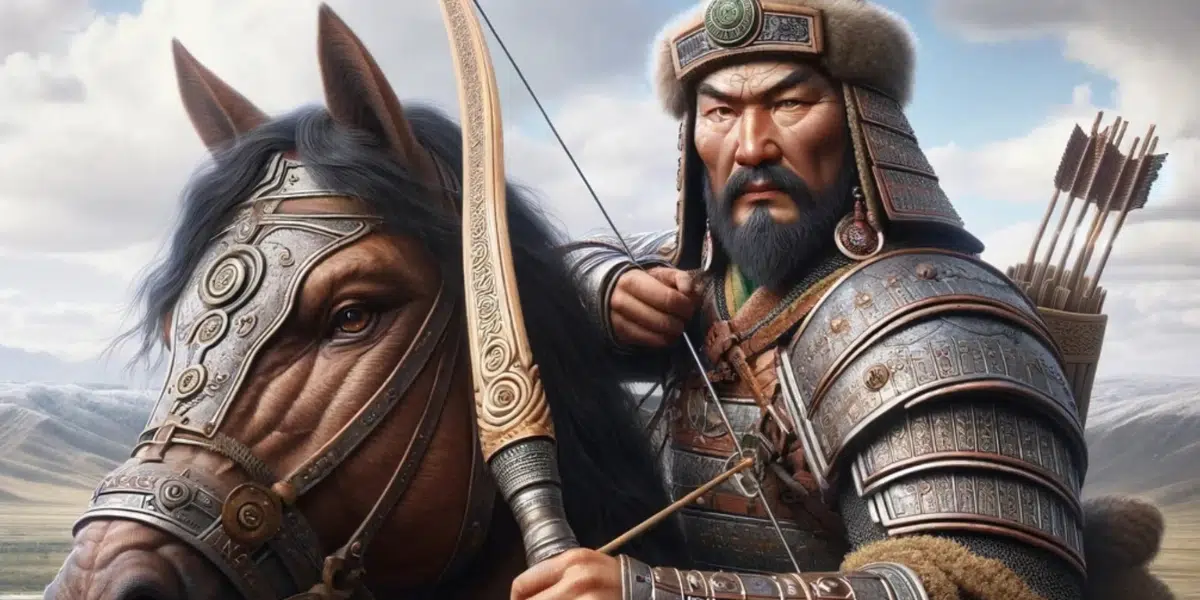
Genghis Khan’s legacy has transcended the passage of time, and his influence is evident in various facets of contemporary culture and academia.
Public Perception and Media
Khan’s image has gone through a transformation in the mainstream consciousness.
Once commonly viewed as a brutal conqueror, there is a growing appreciation for his role as a unifier and an administrative innovator.
Television and film have played a significant role in this reshaping of his image.
Productions often romanticizing his empire’s vastness and the diverse cultures it encompassed.
Research and Scholarship
Scholars across the world continue to explore Genghis Khan’s impact on history.
They delve into records that span from Europe to Asia to understand better his military strategies, governance, and how he managed to control the largest contiguous empire in history.
This research helps in demystifying the legend and painting a more accurate picture of his rule and the Mongol Empire’s complexities.
Cultural Preservation
In Mongolia, Genghis Khan is respected as a national hero, a symbol of strength, and the embodiment of Mongolian identity.
His birthday is a national holiday.
Statues and monuments commemorating his achievements dot the landscape.
The government is active in preserving sites associated with Genghis Khan and promoting Mongol heritage to the world.
Genetic Studies
The widespread reach of Genghis Khan’s genetic lineage is an astounding element of his legacy.
Studies have shown that a significant proportion of men in the region once under Khan’s rule share Y-chromosome DNA.
This suggests a direct male-line descent.
This genetic marker spans across countries, illustrating the biological imprint of his bloodline.
Despite the centuries that have passed since his reign, Genghis Khan remains a figure of intrigue and reverence.
His legacy preserved through a blend of cultural celebration, scholarly pursuits, and the undeniable genetic evidence of his once far-reaching influence.
Understanding the Immense Impact of Genghis Khan
Genghis Khan’s military invasions were pivotal in the formation of the Mongol Empire.
Thus demonstrating a blend of tactical brilliance, speed, brutality, and administrative acumen.
His campaigns not only reshaped the geopolitical landscape of Eurasia but also left a lasting legacy on world history.
Influencing everything from trade to warfare tactics.