Odin: The Allfather in Norse Mythology
Did you know that Odin, the Allfather in Norse mythology, is one of the most revered gods in Germanic paganism? And a central figure in Scandinavian folklore?
With his wide range of powers and complex character, Odin holds a significant place in the Norse pantheon.
Key Takeaways:
- Odin is a widely revered god in Germanic paganism and a central figure in Norse mythology.
- He is associated with wisdom, healing, death, royalty, knowledge, war, sorcery, and poetry.
- Odin’s sacrifices and quests for knowledge demonstrate his dedication and commitment to gaining wisdom.
- As the ruler of Asgard, Odin presides over the magnificent hall of Valhalla.
- Odin’s influence can be seen in Germanic and Norse culture, as well as in modern artistic expressions.
Odin’s Origins and Names
Odin, the central figure in Norse mythology, has a rich and fascinating origin that is deeply rooted in Germanic paganism.
His name, Óðinn, is derived from Old Norse and is cognate with other Germanic names such as Old English Wōden, Old Saxon Uuôden, Old Dutch Wuodan, and Old High German Wuotan.
These names all trace back to the Proto-Germanic theonym *Wōðanaz, which means ‘lord of frenzy’ or ‘leader of the possessed’.
Odin is known by over 170 names, each reflecting different attributes, myths, and religious practices associated with him.
Scholars suggest that Odin’s name and role as a god of rage or madness may have originated from a Proto-Indo-European term meaning ‘god-inspired’ or ‘prophet, seer’.
Odin’s ability to shape-shift and his association with poetry and prophecy make him a complex and multidimensional character in Norse mythology.
Learn more about Norse Mythology:
- Exploring Norse Mythology Gods and Legends
- Norse Mythology Symbols in Archery
- Ullr: The Norse God of Archery and Winter
- Freya: The Enigmatic Goddess of Norse Mythology
- Skadi: Norse Goddess of Winter and Mountains
- Sif Norse Mythology Goddess
- God of Archery: Norse, Greek & Roman Mythology
The Origins of Odin’s Name
Odin, also known as Woden in Old English, shares his name with several other Germanic deities. These variations reflect the wide influence and reverence that Odin held across different Germanic cultures. Here are a few examples:
| Language | Name | Meaning |
|---|---|---|
| Old Norse | Óðinn | Protector, ecstasy, fury |
| Old English | Wōden | Ruler, poet, frenzy |
| Old Saxon | Uuôden | Fury, inspiration, madness |
| Old Dutch | Wuodan | Ecstasy, frenzy, prophetic |
| Old High German | Wuotan | Ruler, fury, inspiration |
These names highlight Odin’s significance and the varied interpretations of his character.
Thus emphasizing his roles as a leader, guardian, poet, and inspired visionary.
The Importance of Odin’s Names
Odin’s multiple names reflect the different aspects of his persona and the rich tapestry of mythology and folklore surrounding him.
Each name captures a particular nuance or attribute associated with Odin.
- As Wōden, he is revered as a wise and powerful ruler in Old English texts.
- In his role as Óðinn, he is known for his ecstatic and furious nature in Old Norse mythology.
- Other names, such as Allfather, Ygg, and Alföðr, emphasize his position as the father and leader of the Norse pantheon.
Odin’s names provide insight into his multifaceted identity and the reverence he commanded in Germanic and Norse cultures.
Odin’s Family and Relationships

Marriage and Children
Odin is married to Frigg, the goddess of marriage and motherhood. Together, they have two prominent sons:
- Balder: Known for his exceptional beauty, Balder is a beloved figure in Norse mythology. However, his tragic death becomes a pivotal event in the Norse pantheon.
- Thor: Perhaps one of the most well-known Norse gods, Thor is the god of thunder and a symbol of strength and protection.
Odin’s familial connections extend beyond his immediate family, with many other gods counting him as their father:
- Vidar and Vali: These sons of Odin play significant roles in the events of Ragnarok, the cataclysmic battle that marks the end of the Norse gods.
- The Valkyries: Mythology refers to the Valkyries as Odin’s daughters. These divine maidens choose which fallen warriors will enter Valhalla, the grand hall ruled by Odin in Asgard.
Complex Relationships
Odin’s familial relationships are not without complications. One such example is his connection to Loki, the trickster god.
While Loki is both Odin’s blood brother and a source of chaos, their bond shapes many mythical tales.
In addition to Loki, Odin’s interactions with other gods and beings in Norse mythology add layers to his character and story.
These intricate relationships contribute to the rich tapestry of Norse mythology, showcasing the complexities that exist within the divine realm.
Odin’s Symbols and Their Meanings
Norse mythology shows Odin as a mighty god with many symbols.
Each symbol captures his wisdom, power, and influence.
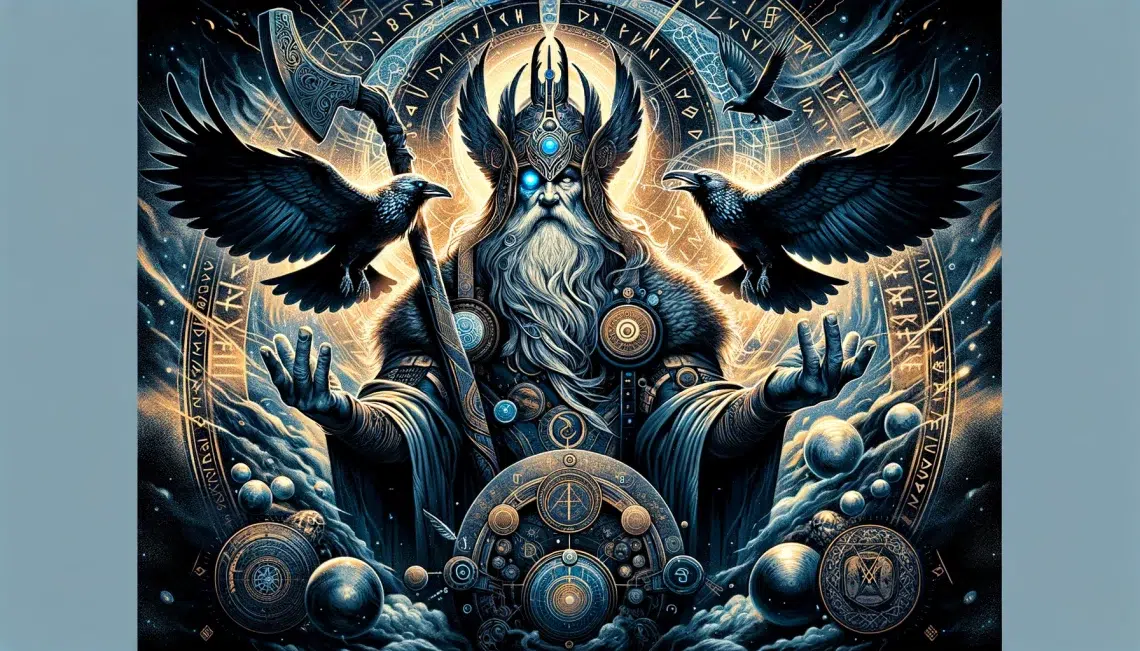
Odin often appears as a one-eyed, long-bearded man.
He lost an eye to gain wisdom, showing his deep desire for knowledge.
His spear, Gungnir, symbolizes his battle skills and power to decide victories.
Odin’s two ravens, Huginn (thought) and Muninn (memory), fly worldwide to bring him news.
This helps him make informed decisions.
Sleipnir, his eight-legged horse, lets him travel between realms easily, showing his vast knowledge and influence.
These symbols highlight Odin’s importance and add depth to his story in Norse mythology.
Odin’s Powers and Attributes
Odin, the Allfather in Norse mythology, possesses a vast array of powers and attributes that set him apart as one of the most revered gods in the pantheon.
His diverse range of abilities encompasses wisdom, knowledge, poetry, and transformation.
Odin’s Source of Wisdom
One of Odin’s greatest sources of wisdom is Mimir, the guardian of a sacred well containing boundless knowledge.
By sacrificing one of his eyes, Odin gained the privilege of drinking from Mimir’s well, attaining unparalleled wisdom and foresight.
To aid him in his quests and gather information from all corners of the world, Odin has two loyal ravens named Huginn and Muninn.
These intelligent birds serve as his eyes and ears, delivering vital knowledge and messages directly to him.
Odin’s Connection to Various Animals
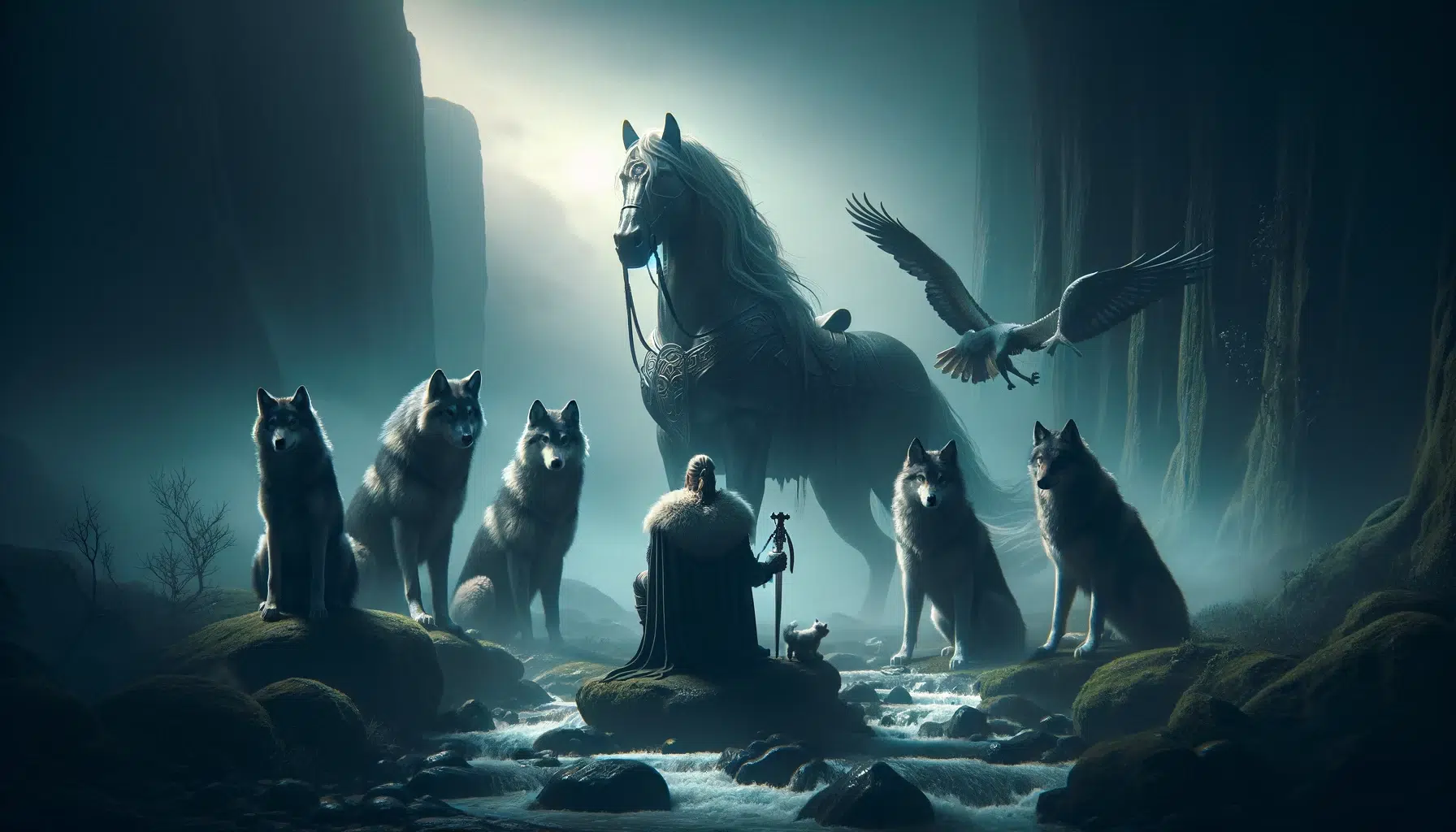
Additionally, Odin boasts a unique bond with various animal familiars, including wolves and his magnificent eight-legged horse, Sleipnir.
These creatures accompany him on his adventures, offering guidance and unwavering loyalty.
Unmatched in his shapeshifting abilities, Odin can assume different forms to navigate through various realms and conceal his identity.
This enables him to explore unseen territories and interact with different beings, both divine and mortal.
Furthermore, Odin possesses extraordinary magical aptitude, capable of manipulating and influencing the natural elements.
His power is such that he can cure the sick, calm raging storms, and render dangerous beings harmless with a mere glance.
Notably, Odin’s powers extend to the realm of poetry, as he is credited with the creation and mastery of this art form.
His poetic abilities grant him eloquence and inspire countless bards and skalds, ensuring the preservation and appreciation of the spoken and written word.
Summary of Odin’s Powers and Attributes
| Power/Attribute | Description |
|---|---|
| Wisdom | Gained from Mimir’s well, Odin possesses unparalleled wisdom and foresight, guiding his decisions and actions. |
| Ravens | Huginn and Muninn, Odin’s loyal ravens, serve as his scouts, gathering vital information from all corners of the world. |
| Animal Familiars | Wolves and Sleipnir, Odin’s trusted companions, aid him in his endeavors and offer unwavering loyalty. |
| Shapeshifting | Odin’s ability to adopt different forms grants him access to various realms and the ability to interact with different beings. |
| Magical Aptitude | Skilled in magic, Odin can cure the sick, calm storms, and render dangerous creatures harmless with a mere look. |
| Poetry | As the master of poetry, Odin’s creative prowess inspires countless bards and skalds, safeguarding the art for future generations. |
Odin’s powers, attributes, and immense wisdom cement his status as a formidable deity in Norse mythology.
His ability to turn the tide of battles, his role as the father of many gods, and his overall influence highlight the significant impact he wields within the pantheon.
Odin’s Sacrifices and Quest for Knowledge
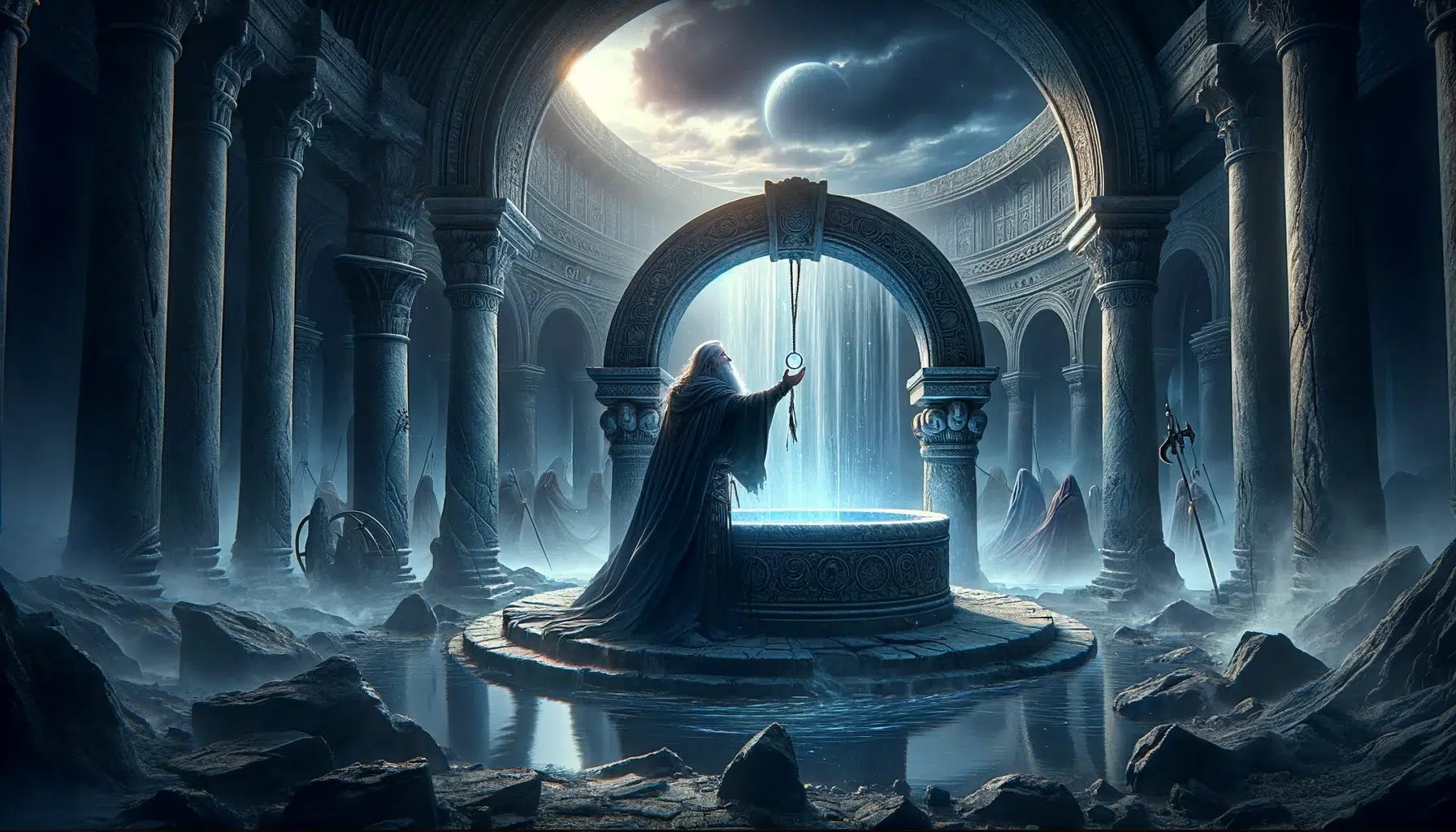
In Norse mythology, Odin, the Allfather, embarked on a profound quest for knowledge and wisdom, which compelled him to make several significant sacrifices.
These sacrifices were crucial milestones on his journey to unravel the mysteries of the universe and gain unparalleled insight into the past, present, and future.
One of Odin’s notable sacrifices was the loss of his eye.
In a bold act, he willingly sacrificed his eye to Mimir’s well, a sacred source of divine wisdom.
By drinking from the well’s enchanted waters, Odin absorbed the secrets and hidden knowledge held within, attaining unparalleled wisdom that surpassed that of any other being.
But Odin’s quest for knowledge did not stop there.
In another remarkable sacrifice, he hung himself from the branches of Yggdrasil, the world tree, for nine arduous days and nights.
This sacrifice offered him a profound connection to the realms beyond the mortal world and bestowed upon him the power to comprehend the ancient and sacred runic alphabet.
By acquiring the knowledge of the runes, Odin unlocked the ability to shape destiny, dispel illusions, and uncover the deepest truths hidden within the fabric of existence.
The runes became a central tool in his vast repertoire of mystical abilities, reinforcing his status as a masterful seer and granting him the power to guide the fates of gods and mortals alike.
Additionally, Odin’s unyielding thirst for knowledge drove him to pursue the Mead of Poetry.
To obtain this coveted elixir, he embarked on a daring mission to steal it from the giant Suttung.
The Mead of Poetry bestowed upon Odin the ability to grant poetic prowess to others, elevating the art of language and verse to unparalleled heights.
Summary: Sacrifices and Quest for Knowledge of Odin
| Odin’s Sacrifices | Quest for Knowledge |
|---|---|
| Sacrifice of his eye to Mimir’s well | Attainment of divine wisdom and insight |
| Sacrifice by hanging on Yggdrasil | Understanding of the runes and connection to other realms |
| Theft of the Mead of Poetry | Granting of poetic abilities to others |
These sacrifices and quests for knowledge exemplify Odin’s unquenchable thirst for wisdom and his unwavering commitment to attaining a deeper understanding of the cosmos in Norse mythology.
They showcase his indomitable spirit and the lengths he was willing to go to acquire unparalleled knowledge and insight.
Odin’s Realm and Role in Norse Mythology
In Norse mythology, Odin’s realm and his role are deeply intertwined, symbolizing his power and influence as the ruler of the gods.
As the sovereign of Asgard, Odin presides over the magnificent hall of Valhalla, a place of honor and glory for fallen warriors.
Valhalla, often depicted as a majestic hall with golden pillars and feasting tables, is the final destination for brave warriors who die in battle, chosen by the valkyries, warlike goddess-maidens.
These valiant fighters are escorted by the valkyries and greeted by Odin himself, who welcomes them to feast and prepare for Ragnarök, the final battle.
The Valkyries play a crucial role in Odin’s realm, as they select which warriors will live or die in battle.
Guided by their divine judgment, they choose the most worthy warriors to ensure their place in Valhalla, where they will train and await Ragnarök.
Odin’s connection with the valkyries extends beyond Valhalla.
He consults with the disembodied head of Mímir, a wise being with knowledge of the future.
Mímir foretells the inevitable doom of Ragnarök and urges Odin to lead the einherjar, the fallen warriors of Valhalla, into the final battle against the forces of chaos.
Through his role as the ruler of Valhalla and his association with the valkyries, Odin assumes a central position in the Norse pantheon.
His divine realm and his responsibility for the fallen warriors highlight his leadership and power, reinforcing his status as the Allfather and a key figure in Norse mythology.
| Odin’s Realm | Odin’s Role |
|---|---|
| As the ruler of Asgard | Presides over the hall of Valhalla |
| Valhalla – a magnificent hall | Welcomes fallen warriors and prepares them for Ragnarök |
| Association with the valkyries | Guides and selects warriors for Valhalla |
| Mímir’s counsel | Consults with Mímir and leads the einherjar |

Influence in Germanic and Norse Culture
Odin’s influence stretches beyond Norse mythology, deeply touching Germanic and Norse culture.
His name echoes across lands once home to ancient Germanic peoples, marking a trail of significance.
Wednesday, named after him in many Germanic languages, including English, shows his impact.
In Old English texts, Odin holds a revered spot among royalty as an ancestral figure.
His mysterious nature deeply embeds in Germanic folklore, inspiring poets, musicians, and artists.
Modern Germanic folklore still carries Odin’s saga, blending into our collective awareness.
Poetry immortalizes his deeds and wisdom, passing them through generations.
Paintings and sculptures give him a face, letting us admire his one-eyed visage in reverence.
Odin also influences music, infusing songs with his tales and symbols.
Captivated by his mystique, musicians create tunes that capture ancient wisdom and courage.
Through their art, Odin’s legacy endures, reaching across time.
Heathenry, a new religious movement, keeps Odin’s flame alive.
This movement honors Germanic gods, with Odin at its heart.
Followers find solace, guidance, and inspiration in the Allfather, drawing from his stories for their spiritual paths.
Odin’s Enduring Legacy and Impact
- Odin’s name permeates regions historically inhabited by ancient Germanic peoples
- The day Wednesday bears his name in Germanic languages, including English
- In Old English texts, Odin holds a particular place of ancestral reverence among royalty
- Odin’s enigmatic persona is revered in modern Germanic folklore
- His stories continue to inspire works of poetry, music, and art
- Odin is a central figure in the new religious movement Heathenry, which venerates Germanic gods
- His presence in Germanic and Norse culture highlights his enduring legacy and impact
Odin Inspires Modern Creativity
Odin continues to influence art, literature, and music today.
He appears in Richard Wagner’s opera cycle “Der Ring des Nibelungen” as Wotan.
Wagner’s operas celebrate Odin’s might and complexity.
Artists often depict him as wise and powerful, bringing his myth to life through visual art.
Musicians and bands also find inspiration in Odin, creating songs that echo his legendary status.
These works honor Odin’s legacy, showing how Norse myths still inspire and fascinate us.
Odin’s lasting impact on culture shows our ongoing interest in Norse mythology and its ancient stories.
Conclusion
Odin, the Allfather, is central in Norse mythology, ruling Asgard and leading the gods.
He embodies wisdom, war, and leadership. To gain understanding, Odin sacrificed his eye and hung on the world tree.
His complex relationships with gods and valkyries shape his stories.
Odin often appears as a one-eyed man, symbolizing his wisdom quest.
His spear, Gungnir, ravens, Huginn and Muninn, and his eight-legged horse, Sleipnir, highlight his power.
Odin’s influence extends beyond mythology to Germanic and Norse cultures, with his name in place names and languages.
Today, he continues to inspire artists and authors, maintaining his relevance in modern culture.
As a key deity, Odin leaves a strong mark on Norse lore, embodying might and mystique.
His significance enriches Norse mythology, making him an essential figure in these ancient tales.