
Norse Mythology Symbols
Norse mythology, the pre-Christian belief system of the Nordic peoples, is rich with tales of gods, giants, and heroes. Generations orally passed down these Norse mythology symbols stories before chronicling them in the Medieval Period.
They carry invaluable insights into the cultural and societal values of the time, providing a mythological framework that influenced the worldview and artistic expressions of the Norse people.
Understanding this mythology is crucial to grasping the historical significance of symbols within Norse society, such as those found in the art of archery.
Learn more about Norse Mythology:
Norse Mythology Symbols: Cosmic Tree and the Well of Urd
Yggdrasil: The World Tree
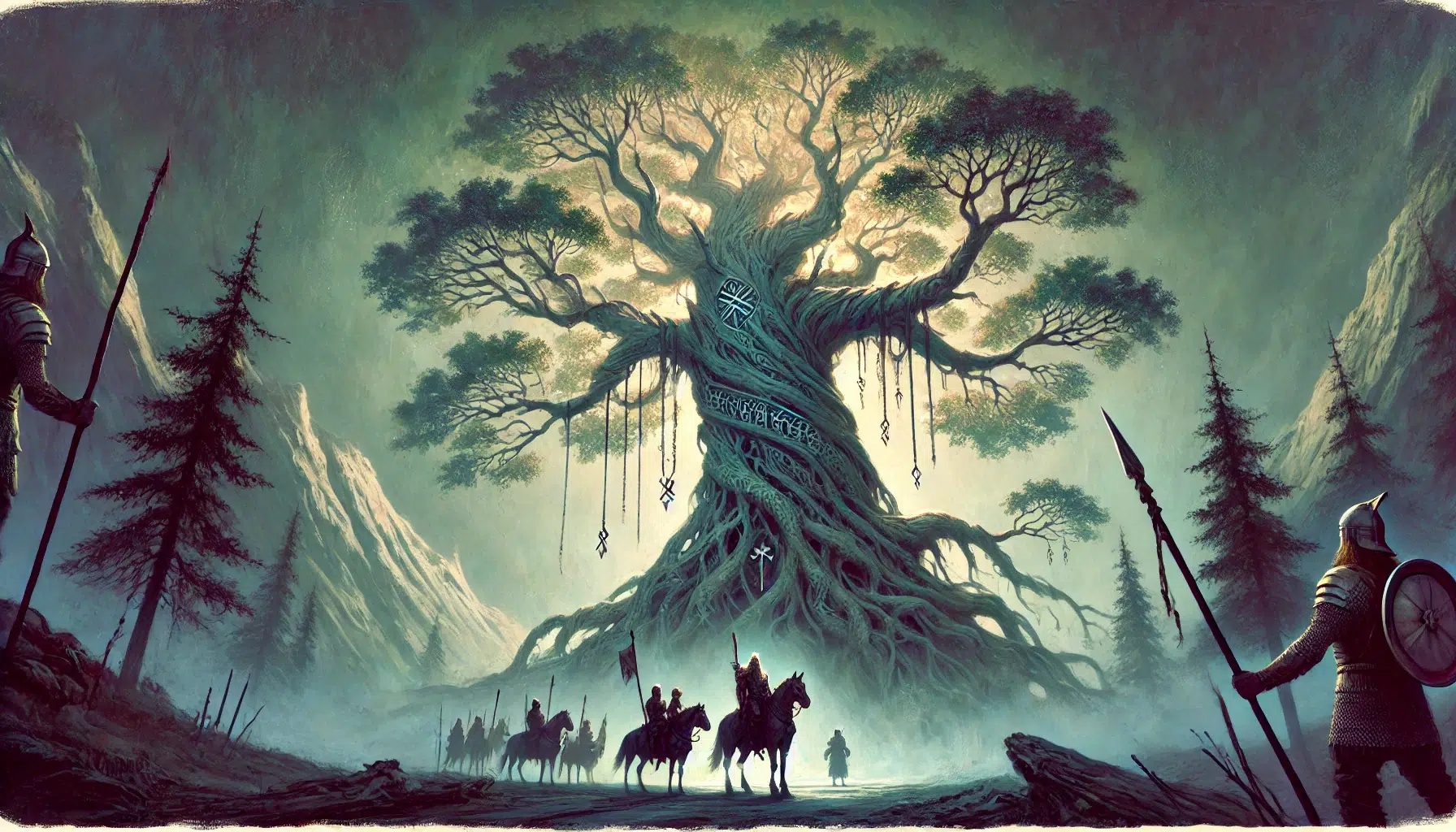
In Norse mythology, Yggdrasil is revered as the cosmic tree that connects all the realms of the universe. Its branches stretch to the heavens, while its roots delve into the mysterious depths of the underworld.
This Cosmic Tree links the Nine Worlds. This sacred ash tree is crucial for keeping the universe balanced and structured.
At the top of Yggdrasil is Asgard, the gods’ realm.
Below, Midgard, the human world, thrives under its branches. This shows how the worlds are connected and depend on each other in Norse stories.
Yggdrasil is filled with creatures that symbolize different aspects of life. Nidhogg, a fierce serpent, eats at the tree’s roots, showing destruction and chaos. On the other hand, an eagle watches over the tree, symbolizing wisdom and alertness.
Four stags, Dainn, Dvalinn, Duneyrr, and Duraþrór, eat the tree’s leaves. They show the cycle of life, death, and rebirth. These elements prove Yggdrasil’s deep role as the eternal Cosmic Tree.
The Cosmic Tree Symbolism in Archery
Within archery, the symbolism of Yggdrasil can be observed in the bow’s structure.
Each bow is a microcosm of Yggdrasil, representing a bridge between the earthly archer and the divine target.
The arrow’s trajectory mirrors the connecting branches of the cosmic tree, while the grounded stance of the archer reflects Yggdrasil’s firm roots.
Through this lens, each shot symbolizes the archer’s quest for harmony within the cosmos.
Urðarbrunnr: The Well of Urd
Symbolism and Meaning
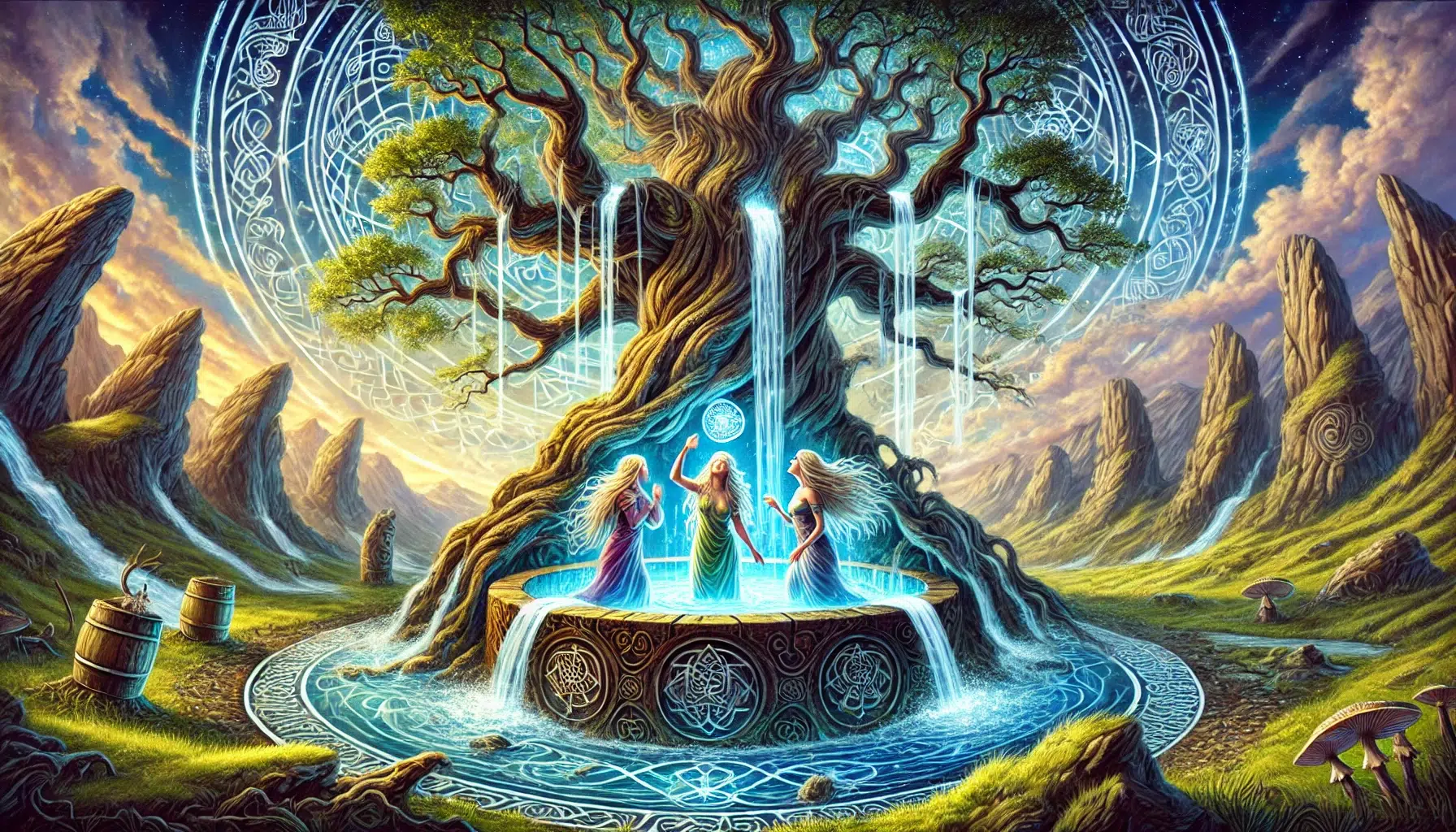
The Well of Urd is a sacred well located at the base of Yggdrasil, the World Tree, feeding the World Tree.
It is closely associated with the Norns, particularly Urd, who represents the past. The well is a source of wisdom and fate, where the Norns weave the destinies of all beings.
The gods of Asgard gather daily at the Well of Urd to hold council and discuss the affairs of the cosmos. The well’s waters are said to nourish Yggdrasil, maintaining the health of the World Tree and the universe.
The Well of Urd is not only a site of prophecy but is also believed to have healing properties. The Norns draw water from the well to keep Yggdrasil healthy, symbolizing the well’s life-sustaining and fate-determining power.
Association with the Norns: Goddesses of Fate
- The Norns are three Goddesses: Urd (past), Verdandi (present), and Skuld (future) who reside near the Well of Urd
The Norns are responsible for spinning the threads of fate, determining the destinies of gods and men. They show us the power of fate in Norse stories.
Each thread they spin tells the story of a life, creating the destiny of all beings. Their work shows how our past, present, and future are linked, shaping our destiny. Urd, Verdandi, and Skuld guide the universe’s course by understanding past, present, and future. They show how every moment shapes what comes next.
Destiny is deeply important in Norse beliefs. It suggests life follows a set path, yet our choices and actions matter. The Norns remind us that while we can’t control fate, our choices are crucial in our life stories.
Norse Mythology Symbols: Associated With Odin
The Valknut: Odin’s Knot

The Valknut, also known as Odin’s Knot, is a symbol made of three interlocking triangles. It is deeply rooted in Norse mythology and culture.
These triangles represent the interconnected nature of life, death, and the afterlife. This cycle shows the Norse belief in the flow between these states, highlighting fate and destiny.
The name “Valknut” comes from the modern Norwegian word meaning “knot of the slain.” “Valr” means “slain warriors,” and “knut” means “knot.”
The nine points formed by the three triangles often represent the nine worlds of Norse cosmology. This links the Valknut to themes of fertility, rebirth, and reincarnation.
It also connects to the heart of Hrungnir, a giant in Norse mythology. According to the Prose Edda, Hrungnir’s heart was made of stone with three pointed corners, like the Valknut. This symbolizes strength and endurance.
The Valknut appears on various artifacts from the Viking Age found in Sweden and Norway. These findings suggest that the symbol held significant cultural and religious importance.
Connection to Odin
The Valknut often has links to Odin, the chief god in Norse mythology.
Odin is known as the “Chooser of the Slain,” and the Valknut is often found in contexts related to death and the afterlife. It appears on artifacts alongside depictions of Odin or symbols connected to him, like his animals (the horse and the wolf).
This connection suggests that the Valknut symbolizes Odin’s power over life and death. It shows his role in guiding the souls of fallen warriors to Valhalla. The Valknut also represents bravery and valour in battle. It embodies the warrior spirit and the honour of those who die courageously.
Some see the Valknut as a protective symbol, offering strength and resilience to those who bear it. This protective aspect aligns with Odin’s role as a god of war and protection.
Gungnir: Odin’s Spear

Gungnir is Odin’s magical spear in Norse mythology crafted by dwarves. It never misses its target and always returns to Odin’s hand. The spear is a powerful symbol of strength, precision, and protection.
The dwarves, skilled craftsmen in Norse myths, created Gungnir. They made it from a special metal that makes the spear unbreakable. Runes carved into the spear enhance its magical properties, giving it incredible accuracy and power.
Odin, the chief god, uses Gungnir in battles and ceremonies. He often throws it over the heads of his enemies at the start of a battle to ensure victory. This act symbolizes Odin’s power and the protection he offers to his warriors.
Gungnir also represents authority and leadership. As the king of the gods, Odin’s spear is a sign of his rule and wisdom. It shows his ability to lead and protect his people.
Many stories in Norse mythology mention Gungnir. It plays a key role in many battles and important events. Its unerring accuracy and return to Odin’s hand make it a symbol of reliability and loyalty.
Today, Gungnir remains a powerful symbol in Norse culture. People who follow Norse traditions or admire Viking mythology often use Gungnir in art, jewellery, and literature. It stands for strength, protection, and the unbreakable bond between a leader and their followers.
Hugin and Munin: Odin’s Ravens
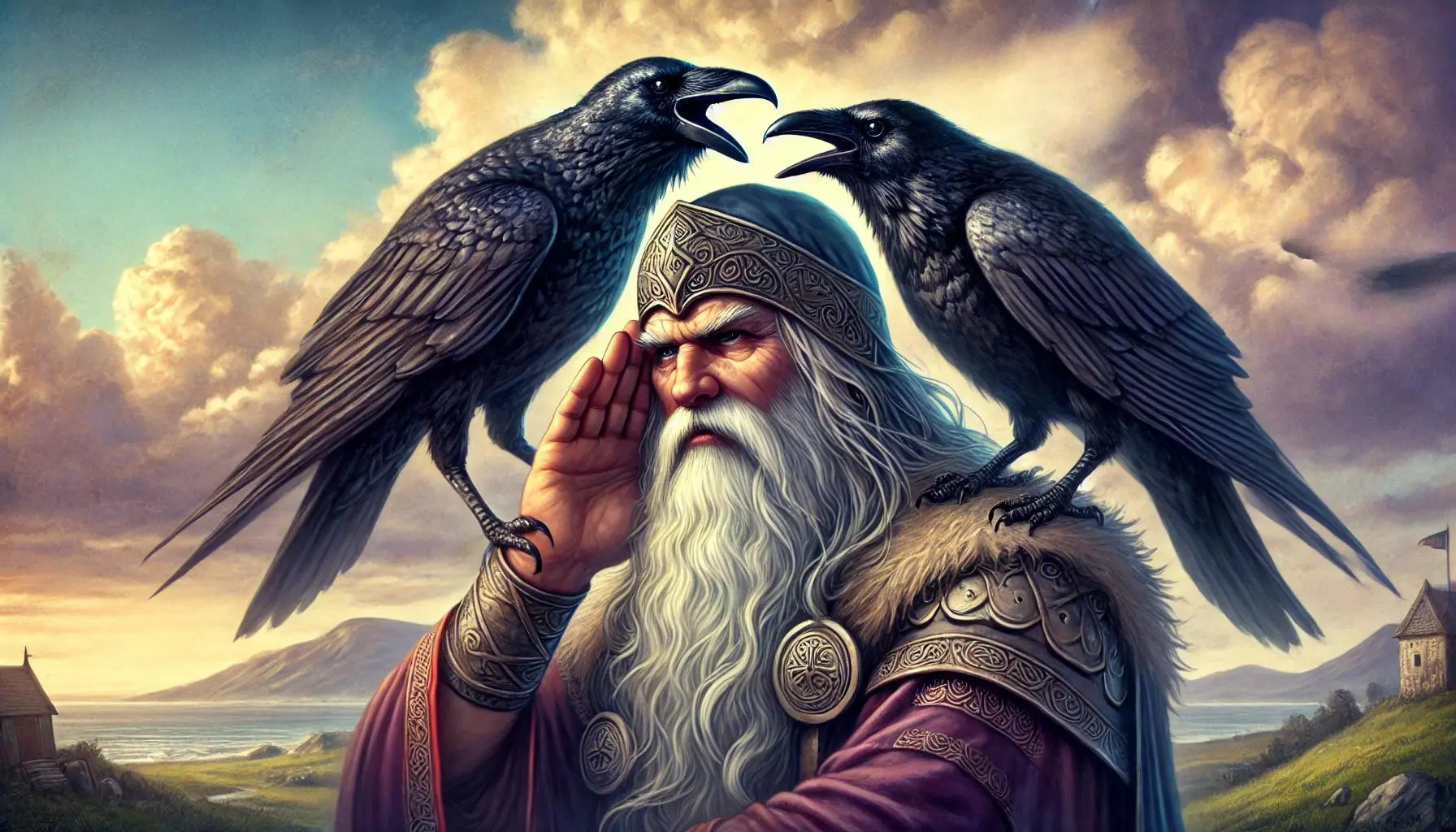
Hugin (thought) and Munin (memory) are Odin’s ravens in Norse mythology. These ravens fly across the world every day, gathering information for Odin.
Every morning, Odin sends Hugin and Munin out to explore. They travel far and wide, seeing everything that happens. At night, they return to Odin and tell him what they have seen. This helps Odin stay wise and informed about the world.
Hugin and Munin sit on Odin’s shoulders when they return. They whisper all the news they have gathered into his ears. This close relationship shows how much Odin relies on their intelligence and observations.
The ravens are a symbol of Odin’s quest for knowledge. They show the importance of thought and memory in understanding the world. By sending Hugin and Munin out each day, Odin keeps himself connected to all events and people.
Hugin and Munin also symbolize the power of nature. Ravens are intelligent birds with keen senses. Their ability to see and hear everything makes them perfect messengers for Odin. They remind us that nature holds great wisdom if we pay attention.
The Triple Horn of Odin
The Triple Horn of Odin is an important symbol in Norse mythology. It shows three interlocking drinking horns. This symbol is connected to Odin, the chief god in Norse myths.
The three horns represent the three draughts of the magical mead of poetry. This mead gives anyone who drinks it the gift of wisdom and poetic skill. The mead comes from the blood of Kvasir, a wise being created by the gods.
Odin drinks the mead in three draughts to gain its power. He uses trickery to get the mead from the giant who guards it. The three horns in the symbol remind us of Odin’s cleverness and quest for knowledge.
The Triple Horn of Odin also symbolizes the threefold nature of Odin. He is a god of war, wisdom, and magic. The three horns reflect these aspects of his character.
People often use the Triple Horn of Odin in jewellery, art, and tattoos. It shows their respect for Odin and his qualities. The symbol reminds us to seek knowledge, be wise, and use our skills well.
The Triple Horn of Odin is a powerful reminder of the importance of wisdom and learning. It encourages us to value knowledge and strive for understanding in all aspects of life. This symbol remains significant in Norse culture and modern times, inspiring those who admire Viking mythology.
Norse Mythology Symbols: Enigmatic Symbols
Mjölnir: Thor’s Hammer
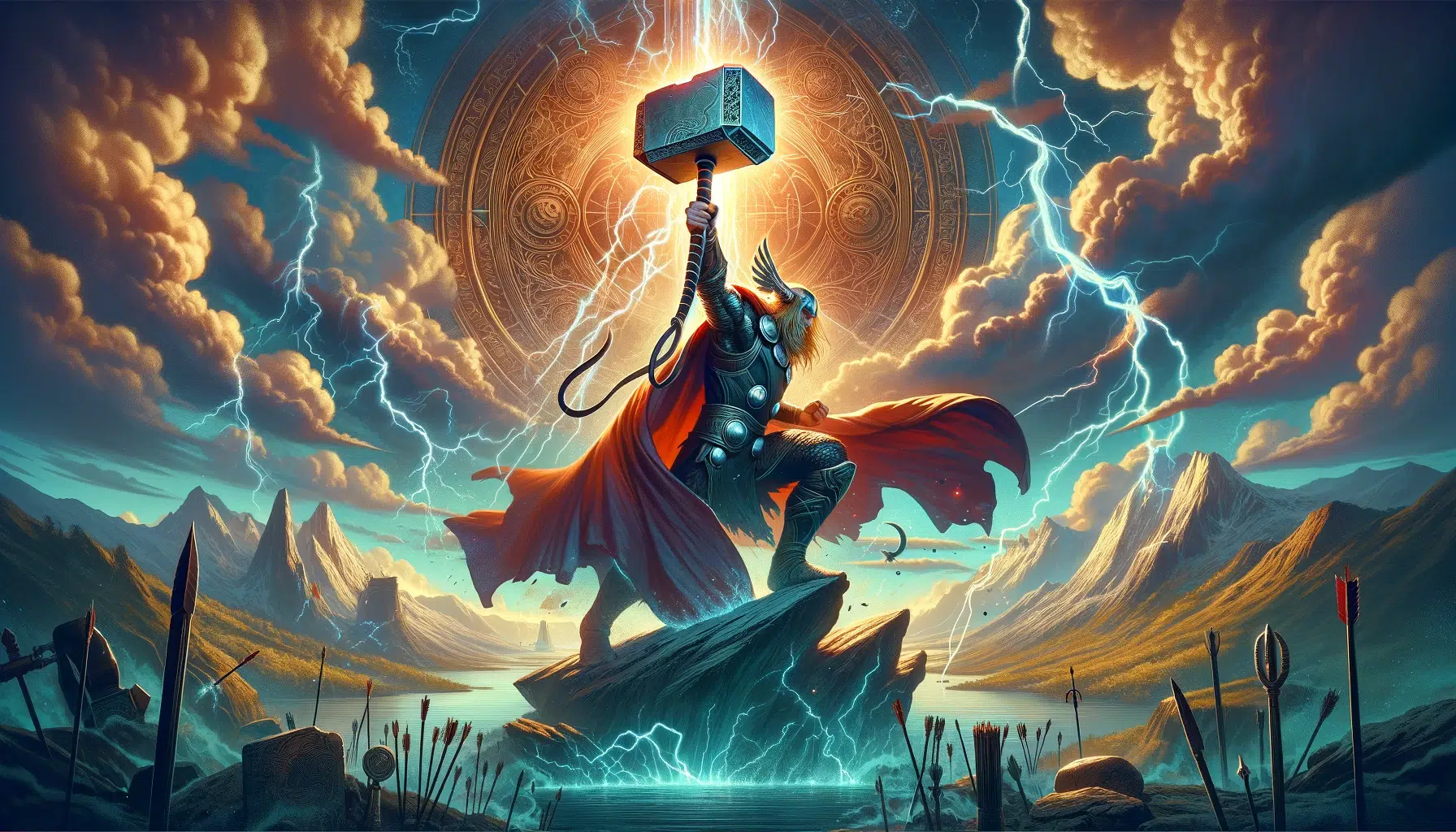
Thor’s hammer, known as Mjölnir, is one of the most significant symbols in Norse mythology, embodying various layers of meaning and cultural importance.
It protects Asgard and Midgard from the forces of chaos, particularly the giants (Jötnar). The hammer’s ability to return to Thor after being thrown symbolizes its protection and relentless power.
It represents Thor’s role as the defender of both gods and humans, making it a powerful emblem of protection and strength.
Beyond its martial uses, Mjölnir also played a crucial role in rituals of blessings. It was used to sanctify marriages, births, and possibly funerals. Thus symbolizing the transition from chaos to order and the establishment of sacred space.
This dual role underscores the hammer’s significance in maintaining cosmic balance and societal order.
During the Viking Age, Mjölnir became a symbol of cultural and religious identity. As Christianity spread through Northern Europe, many Norse people wore Mjölnir pendants as a statement of their faith and cultural heritage.
This was both a form of resistance to the new religion and a way to maintain a connection to their traditional beliefs.
Thor also has links to fertility and the life force. Mjölnir symbolizes these aspects by invoking the power of storms to bring rain and ensure the fertility of the land. This highlights its role in the natural cycles and the sustenance of life.
Vegvísir: The Wayfinder’s Compass
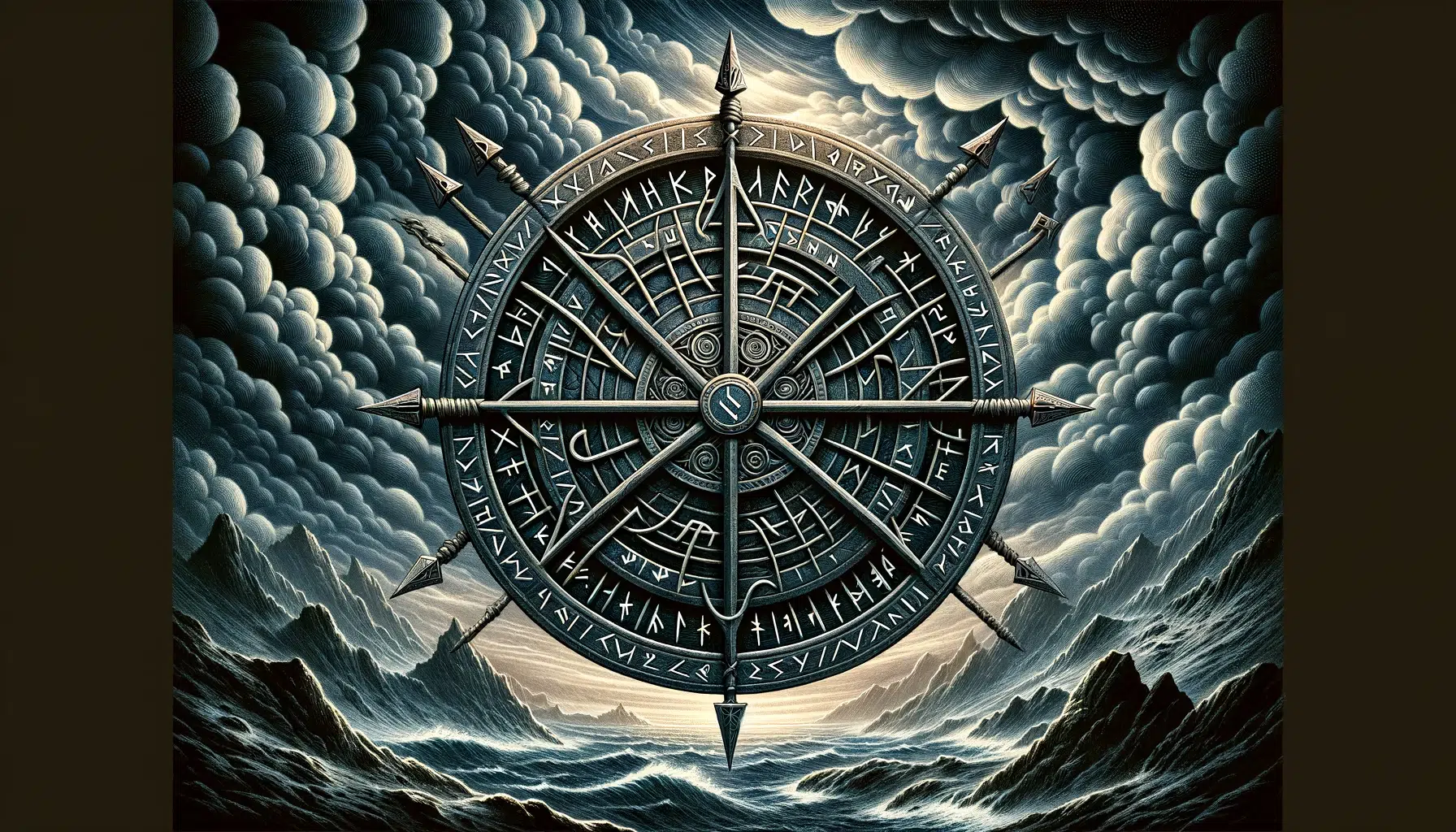
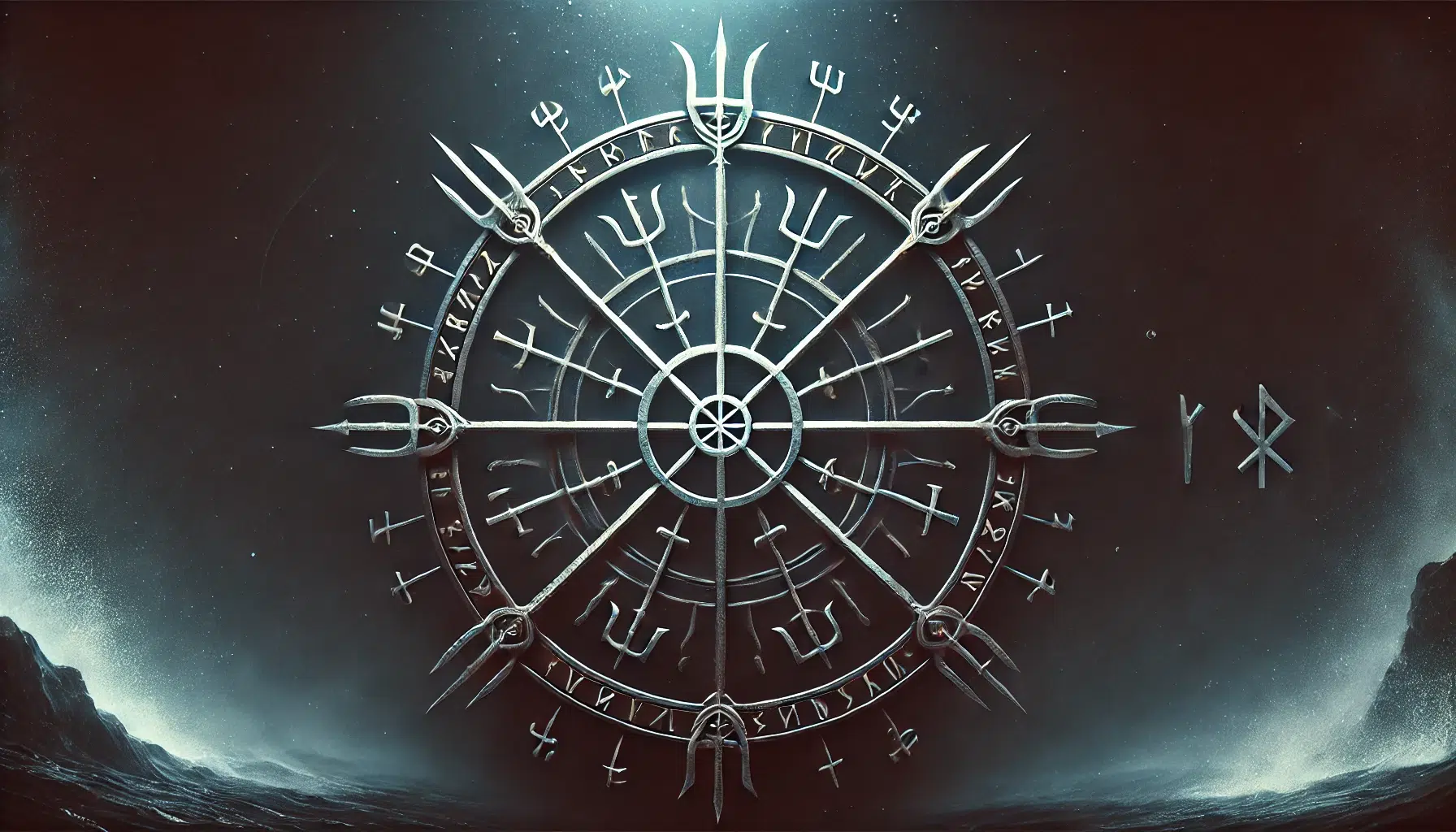
In Norse mythology, the Vegvísir, or Wayfinder’s Compass, guides travellers through harsh weather.
The Vegvísir, also called the “Runic Compass” or “Viking Compass,” comes from Icelandic magical tradition. Although people often link it to the Vikings, historical evidence shows it appeared much later.
The main symbolism of the Vegvísir is guidance and protection.
The word Vegvísir means “wayfinder” or “signpost” in Icelandic. It comes from vegur (way) and vísir (pointer).
The symbol helps the bearer find their way through rough weather and unfamiliar terrain, both literally and metaphorically. It represents the idea of finding one’s path in life and staying true to it despite challenges.
The Vegvísir is one of many Icelandic magical staves, known as galdrastafir. These staves channel magical energy for specific purposes, such as protection, guidance, and success.
The eight points radiating from a central point resemble a compass. They symbolize the eight cardinal directions, emphasizing its role in navigation.
Today, the Vegvísir is a popular symbol in body art, jewelry, and modern pagan practices. People often use it as a tattoo or amulet to invoke its protective and guiding properties.
Web of Wyrd: Skuld’s Net
The Web of Wyrd is a symbol that represents the interconnectedness of past, present, and future. It embodies the concept of wyrd, which is akin to fate or destiny in Norse belief.
The symbol is a complex web or grid, suggesting that all events are interconnected and influence one another.
The Web of Wyrd as a symbol appears to be a modern creation, with its first known appearances dating back to the 1990s. It is inspired by the ancient concept of fate but does not have direct historical precedent in Viking Age artifacts or text.
The symbol typically consists of nine interlocking staves, reflecting the sacred number nine in Norse mythology. This design is thought to encompass all the runes of the Younger Futhark, symbolizing the entirety of fate and destiny.
Skuld is one of the three Norns, who are the goddesses of fate in Norse mythology. She represents the future, or what “shall be.” The Web of Wyrd, or Skuld’s Net, emphasizes her role in shaping the future.
Aegishjalmur: Helm of Awe
Troll Cross
The Troll Cross is a protective symbol in Norse mythology. It looks like an oval loop with a twist at the bottom, similar to an “R” shape. People use it to protect themselves from trolls and evil spirits. The Troll Cross creates a magical barrier that keeps harmful creatures away.
Made from iron, the Troll Cross uses the metal’s power to ward off negative energy. Iron has protective qualities in many cultures. People hang Troll Crosses over doors, wear them as necklaces, or place them in areas needing protection.
The Troll Cross has links to Swedish folklore and is not as ancient as some Norse symbols. However, it has become an important part of modern Norse traditions. People believe it protects against trolls, witches, and other dark forces. The symbol works by creating a shield that prevents evil beings from entering a home or causing harm.
In addition to physical protection, the Troll Cross symbolizes mental and spiritual safety. It reminds people to stay strong and protect their well-being. Today, followers of Norse traditions, as well as those interested in Viking culture, use the Troll Cross for its protective qualities.
Freya’s Fehu
In Nordic tradition, ‘Fehu’ symbolizes wealth, often associated with Freya, the goddess of fertility and prosperity. Quiver craft embraces this potent rune, embossed on leather or wood, to invoke luck and abundance for the archer.
- Ensures good fortune in hunts or battles
- Represents the accumulation of resources, including arrows
- Augments the quiver’s mystical protection
Archers believe that carrying Fehu’s mark can channel Freya’s favor. Thereby boosting their success and guaranteeing their dominance in competitive or survival pursuits.
The Everlasting Legacy of Norse Mythology Symbols
Norse symbols in archery go beyond decoration. They show deep respect for ancient traditions.
Archers today uphold this cultural heritage. They know or appreciate Scandinavian history. Every arrow shot reflects myths and divine strength.
It honours the link between archery and Norse myths. This legacy keeps Norse valor alive in archery.