
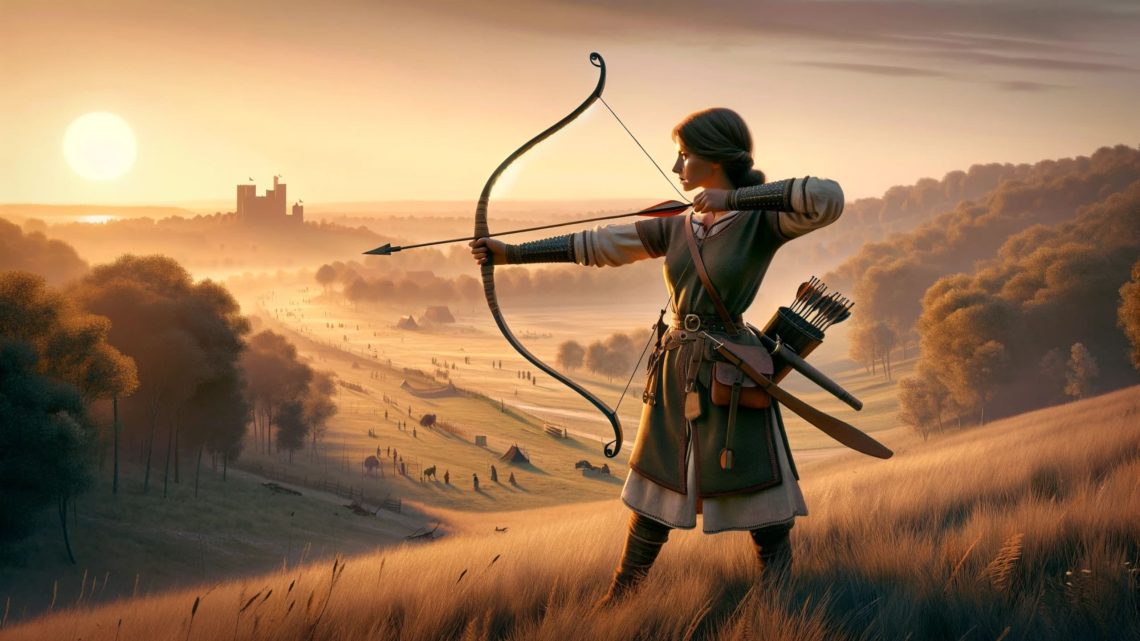
The Medieval Longbow: The Power of the Past
![]() Introduction: Rediscovering the Medieval Longbow
Introduction: Rediscovering the Medieval Longbow
The medieval longbow, a formidable weapon that shaped history, is steeped in myth and legend.
It hails from an era when warfare was a crucible for technological ingenuity.
Far from a simple stick and string, the longbow was an engineering marvel of its time, crafted from yew or elm. It demanded physical prowess and years of training to master.
Archaeologists and historians have pieced together its origins, use in battle, and impact on medieval society.
Exploring the longbow’s narrative is a voyage into the heart of medieval life, unearthing insights into the social and military fabric of the past.
Origins and History of the Longbow
The medieval longbow, a formidable weapon, traces its lineage to prehistoric times.
Archery itself dates back to the Paleolithic era, but the longbow as recognized today likely originated in Wales during the 12th century.
Welsh soldiers wielding these bows were noted for their pivotal role in conflicts against English invaders.
Their effectiveness didn’t go unnoticed, and by the 13th century, the English had incorporated the longbow into their own arsenals.
Renowned for its use during the Hundred Years’ War, the longbow’s power contributed significantly to victories at famous battles such as Crecy and Agincourt, establishing it as an iconic symbol of medieval warfare.
Learn more about: Crossbows and Longbows – Pros and Cons
Design and Construction: The Crafting of War Bows
Medieval longbows wielded in war were feats of engineering, typically crafted from yew wood, though ash, elm, and wych elm could also be utilized.
The design process required selecting the wood with the ideal balance of strength and flexibility.
Once chosen, skilled bowyers would shape the wood following the natural curve of the stave to optimize tension and compression forces when drawn.
- The back of the bow, facing the target, was the wood’s natural outer layer, accommodating tensile stress.
- Closer to the archer, the heartwood effectively absorbed compressive forces.
Bowstrings, often made of hemp or flax, needed waxing to withstand the elements.
Their creation demanded precision, as the correct length was crucial for optimal bow performance.
Implementing such techniques, medieval craftsmen produced longbows capable of releasing arrows with formidable force and accuracy, a testament to their mastery of bow-making.
The Longbow in Warfare: A Tactical Revolution
The medieval longbow catalyzed a tactical revolution in warfare.
Its significant range, accuracy, and piercing power granted archers the ability to wound or even penetrate the armor of enemy soldiers from a great distance.
This made the longbow a formidable weapon against massed infantry and even cavalry.
Armies wielding longbows, such as the English during the Hundred Years’ War, decimated their opponents in pivotal battles like Crécy and Agincourt.
The longbow’s influence extended beyond the battlefield, altering military strategies and prompting changes in armor design. Ultimately, the longbow’s impact was profound, reshaping warfare in the Middle Ages.
The Longbow’s Role in Medieval Conflicts
The medieval longbow had a significant impact on warfare and featured prominently in various battles in medieval Europe, notably in England and France.
Famous Battles
Here are key conflicts where the longbow played a pivotal role:
- Battle of Falkirk (1298): English archers decimated the Scottish schiltrons, demonstrating the longbow’s power against massed infantry.
- Battle of Crecy (1346): The longbow helped the English defeat a numerically superior French army, causing heavy cavalry losses.
- Battle of Poitiers (1356): English forces again utilized longbows effectively, contributing to the capture of the French king, John II.
- Battle of Agincourt (1415): The longbow was instrumental in another English victory against the French, despite being heavily outnumbered.
These battles underscore the longbow’s game-changing influence in medieval military strategy and tactics.
Training the Archer: Skills and Drills of the Longbowman
Training to become a proficient longbowman was a rigorous process, involving mastering several key skills:
- Stance and Posture: Adopting a proper shooting stance with feet shoulder-width apart and body perpendicular to the target.
- Drawing Technique: Learning to draw the longbow with consistent force, ensuring the arrow’s speed and trajectory are maintained.
- Aiming and Accuracy: Practicing sighting along the arrow shaft and developing an intuitive sense of aim.
- Release and Follow-through: Perfecting a smooth release of the string while maintaining the body’s position to guarantee arrow stability.
- Strength Training: Building the upper body and arm strength necessary to handle the longbow’s heavy draw weight.
- Endurance Drills: Engaging in repetitive shooting to cultivate the stamina needed for prolonged battles.
- Strategic Shooting: Training in various scenarios, such as targeting moving objects or shooting in different weather conditions.
This comprehensive regimen honed a longbowman’s capability for precision and resilience on the battlefield.
Material Science: The Wood That Changed Warfare
In medieval times, a particular type of wood revolutionized military tactics and bow design: the English Yew.
This formidable resource was fundamental in constructing the medieval longbow, a weapon that granted English archers a fearsome reputation.
- Yew trees provided strong, resilient, and flexible wood, which was ideal for longbows.
- The unique properties of yew allowed for longer draw lengths and powerful tension without breaking.
- Longbows crafted from yew could shoot arrows over vast distances with high accuracy and devastating impact.
- The procurement and management of yew resources became a strategic asset, influencing battles and wars.
The English Yew, through its physical qualities, transformed warfare in medieval Europe, making the longbow a legendary weapon in history.
The Cultural Impact of the Longbow in Medieval Society
The medieval longbow significantly influenced cultural dynamics within European societies.
Its introduction brought about a distinctive shift in military strategies, as it allowed for faster and longer-range combat.
It also had profound social implications, changing the status and necessity of archers, who were often commoners trained from youth to master this powerful weapon.
Feasts and competitions emerged to celebrate longbow skills, knitting communities together for events that were as much about social cohesion as martial prowess.
Moreover, the longbow’s prominence in warfare contributed to legends and folklore, with figures such as Robin Hood symbolizing the democratization of military might through this formidable weapon.
Comparative Weaponry: Longbow Versus Crossbows
The medieval longbow, crafted from yew or elm, could unleash volleys rapidly, up to six arrows per minute.
In contrast, the crossbow, with a slower reload time, offered greater force and accuracy but at a reduced rate of fire. The advent of firearms introduced devastating firepower and penetration abilities, fundamentally altering combat.
Despite this, during the transition period, the longbow remained favoured for its range, swiftness, and silent discharge, allowing archers to remain stealthy and mobile.
Conversely, firearms, particularly early models like the arquebus, were cumbersome and noisy, but could pierce armor that longbows struggled against.
Decline and Legacy: The End of the Longbow Era
The longbow’s decline began in the 16th century with the advent of more powerful gunpowder weapons.
While the longbow offered remarkable range and penetrating power, firearms progressed rapidly in reliability and effectiveness.
The cumbersome nature of the longbow, requiring years of training to master, was overshadowed by the relative ease of training soldiers to use firearms.
- Superior armor-piercing abilities became less relevant as plate armor fell out of use.
- Firearms’ improving rate of fire eventually surpassed that of longbows.
- Armies favored the logistical simplicity of equipping troops with guns over bows.
Despite falling into obsolescence, the longbow’s legacy endures, symbolizing medieval warfare’s ingenuity and shaping military tactics for centuries.
The Longbow Today: Recreation and Historical Reenactment
In modern times, the longbow serves as a fascinating link to medieval history.
Enthusiasts of archery cherish the longbow for both its historical significance and the skill required to master it.
Recreational archers often pursue longbow archery as a hobby, appreciating its traditional form and the challenge it presents.
Historical reenactors, on the other hand, use the longbow to bring vivid authenticity to their portrayals of medieval battles and daily life.
They meticulously recreate historic longbows and engage in competitions that mirror the archery contests of the past, further preserving this ancient art.
Thus, the longbow remains a vibrant part of cultural heritage events, connecting the modern world with the medieval era.
Conclusion: The Longbow’s Lasting Influence
The medieval longbow leaves an indelible mark on warfare and culture. Its historical efficacy heralded revolutionary tactical changes, emphasizing long-range combat and disciplined volleys.
Descendant technologies, like modern composite bows and principles applied in military strategy, owe to the longbow’s legacy.
In popular culture, the longbow endures, romanticized in literature and film, symbolizing a bygone era’s valor and ingenuity.
Thus, the longbow’s influence extends beyond medieval battlefields to mold contemporary military thought and inspire societal narratives of heroism and skill.