Dokkaebi: Korean Goblins of Luck, Trickery, and Power
Dokkaebi are supernatural beings from Korean folklore, often compared to goblins but far more complex.
They are tricksters, challengers, and sometimes protectors. Born from everyday objects touched by spirit energy, they blur the line between mischief and justice.
In stories, Dokkaebi reward the brave, punish the greedy, and test human character through riddles and games. Their legends reveal deep cultural values about fortune, morality, and fate.
Quick Facts About Dokkaebi
What are Dokkaebi?
Dokkaebi are supernatural beings in Korean folklore, often described as goblin-like spirits that challenge humans through games, riddles, and tests of character.
What does Dokkaebi mean?
The word “Dokkaebi” refers to Korean goblin spirits that arise from possessed objects or spiritual energy rather than from birth.
What do Dokkaebi look like?
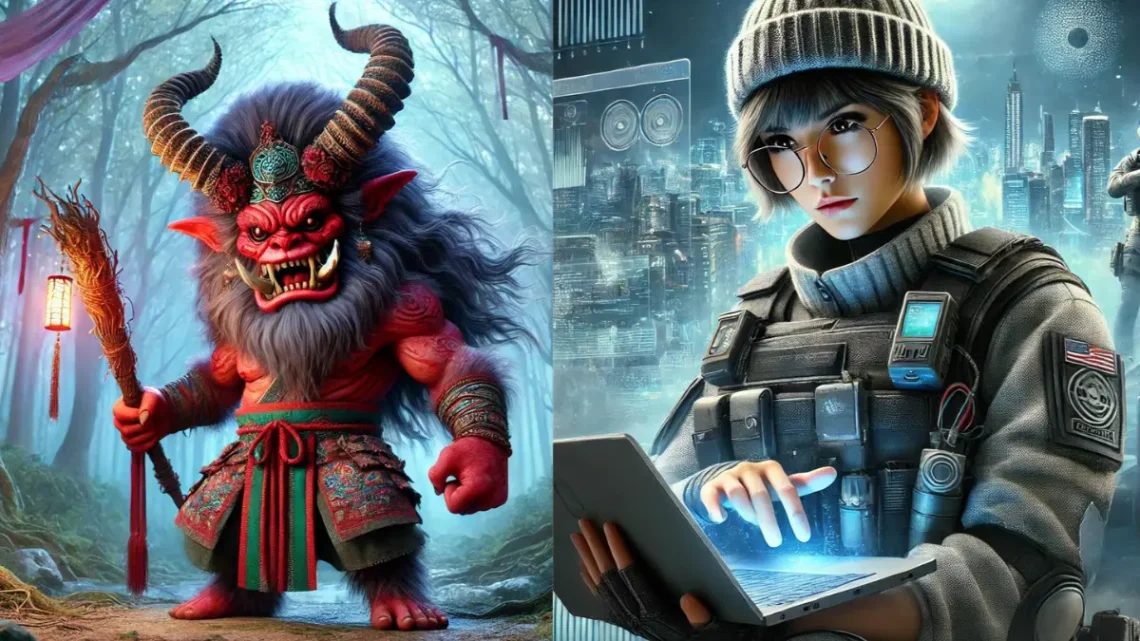
They are often depicted with horns, wild hair, large eyes, and carrying a magical club called a bangmangi.
Are Dokkaebi good or evil?
They are neither purely good nor evil. They reward honesty and bravery but punish greed and deceit.
The Origins of Dokkaebi
Unlike many mythological beings, Dokkaebi are not born as gods or demons.
In Korean folklore, they are said to arise from everyday objects that absorb spiritual energy over time. Old tools, household items, or discarded belongings can transform into Dokkaebi once touched by lingering human spirit. This origin sets them apart from other supernatural beings in Korean myth.
Early references to Dokkaebi appear in texts such as the Samguk Yusa, a thirteenth century collection of legends and historical accounts. In these stories, Dokkaebi are mysterious but not inherently evil. They are unpredictable spirits who test human character rather than destroy it.
Because they are formed from objects, Dokkaebi represent the idea that the spiritual world exists alongside ordinary life. They emerge from what is forgotten, discarded, or overlooked.
Their origins reflect a worldview in which spirits are not distant forces, but active presences woven into daily existence.
Appearance and Attributes
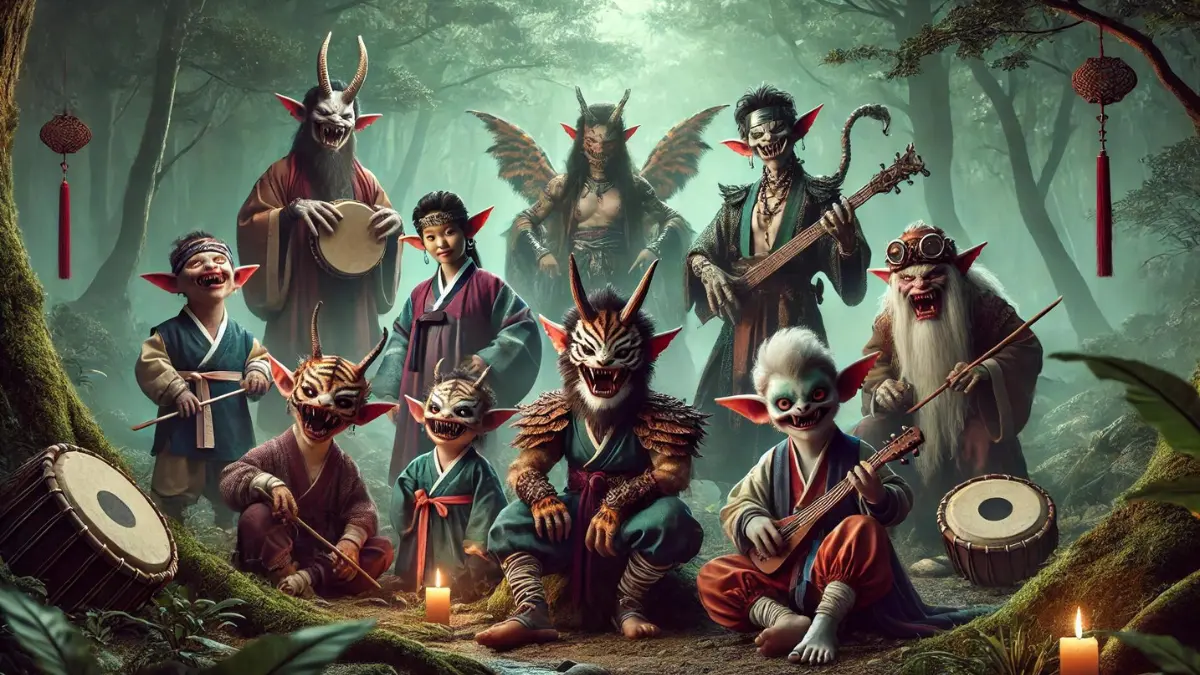
Artists often depict Dokkaebi with exaggerated, striking features. Many appear human in form but with sharp teeth, wide eyes, and curved horns that mark them as supernatural.
The most recognizable object they carry is the bangmangi, a magical club that produces objects or wealth when struck against the ground. This tool symbolizes both creation and disruption, depending on how it is used.
Traditional illustrations sometimes show Dokkaebi wearing tiger skins or loose garments tied at the waist. Some carry large fans, while others stand barefoot with wild hair and expressive faces.
Despite their fearsome traits, many depictions include humour. A broad grin, raised brow, or playful stance suggests mischief rather than pure menace.
Shape shifting also defines their nature. They can vanish, transform, or appear unexpectedly. This ability reinforces their role as tricksters who blur the line between the ordinary and the supernatural.
Rather than fitting neatly into “monster” or “spirit,” Dokkaebi combine both. Their appearance reflects that duality, part threatening, part amusing, always unpredictable.
Types of Dokkaebi
Korean folklore describes Dokkaebi in many forms. They do not follow a strict hierarchy, but storytellers often group them by behaviour and role.
Some Dokkaebi act as helpers.
Cham Dokkaebi reward honesty and kindness. They offer protection or unexpected fortune. Stories sometimes show them carrying fire or wearing a bamboo hat that allows them to vanish from sight.
Others delight in mischief.
Pyob Dokkaebi enjoy harmless tricks. They confuse travellers, startle villagers, and create laughter through playful deception.
More fearsome figures also appear.
Kwedok Dokkaebi take on the role of warrior or challenger. These spirits test strength and courage. In some tales, they guard mountains or sacred places.
Regional stories introduce additional variations.
- Gae Dokkaebi are known for cunning and sharp wit
- Gaksi Dokkaebi appear in more graceful forms and often connect with music or charm
- Oenun Dokkaebi link to agriculture and harvest
- Oedari Dokkaebi stand out for agility and dance
Not every tradition includes the same categories. Folklore shifts by region and storyteller. What remains consistent is their unpredictability. Dokkaebi can bless, test, mislead, or reward.
Their variety reflects the richness of Korean oral tradition rather than a fixed mythological system.
The Role of Dokkaebi in Korean Culture
Dokkaebi are playful spirits and play a big role in Korean culture. They are not just stories but rather a big part of Korean traditions. They appear in stories, art, and customs, making them a significant part of Korean life.
Dokkaebi’s stories and images are everywhere in Korean culture. You find them in folktales and historical art. These stories teach important lessons and shape Korean values.
People celebrate them in festivals and rituals. Village exorcisms, for example, show how much people believe in them. These events bring people together and share cultural heritage.
Dokkaebi also appear in Korean art and literature. They are in old poetry and new novels. They represent the mix of human and supernatural worlds, reflecting life’s mysteries.
In the end, Koreans view them with a mix of fear, respect, and admiration. They are a big part of traditions, stories, and art, showing their lasting impact and importance in Korean folklore.
The Symbolism of Dokkaebi

Dokkaebi, mythical beings from Korean folklore, hold deep cultural symbolism. They reflect Korean society’s beliefs and traditions. These beings can be tricksters or kind figures, showing the community’s inner thoughts and representing both fears and hopes.
They can be mischievous or reward good deeds, showing the dual nature of Korean culture. They are linked to nature and the unknown, giving them spiritual significance.
Dokkaebi are tied to family and community values. They often protect homes or communities, teaching right from wrong. This highlights the importance of harmony and ethics in society.
In folklore, they symbolize nature’s unpredictability, like storms or wildfires, bringing life or destruction. This reflects the balance in nature and society between creation and destruction.
Over time, dokkaebi’s meanings have evolved but remain important today. They’re present in both folklore and modern media, continuing to capture and shape cultural stories.
Legends and FolkTales
Dokkaebi appear throughout Korean folklore as tricksters, challengers, and unexpected judges of character.
Their stories are not only meant to amuse. They test human virtue. Greed, pride, kindness, and courage are all placed under scrutiny. Through humour and mischief, Dokkaebi reveal deeper moral truths woven into everyday life.
1. The Goblin’s Gold

A struggling farmer longs for wealth and relief from hardship.
One day, while working in his fields, he encounters a Dokkaebi. The creature offers him a chance to become rich beyond imagination. It leads him to a hidden cave overflowing with gold and precious stones.
“You may take as much as you can carry,” the Dokkaebi says. “But you must leave your old life behind.”
Blinded by desire, the farmer gathers armfuls of treasure. He ignores the warning. He thinks only of escape.
As he reaches the cave entrance, the gold grows unbearably heavy. The Dokkaebi watches in silence. In an instant, the treasure turns to stone. The cave closes, leaving the farmer empty-handed.
The Dokkaebi vanishes.
The lesson lingers.
2. The Haunting Song
A young musician hears an unearthly melody drifting through the forest at night.
Following the sound, he discovers a circle of Dokkaebi playing enchanted instruments beneath the trees. Hidden in the shadows, he memorizes their song.
He begins performing it in the village.
The melody captivates everyone who hears it. His name spreads. Wealth follows.
But the song was never his.
The Dokkaebi confront him and demand its return. The music, they say, carries their power. It is not meant for human hands.
The musician refuses. Fame has already taken hold of him.
In response, the Dokkaebi twist the melody. From that day forward, whenever he plays it, misfortune follows. Listeners grow uneasy. Prosperity fades. The gift becomes a curse.
The music remains beautiful.
But it no longer brings joy.
3. The Kindhearted Child
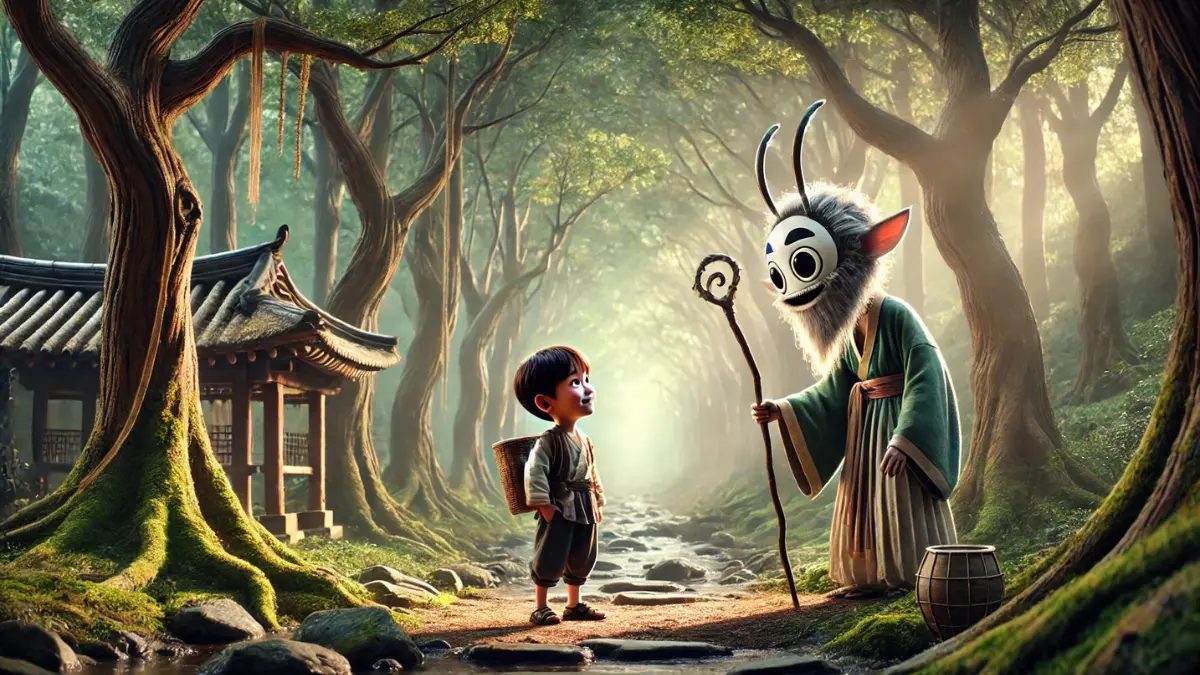
A poor boy lives quietly in a small village, known not for wealth, but for kindness.
One day in the forest, he encounters a Dokkaebi. Instead of fleeing, he greets the creature with respect. Amused and curious, the Dokkaebi offers him three wishes.
For his first wish, the boy asks for food and clothing for his struggling neighbours. The village awakens to unexpected abundance.
For his second wish, he asks for healing for an older woman who has long suffered from illness. She rises restored.
For his final wish, he asks for a harvest so strong that no one will face hunger again.
The Dokkaebi studies him carefully. None of the wishes were for himself.
Pleased, the creature grants him a blessing beyond the three promises. Fortune follows him throughout his life, though he never seeks it.
In the village, he is remembered not for wealth, but for generosity.
4. The Goblin’s Club
A weary woodcutter struggles to feed his family.
One day in the forest, a Dokkaebi appears and offers him a magical club. Strike the ground with it, the creature says, and gold will rise from the earth.
At first, the woodcutter uses the club sparingly. A few coins repair his roof. A few more fill his pantry. Life improves.
But the sound of gold striking the ground becomes irresistible.
He returns to the forest each day. Piles of coins grow. His axe gathers dust. He begins to watch his neighbours with suspicion. He hides his wealth as trusts no one.
Still, it is not enough.
One afternoon, he strikes the earth again and again, demanding more. The ground trembles. Instead of gold, it splits open and swallows him, along with the club and every coin he claimed.
The forest grows quiet.
5. The Dokkaebi and the Old Man
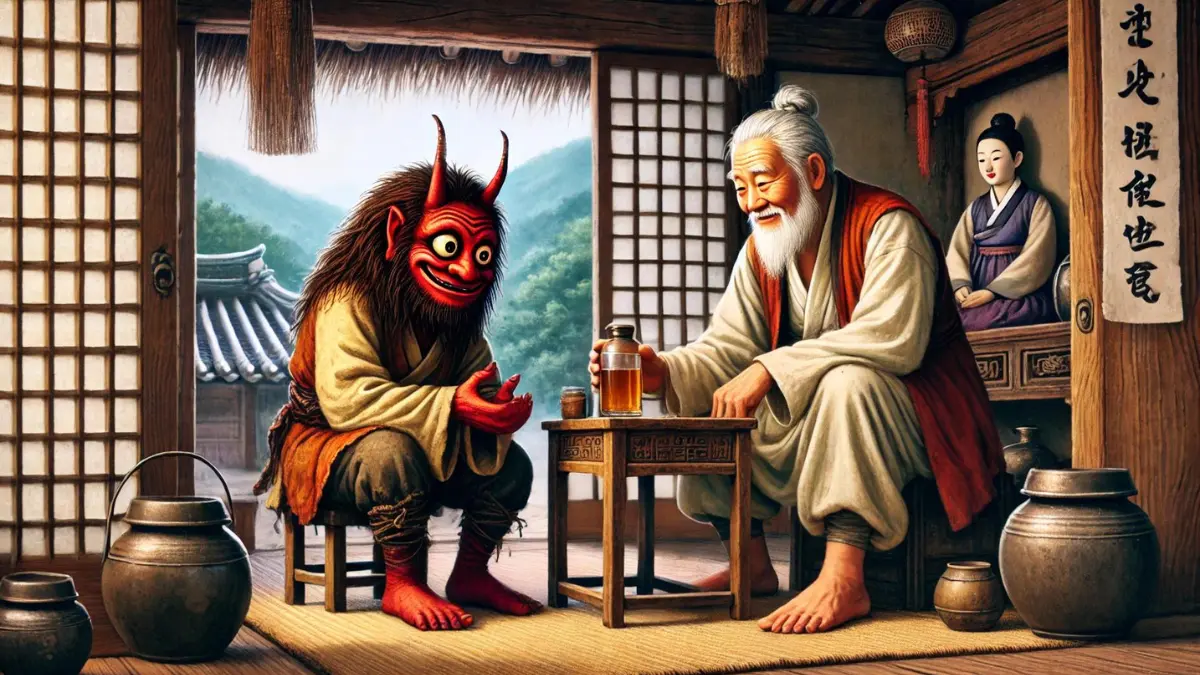
An old man lived alone on a mountain, content with simple company.
One evening, a Dokkaebi arrived at his door. Instead of fear, the old man offered the creature drink and conversation. The two began meeting regularly, sharing stories long into the night.
But something began to change.
The old man noticed his reflection shifting. His features slowly mirrored those of the Dokkaebi. He understood what was happening. Prolonged company would transform him.
Quietly, he asked the Dokkaebi what it feared most.
“Blood,” the creature answered.
The old man nodded. When asked the same question, he replied, “Money.”
The next day, he slaughtered a cow and poured blood around his home. Horrified, the Dokkaebi fled.
But it soon returned, determined to frighten the old man in return. It scattered bags of silver and gold outside his door.
The old man trembled convincingly and gathered the money inside.
The Dokkaebi never came back.
6. The Dokkaebi and the Bride
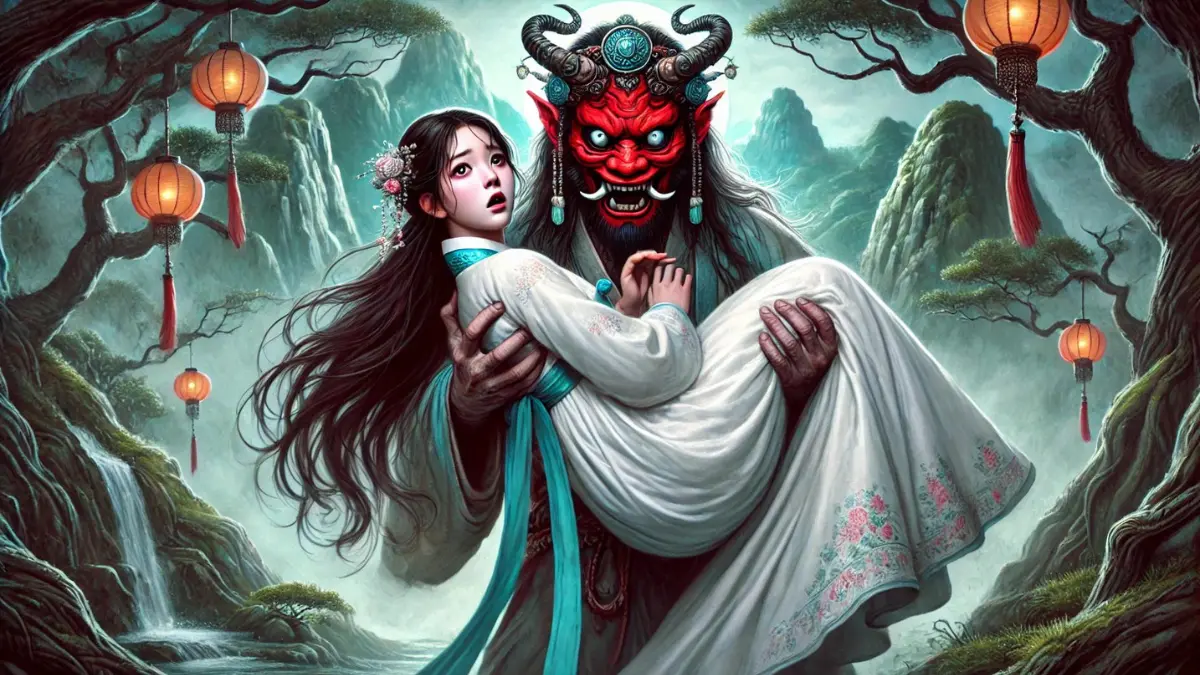
In one well known legend, a Dokkaebi becomes captivated by a young bride and carries her away to his mountain dwelling.
Her family searches desperately but cannot find her. At last, a clever servant offers to help. He disguises himself as a travelling merchant and climbs the mountain with rare trinkets and curious goods.
The Dokkaebi, drawn by novelty and vanity, welcomes him inside.
As the creature inspects the enchanted wares, boasting and bargaining, the servant quietly slips away. He finds the bride and leads her down the mountain path.
By the time the Dokkaebi realizes what has happened, the house stands empty.
The mountain keeps its silence.
Dokkaebi in Modern Games
Dokkaebi and Dokebi appear in several modern video games, often reimagined for contemporary audiences.
In DokeV, players collect dream-powered creatures called Dokebi. These beings draw strength from human emotion, echoing the folkloric idea that Dokkaebi emerge from spiritual energy tied to everyday life.
In Dislyte, a character inspired by Korean goblins reflects the dual nature of Dokkaebi as both helpful and mischievous. The adaptation blends mythology with stylized modern fantasy.
Other games, such as Dokkaebi Village, build entire worlds around the creature’s image, using it as a cultural motif rather than a direct mythological retelling.
Across these interpretations, the core traits remain recognizable. Trickery, transformation, and supernatural influence continue to define Dokkaebi, even when translated into digital form.

Rainbow Six Siege
The name Dokkaebi also appears in modern gaming culture. In Tom Clancy’s Rainbow Six Siege, one of the playable operators is nicknamed Dokkaebi.
The character, Grace Nam, is portrayed as a skilled hacker who disrupts enemy communications through digital interference. While the game does not directly adapt traditional folklore, the use of the name reflects the creature’s association with trickery, disruption, and clever manipulation.
In this context, “Dokkaebi” becomes a modern reinterpretation of the folkloric trickster. Instead of magical clubs and riddles, the character uses technology and strategy. The connection shows how traditional myth continues to influence contemporary storytelling across different mediums.
Conclusion
Dokkaebi remain among the most distinctive figures in Korean folklore. Tricksters, challengers, protectors, and judges of character, they test human nature rather than simply frighten it.
Their stories move between humour and warning, reward and consequence. Through riddles, magical clubs, music, and clever deception, they reveal values that shaped traditional Korean society.
These legends endure because they speak to universal themes. Greed invites loss. Kindness invites fortune. Cleverness can outmatch strength. Each tale reflects the tension between desire and restraint.
By preserving Dokkaebi folklore, we preserve more than stories. We preserve a worldview in which the spiritual and ordinary exist side by side, and where even a simple object can awaken with power.
That balance keeps the Dokkaebi alive in both memory and imagination.