
Diana: Goddess of Hunt in Roman Mythology
Introduction to Diana: The Roman Goddess of the Hunt
Diana is a deity in Roman mythology, associated with wild animals, the hunt, and having the power to talk to and control animals.
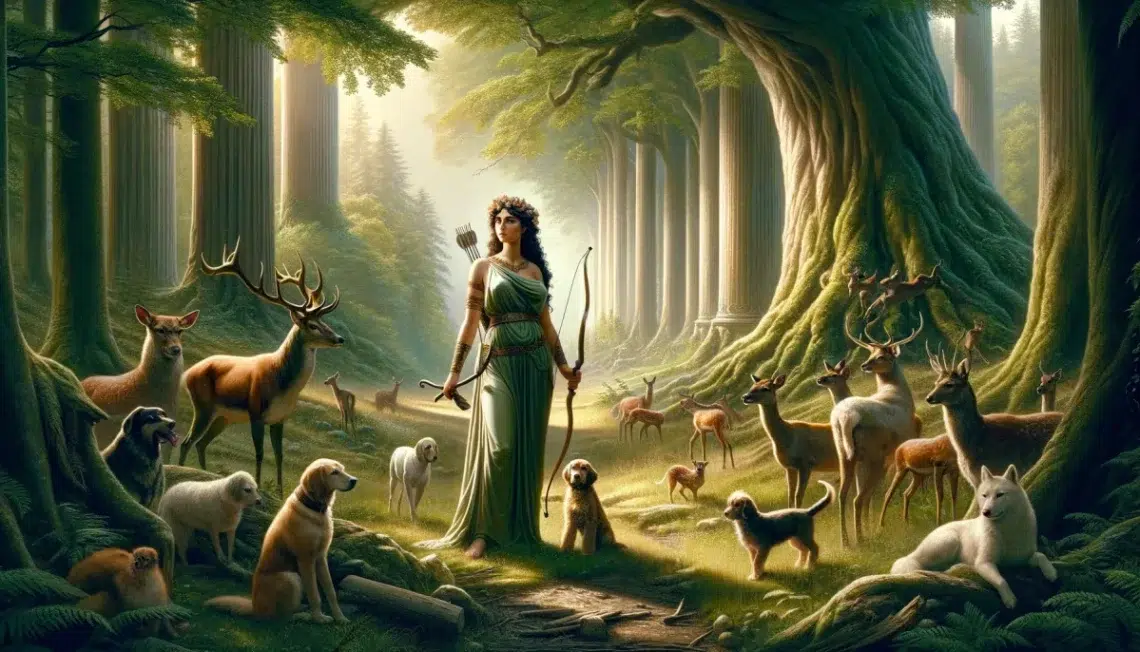
She is known for her virginity and is a protector of childbirth and women. She is often depicted as a huntress carrying a bow and arrows, accompanied by a deer or hunting dogs.
Synchronizing with the wilderness, she safeguards its creatures, ruling over woodlands and mountains with sovereign grace.
As an eternal virgin, Diana represents chastity, upholding an aura of independence and strength. Her veneration extends beyond the hunt; she is also a custodian of childbirth and nature.
Often equated with the Greek Artemis, Diana’s cult was integral to ancient Roman religion, her temples being sites of pilgrimage and her imagery pervading Roman culture.
She embodies a multifaceted deity, whose attributes and worship highlight the Romans’ deep connection with the natural world.
Learn more about Roman Mythology: God of Archery: Norse, Greek & Roman Mythology
The Origins and Evolution of Diana in Roman Beliefs

Diana began as an Italian woodland goddess associated with fertility and wildlife.
Later, Roman beliefs assimilated her as the moon goddess and counterpart to the Greek Artemis, emphasizing virginity and chastity.
Under Roman influence, Diana’s role expanded from a local deity to a protector of the lower classes and slaves.
Over time, her worship merged with state religion. S
he grew in prominence, culminating in magnificent temples and dedicated festivals like the Nemoralia.
Diana’s complexity evolved, reflecting Rome’s own societal changes and the synthesis of external influences.
Diana and the Greek Goddess Artemis
Comparative mythology reveals striking similarities between Roman Diana and Greek Artemis.
Both goddesses associate themselves with the moon and stand as virgin huntresses. They protect the wilderness and wildlife, often appearing with a bow and arrows.
They also aid women, especially during childbirth.
While Artemis exhibits a wilder and more untamed nature, Diana sometimes presents a more domesticated facet, reflecting Roman ideals.
Yet, despite these parallels, the worship and cultural significance of Diana evolved distinctly within Roman society.
Sacred Sites and Temples
Diana was revered as the goddess of the hunt, the moon, and nature, and her worship was widespread throughout the Roman Empire.
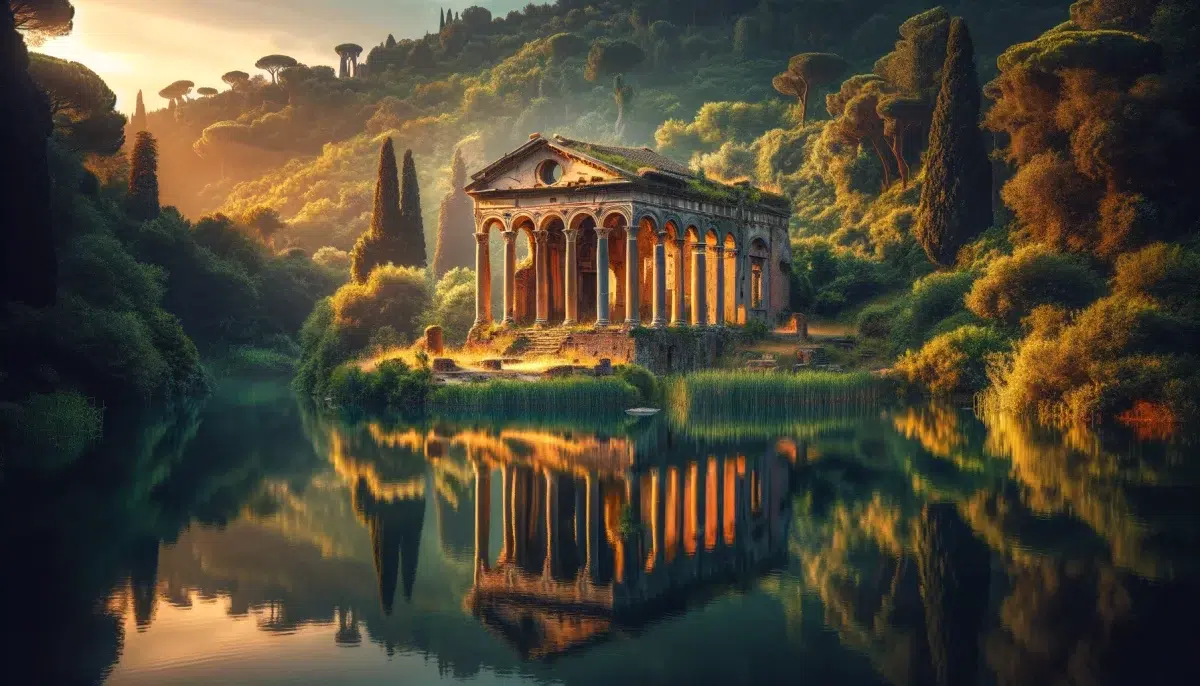
Her most notable sacred site was the Temple of Diana at Nemi, known as “Diana’s Mirror,” adjacent to Lake Nemi in the Alban Hills near Rome.
This sanctuary served as a retreat for her followers and as the center for the Rex Nemorensis, the priest of Diana at Nemi, symbolizing her connection with woodlands and water.
Diana’s temples were often located in groves, tying her worship to the natural world, and wildlife.
These locales hosted festivals such as the Nemoralia. This is a celebration of Diana’s mythology and her role as protectress of the downtrodden.
Vestiges of these temples attest to Diana’s significance in Roman spirituality and her veneration as a powerful deity in Roman mythology.
Diana in Art and Sculpture
Diana, the Roman goddess of the hunt, the moon, and nature, has been a captivating subject for artists and sculptors throughout history.
Her representations have evolved, showcasing her as both a huntress with bow and quiver and as a protector of animals and children.
- Renaissance art often depicted Diana in pastoral landscapes, emphasizing her connection to nature and fertility.
- Baroque artists focused on her hunting prowess, illustrating dynamic scenes of the chase.
- In sculpture, Diana appears both in the graceful solitude of the hunt and in the company of her nymphs or loyal hound.
- Notably, the iconic 1st-century AD statue “Diana of Versailles” captures her poised in mid-stride, a juxtaposition of both motion and timeless elegance.
- Diana’s iconography resonates across epochs, embodying the shifting human relationship with the wild and the divine.
Diana’s Role in Mythology and with Other Deities

Diana held a multifaceted role within Roman mythology, prominently known as the goddess of the hunt, wild animals, and nature, as well as a protector of women and children.
Revered for her connection to the moon, she is often identified with the Greek goddess Artemis. Diana’s virginity symbolized her independence and strength, resonating with her followers.
Notably, Diana shared relationships with several key deities:
- Jupiter (Jove): Diana was often recognized as the daughter of Jupiter, the king of the gods, which placing her among the high deities of Roman pantheon.
- Apollo: Her twin brother was Apollo, the god of the sun, with whom she shared a deep familial bond, contrasting and complementing the celestial balance between the moon and the sun.
- Janus: In some myths, Janus, the two-faced god of beginnings, was said to be Diana’s partner in love and worship, wherein they jointly symbolized the transition of girls into womanhood.
Rituals and Festivals: Celebrating Diana
Ancient Romans celebrate Diana with various rituals and festivals, highlighting her importance in their religion.
The most famous festival, the Nemoralia, occurs on the Ides of August at Lake Nemi, Diana’s sacred grove.
Worshippers light torches and candles to honor her, seeking her favor and celebrating her connections to the moon and the hunt.
They adorn dogs, Diana’s sacred animals, with flowers and grant temporary freedom to slaves, reflecting the goddess’s themes of liberation and protection.
Additionally, women wash their hair and create intricate garlands, symbols of purity and nature’s bounty.
These festivals emphasize Diana’s dual role as both nurturer and protector within the Roman pantheon.

Diana’s Influence on Roman Society and Political Life
Diana, Roman mythology’s goddess of the hunt, wilderness, and childbirth, intricately wove herself into the societal and political fabric of ancient Rome.
Her virginity symbolized independence, influencing Roman women’s social roles, while her hunting aspect reflected the virtues of the elite.
Politically, her sanctuary at Lake Nemi, known as the sanctuary of Diana Nemorensis, became a haven for slaves and the disenfranchised.
Thus contributing to the complex interplay of power and sanctuary rights in the Roman Republic and later Empire.
Diana’s temple also served as a meeting place for the Roman Senate on occasions, emphasizing her role in public and political life.
Her festivals, such as the Nemoralia, were popular public events that further integrated her worship into the fabric of Roman civic life.
Literary References: Diana’s Presence in Ancient Texts
- In ancient Roman literature, Diana is frequently mentioned as a deity with complex roles.
- Ovid’s “Metamorphoses” depicts her as both nurturing and vengeful, illustrating her duality.
- In Virgil’s “Aeneid”, her influence is clear in the character of Camilla, a fierce warrior.
- Seneca’s “Phaedra” references Diana to contrast purity with Phaedra’s passionate nature.
- The “Homeric Hymns”, though Greek, show her early influence, later embraced by Romans.
- Servius’ commentary on the “Aeneid” reveals ancient interpretations of Diana’s mythos.
- Plutarch’s writings further elucidate Roman attitudes and beliefs regarding her.
- In “Fasti”, Ovid explores Diana’s connection with the calendar and sacred rituals.
The Decline of Diana Worship: From Paganism to Christianity
In ancient Rome, Diana held immense reverence as the goddess of the hunt, moon, and childbirth, embodying both strength and chastity.
Yet, as Christianity spread throughout the Roman Empire, the old ways and their deities, including Diana, began to wane.
- The monotheistic worldview of Christianity stood in stark contrast to the polytheistic Roman religion.
- Early Christians condemned pagan worship as heretical, leading to a gradual suppression of Diana’s cult.
- Veneration of saints and the Virgin Mary supplanted the roles and characteristics once attributed to Diana; for instance, Mary assumed the mantle of purity and motherhood.
- By the late antiquity period, temples and shrines dedicated to Diana had been either destroyed, abandoned, or repurposed for Christian worship.
- The transition was not immediate; for a time, syncretism allowed Diana’s symbolism to persist covertly within Christian iconography and festivals.
- Ultimately, the systematic conversion of the Roman Empire to Christianity signified the inevitable decline of Diana worship.
The shift from paganism to Christianity redefined the religious landscape, and with it, Diana’s place in the collective consciousness became a remote, mythological echo.
Modern Interpretations and Resurgence of Interest in Diana
In recent years, there has been a reawakening of interest in Diana, mirroring a broader cultural movement towards exploring ancient mythologies.
Contemporary fascination with Diana is multifaceted:
- Feminist scholars and neopagan groups have reinterpreted Diana as an emblem of female empowerment and independence.
- Popular media often depicts her as a figure of nature and wildlife conservation, aligning with modern ecological concerns.
- Academics have delved deeper into her syncretism with other deities, unraveling the complexities of Roman religious practices.
- Mythology enthusiasts have embraced her symbolism in astrology, where she represents the moon’s mystique and influence.
- Art and literature continue to draw inspiration from her narratives, bridging the gap between ancient mythology and modern creative expression.
This resurgence ensures that Diana remains a vibrant aspect of contemporary cultural discourse, as communities seek connections to their mythological past.
The Enduring Legacy of Diana in Roman Mythology
Diana, the multifaceted deity of Roman mythology, continues to captivate modern audiences with her rich symbolic essence as a goddess of the hunt, the moon, and the natural world.
Her representation as a protector and nurturer highlighting autonomy and virginity underlines continuity in thematic relevance across eras.
Diana’s mythological narrative echoes in literature, art, and folklore, reinforcing her status as an enduring figure whose influence transcends the confines of ancient Roman worship.
Her legacy manifests in cultural contexts and personal identifications, illustrating her undiminishing significance in contemporary exploration of myth and archetype.