Arab Archery: Manual on Medieval Techniques
Arab Archery, an ancient manual on archery technique and practice, provides insights into the various aspects of archery considered essential for mastering the bow in the medieval Islamic world.
Arab Archery emphasizes speed shooting, highlighting a broader tradition that highly valued archers for their ability to swiftly and precisely deliver multiple arrows.
This capability was crucial for military effectiveness, allowing archers to provide a continuous barrage of arrows onto enemy lines or targets.
Various techniques and drills improve the speed at which an archer could shoot, focusing on aspects such as:
- Efficient Arrow Handling: How to quickly draw an arrow from a quiver, place it on the bow, and prepare it for shooting, all in one smooth motion.
- Quick Drawing and Releasing: Techniques for rapidly drawing the bow to full draw and releasing the arrow with precision, making use of muscle memory and optimized movements.
- Stance and Posture for Rapid Shooting: Adopting a stance and posture that allows for quick movements and stability, enabling the archer to shoot rapidly without losing balance or accuracy.
- Breath Control and Focus: Instruction on how to control one’s breath and focus during rapid shooting, as these elements are crucial for maintaining concentration and accuracy under the pressure of speed.
History of Arab Archery

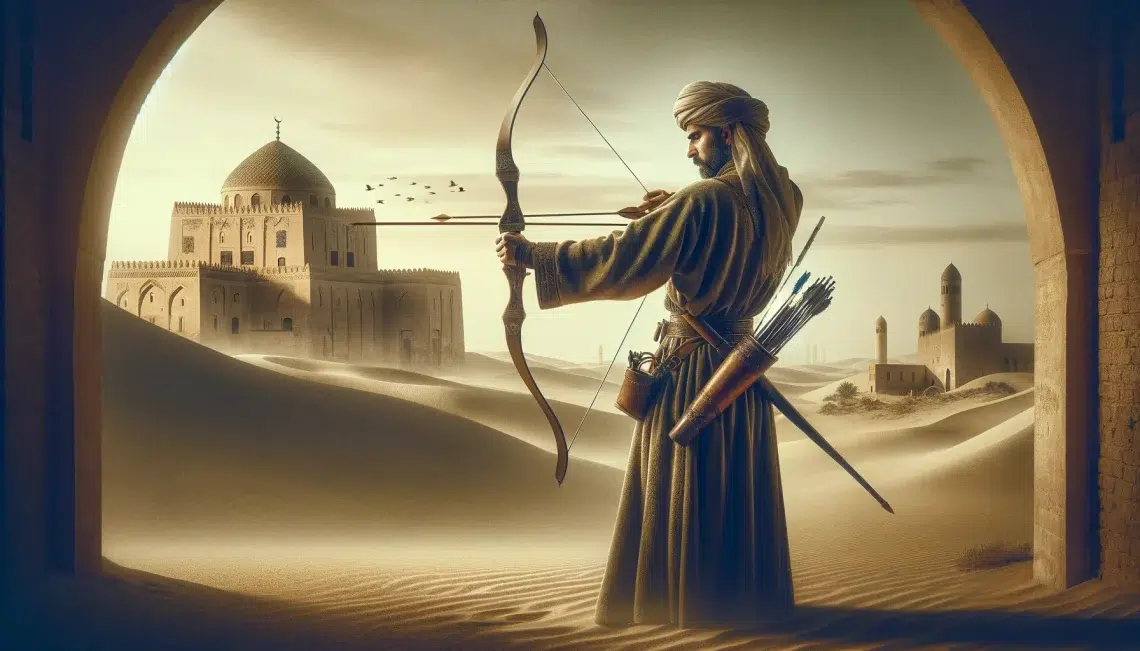
Arab Archery, formally known as “Kitab fi ‘ilm al-ramy” (Book on the Science of Archery), is a comprehensive manual on archery that offers a deep insight into the techniques, equipment, and philosophy of archery as practiced in the medieval Islamic world.
Scholars often attribute this treatise to Hussain bin ‘Abd al-Rahman, who wrote it in the 14th or 15th century, though they still debate the exact date and authorship.
Considered one of the most detailed and significant historical documents on archery from the Arab world, the manuscript reflects the martial prowess and cultural significance of archery in Islamic society at the time.
Historical Context
Archery has been a crucial martial skill and a revered sport throughout human history, with its importance echoed in the Islamic world through religious, military, and recreational contexts.
Reports say the Prophet Muhammad advised, “Teach your children swimming, archery, and horseback riding.”
Following this encouragement, archery flourished in the Islamic world, leading to the writing of manuals like Arab Archery to preserve and transmit the knowledge and skills of this esteemed practice.
Content and Contributions
Arab Archery details various aspects of archery, including the types of bows and arrows, the making and maintenance of archery equipment, shooting techniques, and the mental and physical discipline required for mastering archery.
The manual also delves into the tactical use of archery in military contexts, offering strategies for combat and discussions on the ethics of warfare.
The work is significant not only for its technical content but also for its philosophical insights into the practice of archery, emphasizing qualities such as patience, concentration, and perseverance.
It provides a holistic view of archery, combining the practical and spiritual aspects of the discipline.
Legacy and Influence
The legacy of Arab Archery extends beyond its historical period, contributing valuable knowledge to the global understanding of traditional archery practices.
Its detailed descriptions of techniques and equipment have been of interest to historians, cultural scholars, and archery enthusiasts, offering a window into the past and influencing contemporary practices in traditional archery.
The manuscript has been translated into various languages, making it accessible to a broader audience interested in the history of archery, military history, and Islamic culture.
Through these translations, Arab Archery continues to be a key resource for understanding the rich tradition of archery in the Islamic world and its lasting impact on the art and science of archery globally.
#1 Efficient Arrow Handling for Arab Archery
Efficient arrow handling is a critical aspect of archery.
The “Kitab fi ‘ilm al-ramy” (Book on the Science of Archery) likely includes detailed discussions on how to handle, prepare, and utilize arrows effectively.
Thus reflecting the comprehensive approach to archery in the medieval Islamic world.
Here’s an expansion on efficient arrow handling as it might relate to the principles found in Arab Archery:
Selection and Preparation of Arrows
Efficient arrow handling begins with the selection and preparation of the arrows themselves.
Arab Archery emphasizes choosing arrows that are straight, well-balanced, and of appropriate length and weight for the bow in use.
This emphasis also covers the need to ensure proper fletching of the arrows. I
t also notes the suitability of their points for the intended purpose, be it target practice, hunting, or warfare.
Quiver Management
The quiver plays a crucial role in efficient arrow handling.
It must be designed and worn in a manner that allows for easy access to arrows while minimizing the chance of damage.
The arrangement of arrows within the quiver is also important.
The tips and fletchings are properly aligned to prevent entanglement and to facilitate quick and smooth withdrawal.
Nocking the Arrow
The process of nocking the arrow, or placing it on the bowstring, is a fundamental skill that must be performed quickly and accurately.
Arab Archery would likely detail techniques for gripping the arrow in such a way that it can be swiftly positioned on the string.
This would be with minimal movement and without the need to divert one’s gaze from the target.
This might involve specific finger positions or methods of manipulating the arrow and bow simultaneously.
Drawing and Aiming
Once the arrow is nocked, the archer must draw and aim with efficiency and control.
Arab Archery would stress the importance of a smooth, continuous motion from nocking to full draw.
Thus maintaining proper form to ensure both speed and accuracy.
This includes aligning the body correctly, using the back muscles to draw the bow, and achieving a consistent anchor point to stabilize the aim.
Releasing and Transitioning
The release of the arrow is the culmination of the archer’s efforts, and it must be executed with precision.
Arab Archery would advocate for a release technique that is both swift and controlled, minimizing the disruption to the arrow’s flight.
Following the release, the archer should be able to quickly transition back to retrieving the next arrow from the quiver.
This maintains a rhythm that allows for a rapid rate of fire while still focusing on accuracy and effectiveness.
Training and Practice
Efficient arrow handling is a skill honed through consistent practice.
Arab Archery would likely include exercises designed to improve the speed and fluidity of arrow handling, such as drills that simulate various combat or hunting scenarios.
These exercises would not only focus on the physical actions but also on the mental preparation. Thus ensuring that the archer can maintain focus and efficiency under pressure.
Mastery of these elements enables the archer to shoot quickly and accurately, embodying the skill and artistry that were highly esteemed in the medieval Islamic world.
#2 Quick Drawing and Releasing Techniques
Quick drawing and releasing are essential techniques in speed shooting for archery.
This is where the ability to shoot rapidly without compromising accuracy is paramount.
These skills require a harmonious blend of physical coordination, muscle memory, and practice to execute efficiently.
Quick Drawing Techniques
The process of quickly drawing the bow starts with the proper stance and grip.
Archers must ensure their body is aligned with the target, with feet shoulder-width apart for stability.
The grip on the bow should be firm yet relaxed to prevent tension from affecting the draw.
One key to quick drawing is the use of back muscles rather than just the arms.
This technique allows for a smoother, more powerful draw, reducing strain on the arm muscles and increasing draw speed.
Engaging the back muscles requires practice, as it involves pulling the shoulder blades together as the bow is drawn.
To enhance speed, archers often practice the “snap draw” technique, which involves quickly raising the bow and drawing in one fluid motion.
This method eliminates any pause between aiming the bow at the target and drawing the string, significantly reducing the time to shoot.
Quick Releasing Techniques
The release phase is critical in ensuring the arrow’s flight is true and fast.
A quick release is achieved through a combination of finger positioning, tension control, and practice.
The fingers should lightly touch the string, allowing for a swift, smooth release that does not alter the arrow’s path.
Consistency in the release point is crucial for accuracy.
Archers develop muscle memory for their release by practicing thousands of shots, ensuring that each release is identical.
This consistency helps in minimizing the time spent aiming after drawing, as the archer can rely on their training to ensure accuracy.
Using a mechanical release aid can also facilitate quicker releasing.
For compound bow users, release aids can improve the speed and consistency of releases.
This allows for a trigger-pull action rather than relying on finger release.
The choice of release aid should be based on comfort, reliability, and the ability to execute a fast release without disturbing the arrow.
Training for Quick Drawing and Releasing
To master these techniques, archers incorporate specific drills into their training regimen.
Drills may include timed shooting sessions, where archers aim to release a set number of arrows accurately within a limited time frame.
Another effective practice is blind bale shooting, focusing solely on the drawing and releasing movements without aiming at a target.
This exercise helps in developing muscle memory for quick drawing and releasing.
Ultimately, the combination of proper technique, consistent practice, and mental preparation enables archers to excel in quick drawing and releasing for speed shooting.
This skill set not only improves their performance in competitive settings but also enhances their overall archery prowess.
#3 Stance and Posture for Rapid Shooting
Stance and posture play a pivotal role in rapid shooting within archery, forming the foundation upon which speed and accuracy are built.
A well-executed stance not only facilitates quicker movements but also ensures stability and precision throughout the shooting process.
For archers aiming to enhance their rapid shooting capabilities, mastering the nuances of stance and posture is essential.
Optimal Stance for Speed
The optimal stance for rapid shooting is one that balances stability with mobility.
Archers typically adopt a square or slightly open stance, with feet shoulder-width apart and parallel to the shooting line, ensuring a stable base.
This position allows for quick pivoting and movement, crucial for engaging multiple targets rapidly or adjusting positioning without losing balance.
Weight distribution is another critical aspect.
By evenly distributing weight on both feet and maintaining a slight knee bend, archers can achieve a dynamic balance that supports quick movements and adjustments.
This flexibility is vital for maintaining speed without sacrificing the stability required for accurate shooting.
Posture and Alignment
A correct posture involves aligning the body in a way that promotes efficient energy transfer.
It also helps with control during the draw and release phases.
Archers should keep their back straight and shoulders level.
Avoid arching the back or shrugging the shoulders, which can lead to tension and hinder rapid shooting.
Turn the torso perpendicular to the target and the head towards it to allow a natural alignment of the eyes, bow, and target.
This alignment plays a crucial role in maintaining focus and ensures the execution of the draw, aim, and release swiftly and smoothly.
Upper Body Positioning
The position of the arms and shoulders significantly impacts the speed of drawing and releasing.
Extend the bow arm fully but do not lock it, keeping it in a natural, relaxed position for quick movement.
Position the drawing arm’s elbow high to enable a rapid, smooth draw using the back muscles instead of just the arm strength.
Incorporating Movement into Practice
Rapid shooting often requires the ability to shoot accurately from different positions and under varying conditions.
Practicing shooting while stepping into the stance or after a quick pivot can help archers develop the agility and responsiveness needed for rapid shooting.
These drills encourage the development of muscle memory for maintaining proper stance and posture even when moving quickly or adjusting position.
Continuous Improvement
Archers dedicated to improving their rapid shooting skills should continuously evaluate and refine their stance and posture.
Recording practice sessions and seeking feedback from coaches or experienced archers can provide valuable insights into areas for improvement.
Adjustments, even minor ones, can lead to significant gains in speed, stability, and accuracy.
#4 Breath Control and Focus for Speed Shooting in Archery

Breath control and focus are critical elements in the realm of speed shooting in archery.
Serving as the bridge between the physical and mental aspects of the sport.
Mastering these skills can significantly enhance an archer’s ability to shoot rapidly and accurately under pressure.
Breath Control
Breath control is essential for maintaining composure and steadiness during shooting.
Proper breathing techniques help in stabilizing the body, calming the mind, and ensuring a consistent shooting rhythm. These are all of which are vital for speed shooting.
Here’s how to integrate breath control into rapid shooting:
- Pre-Shot Breathing: Before drawing the bow, take a few deep breaths to oxygenate the body and calm the nerves. This preparatory step helps in reducing tension and focusing the mind on the task ahead.
- Breathing During the Draw: Inhale slowly and deeply as you begin to draw the bow. This action helps in maintaining balance and provides the necessary stability for a controlled draw.
- Breath Holding at Full Draw: Holding your breath at full draw for a brief moment can aid in stabilizing the shot. However, this hold should be short to prevent muscle fatigue or tremors that can affect aim and release.
- Exhaling on Release: Exhale gently upon releasing the arrow. This practice aids in relaxing the body and reinforces the rhythm of shooting. This is crucial for speed shooting where consistency and rhythm are key.
Focus
Maintaining focus during speed shooting is challenging but critical for achieving accuracy at high speeds.
Focus involves both concentration on the present shot and the mental discipline to quickly move from one shot to the next.
Here’s how archers can sharpen their focus for speed shooting:
- Visualization: Before the shooting sequence begins, visualize the entire process from drawing to release, including the arrow hitting the target. This mental rehearsal primes the mind for performance and enhances focus on the steps required for successful shots.
- Single-Shot Concentration: Treat each shot as a separate event, focusing entirely on the present without letting past shots or future concerns intrude. This concentrated attention ensures that each action, from nocking to release, is performed with precision and intention.
- Rapid Reset: Develop the ability to quickly reset focus after each shot, preparing mentally for the next arrow. This rapid reset is crucial for speed shooting, where time between shots is minimal. Practice transitioning smoothly and swiftly from one shot to the next, maintaining a steady flow of concentration.
- Mindfulness and Mental Training: Engage in mindfulness exercises and mental training to enhance your ability to stay focused under pressure. Techniques such as meditation can improve mental clarity, resilience, and the capacity to remain focused on the task at hand, despite external pressures or internal distractions.
Integration into Training
Incorporating breath control and focus into regular training routines is essential for their effective application during speed shooting.
Archers can practice specific breathing patterns and focus drills alongside their technical shooting practice.
Thus ensuring these mental and physical techniques become second nature.
Simulating competition conditions in practice sessions can help archers refine their ability to maintain breath control and focus.
Timeless Nature of Arab Archery
As we reflect on Arab Archery, we are reminded of the timeless nature of archery as both an art form and a means of combat.
The principles and techniques detailed in this ancient manuscript continue to resonate with modern practitioners.
This offers lessons that extend beyond the archery field into the realms of personal development and cultural understanding.
Arab Archery, therefore, stands not merely as a historical document but as a bridge connecting past and present.
Inviting archers and scholars alike to explore the depths of archery’s heritage.
Its legacy continues to inspire and inform. Underscoring the enduring relevance of archery in fostering discipline, focus, and a profound connection with the traditions of yesteryear.