Precision on a Small Scale: The Mini Crossbow
![]() Introduction to the Miniature Marvels: Mini Crossbow
Introduction to the Miniature Marvels: Mini Crossbow
A mini crossbow is an intricate device mirroring their full-sized counterparts in design and function.
These diminutive versions pack a surprising punch and can demonstrate both the charm of miniature craftsmanship and the excitement of target shooting. Rising in popularity, they capture the attention of hobbyists and collectors alike.
Not only do they serve as a practice tool for precision and hand-eye coordination, mini crossbows also represent a unique blend of art and engineering, often being used in recreational competitions and for educational purposes.
They’re a testament to the fact that great things sometimes come in small packages.
A Brief History of the Crossbow and Its Miniature Counterpart
The crossbow, with origins dating back to ancient China around 600 BC, was a pivotal innovation in military technology, allowing a projectile to be fired with greater force and accuracy than traditional bows.
Its mechanism—combining a bow-like assembly mounted on a stock—was operated by an easy-to-use trigger, revolutionizing warfare and hunting.
In medieval Europe, the crossbow leveled the playing field between armored knights and common foot soldiers.
Its impact led to the development of countermeasures, such as improved armor and military tactics.
With time, the crossbow evolved, and enthusiasts miniaturized this lethal weapon for leisure purposes.
Mini crossbows, resembling their full-sized ancestors, emerged as novelties, gaining popularity as precision hobby tools rather than tools of war.
They capture the sophisticated engineering of their predecessors in a compact, modern design.
The Mechanics Behind the Mini Crossbow
Mini crossbows function similarly to their full-sized counterparts, using the basic principles of tension and projectile motion.
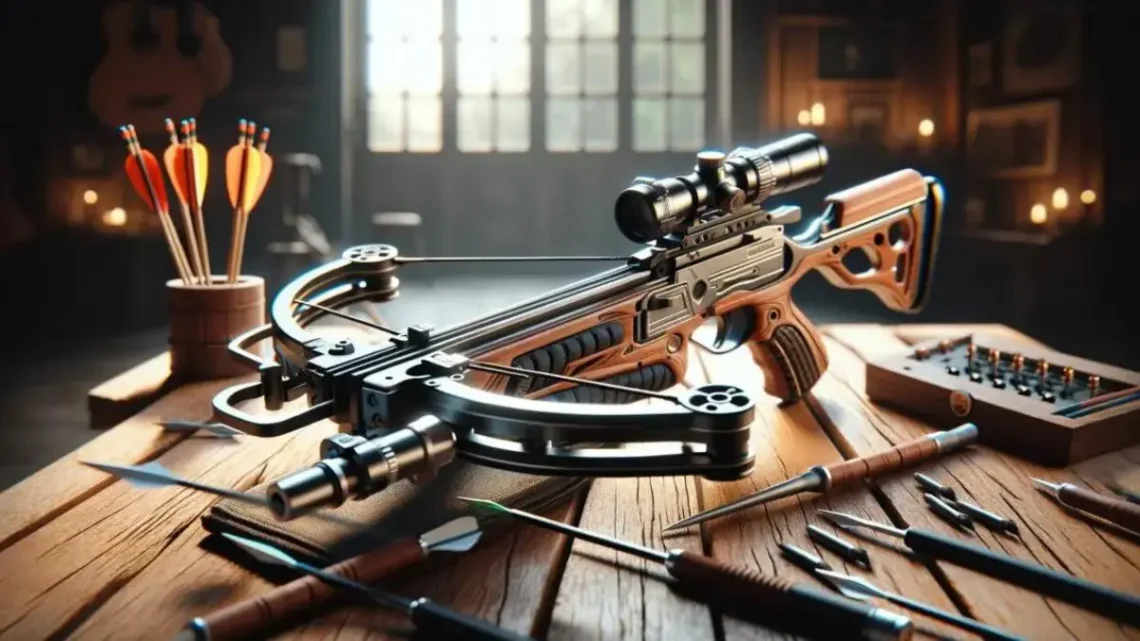
They consist of a:
- Frame: Serves as the structure, holding the bow and mechanisms in place.
- Bowstring: When pulled back, it stores elastic potential energy.
- Limb or Prod: A flexible piece that bends as the string is drawn.
- Trigger mechanism: Holds the string in the cocked position and releases it on command.
- Bolt or projectile: The ammunition, smaller in scale, designed to be shot with precision.
The user pulls back the bowstring, locks it in place with the trigger mechanism, and upon pulling the trigger, the tension releases, converting potential energy into the kinetic energy that propels the bolt forward.
Exploring the Materials and Craftsmanship in Mini Crossbow Construction
Crafting a mini crossbow demands precision and a meticulous selection of materials.
Skilled artisans often choose:
- Durable metals like steel or brass for the body, providing longevity.
- Composite materials or dense woods for the stock, to balance weight and strength.
- Toughened string materials, such as synthetic fibers that offer elasticity and enduring tension.
These components are intricately assembled, sometimes with customized tools, to ensure a mini crossbow’s reliable functionality and pinpoint accuracy.
Artistry combines with function, often resulting in visually stunning pieces that showcase the expertise and dedication of their creators.
Mini Crossbows in Competitive Shooting and Recreation
Mini crossbows have found their niche within competitive shooting.
Enthusiasts appreciate the skill required to achieve precision with these scaled-down weapons.
Competitions often feature target shooting at various distances, challenging participants to showcase their steadiness and accuracy.
These events cater to all ages, promoting an inclusive atmosphere where expertise is celebrated.
On the recreational side, families and friends enjoy mini crossbow shooting as a backyard pastime.
It offers a different level of engagement compared to traditional sports, requiring concentration and fine motor skills.
The compact size of mini crossbows makes them ideal for indoor ranges as well, providing year-round entertainment regardless of weather conditions.
Their rise in popularity is a testament to the versatility and fun they offer in both competitive and casual settings.
The Art of Mini Crossbow Making and Collecting
Mini crossbow crafting is a precise art that demands attention to detail and a deep understanding of mechanics and craftsmanship. Enthusiasts dive into selecting the finest woods, metals, and other materials to create these intricate pieces.
The creation process involves:
- Meticulous planning and design
- Skilled woodworking and metalwork
- Assembly with precision components
Collectors prize these diminutive replicas for their historical significance and the skill required to produce them.
As decorative objects or as functional models, mini crossbows represent a merger of aesthetics and engineering, captivating both hobbyists and artisans alike.
Handling and Usage Guidelines for Mini Crossbows
Mini crossbows may be small, but they are not toys.
The following guidelines ensure safe handling and usage:
- Always point the crossbow in a safe direction, away from people or pets.
- Before loading, check that the crossbow path and the target area are clear.
- Use only the recommended projectiles for your specific mini crossbow model.
- Keep your fingers away from the crossbow’s string and firing path to prevent injury.
- Wear protective eyewear to protect against accidental ricochets or debris.
- Do not dry fire the crossbow; it can cause damage to the bow and be dangerous.
- Never leave a loaded crossbow unattended.
- Store the crossbow and bolts in a secure place, out of reach of children and irresponsible individuals.
- Familiarize yourself with local laws and regulations governing the use of mini crossbows.
Customization and Maintenance: Tips for Mini Crossbow Enthusiasts
Mini crossbow enthusiasts can enhance their experience through customization and vigilant maintenance.
Here are some tips:
- Choice of Bolts: Experiment with different bolt weights and materials to find the perfect match for accuracy and distance.
- String Care: Regularly wax the string to minimize wear and maintain performance. Replace the string promptly if you notice fraying.
- Limb Inspection: Check the limbs for any signs of damage or warping, which can drastically affect accuracy.
- Trigger Mechanism: Keep the trigger mechanism clean and lubricated to ensure a smooth release.
- Custom Grips: Install custom grips that fit comfortably in your hand for better control and precision.
- Protective Storage: Store your mini crossbow in a protective case to shield it from dust and damage when not in use.
- Regular Cleaning: Clean the crossbow after usage to remove dirt and residues, preventing build-up that can affect performance.
Innovations and Technological Advancements in Mini Crossbow Design
Miniature crossbows have seen significant advancements in materials and mechanisms.
Modern mini crossbows often feature:
- High-strength materials: Carbon fiber and aerospace-grade aluminum enhance durability while reducing weight.
- Precision engineering: Computer-aided design (CAD) and computer numerical control (CNC) machining allow for exacting tolerances.
- Advanced propulsion: Magnetic or spring-loaded systems replace traditional bowstrings, leading to more consistent force application.
- Sighting technology: Laser sights and miniature scopes improve accuracy at longer distances.
- Safety features: Automatic safety catches and anti-dry fire mechanisms prevent accidental discharge.
- Ergonomic designs: Custom grip profiles and balance adjustments cater to user comfort and precision handling.
These innovations make modern mini crossbows highly capable in precision shooting.
The Role of Mini Crossbows in Education and STEM Learning
Mini crossbows are emerging as beneficial educational tools, particularly within STEM (Science, Technology, Engineering, and Mathematics) curricula.
Their intricate design and operation present students with a hands-on opportunity to explore physics concepts such as energy, force, and motion, as well as engineering principles related to building and mechanics.
Here’s how they contribute:
- Integration in Physics: When students calculate trajectory or determine the kinetic energy of a fired bolt, they apply mathematical equations to real-world scenarios.
- Engineering Challenges: Designing and assembling mini crossbows can enhance problem-solving skills and introduce students to basic engineering processes.
- Technological Exploration: They can be employed to discuss advances in materials science, such as the use of composites in construction.
- Promotion of Fine Motor Skills: As students construct and use mini crossbows, they develop precision and coordination, which are important in many STEM careers.
The Growing Community of Mini Crossbow Users
Mini crossbows, once a niche hobby for enthusiasts, are now capturing the attention of a diverse audience.
Initially, these precision tools were crafted and used by hobbyists, often for the sheer pleasure of building and mastery.
As their popularity increases, the community has expanded significantly.
- New Adopters: There is a surge in interest from people looking for unique collectibles, sports equipment, or engaging in competitive shooting events.
- Online Forums and Clubs: Enthusiastic users are forming online communities and local clubs, sharing techniques, designs, and challenging each other with new targets.
- Professional Interest: Even professionals, such as engineers and educators, are finding value in mini crossbows — from studying their mechanics to using them as teaching aids in physics and engineering principles.
This expanding community is contributing to the innovation and refinement of mini crossbow design and usage, steadily pushing the boundaries of what is possible on this small scale.
The Future of Mini Crossbows
The mini crossbow market is ripe for innovative trends.
Potential developments may include:
- Integration of Smart Technology: Enhanced precision through digital scopes and rangefinders could revolutionize targeting.
- Materials Evolution: The adoption of advanced composite materials may reduce weight and improve durability without sacrificing performance.
- Customization: A growing trend in personalization could see mini crossbows with adjustable components for individual comfort and style preference.
- Compact Mechanisms: Engineers are working on more compact and efficient firing mechanisms to make mini crossbows even more portable.
- Sustainability Focus: Eco-friendly materials and production methods are likely to gain prominence as environmental concerns become more central to design choices.
These advancements could lead to a new era for mini crossbow enthusiasts, combining tradition with cutting-edge technology.
Conclusion: Why Mini Crossbows Capture Our Imagination
Mini crossbows fascinate us due to their blend of historical resonance and modern craftsmanship.
These diminutive replicas evoke images of ancient skirmishes and stealth missions, connecting us to a bygone era of warriors and spies.
They represent human ingenuity in miniaturization, turning a formidable weapon into a hand-held marvel of precision engineering.
The fun and challenge of mastering its use in small-scale target practice also stoke the fires of our competitive spirits.
Moreover, they appeal to collectors and hobbyists alike, offering a unique and attractive item to display or use, fulfilling both aesthetic and functional desires.