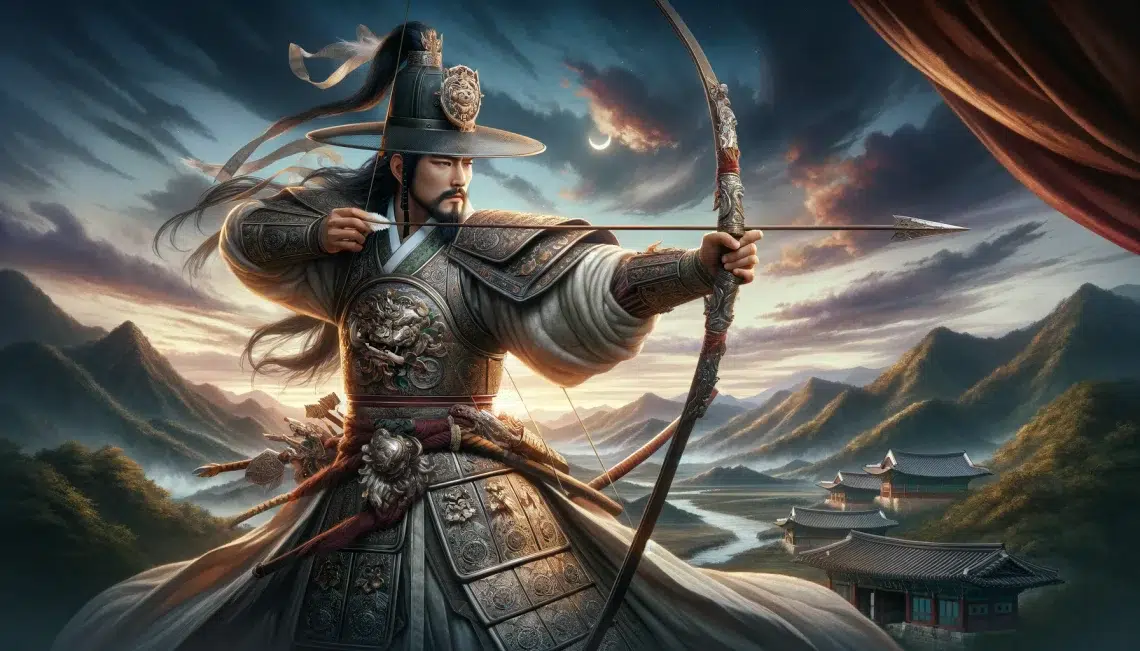
Jumong: Archer King of Goguryeo Kingdom
The Mythological Origins of Jumong
Jumong is the central figure in one of the most legendary tales in Korean history.
Known as the Holy King of the East, he played a pivotal role in the establishment of the Goguryeo kingdom, the largest dynasty in Korean history.
According to mythological tales, Jumong’s origins are rooted in the heavens.
His father, Hae Mosu, was a divine being sent from above.
During his time on Earth, Hae Mosu fell in love with Yuhwa, who would become Jumong’s mother.
Their union would bring forth the birth of Jumong, a remarkable figure in Korean history.
The story of Jumong’s birth is filled with intrigue and captivating events.
Yuhwa attempted to trap Hae Mosu but was unsuccessful. In a twist of fate, she laid an egg from which Jumong emerged.
Thus sealing it with both his divine heritage and mortal birth.
This remarkable birth became a cornerstone of Jumong’s legend.
King Geumwa of Dongbuyeo took Jumong under his wing, recognizing the extraordinary talents the young prince possessed.
Jumong’s skills in archery is a testament to his divine lineage.
It set him apart from his half-brothers and would shape his path towards greatness.
| Mythological Origins of Jumong | |
|---|---|
| Jumong’s Father | Hae Mosu, a divine being from the heavens |
| Jumong’s Mother | Yuhwa, mortal woman who fell in love with Hae Mosu |
| Jumong’s Birth | Emergence from an egg laid by Yuhwa |
| Raised By | King Geumwa of Dongbuyeo |
| Exceptional Talent | Archery skills |
The blend of divine and mortal elements showcases the extraordinary nature of his character.
Jumong’s Journey to Unify the Gojoseon Territories
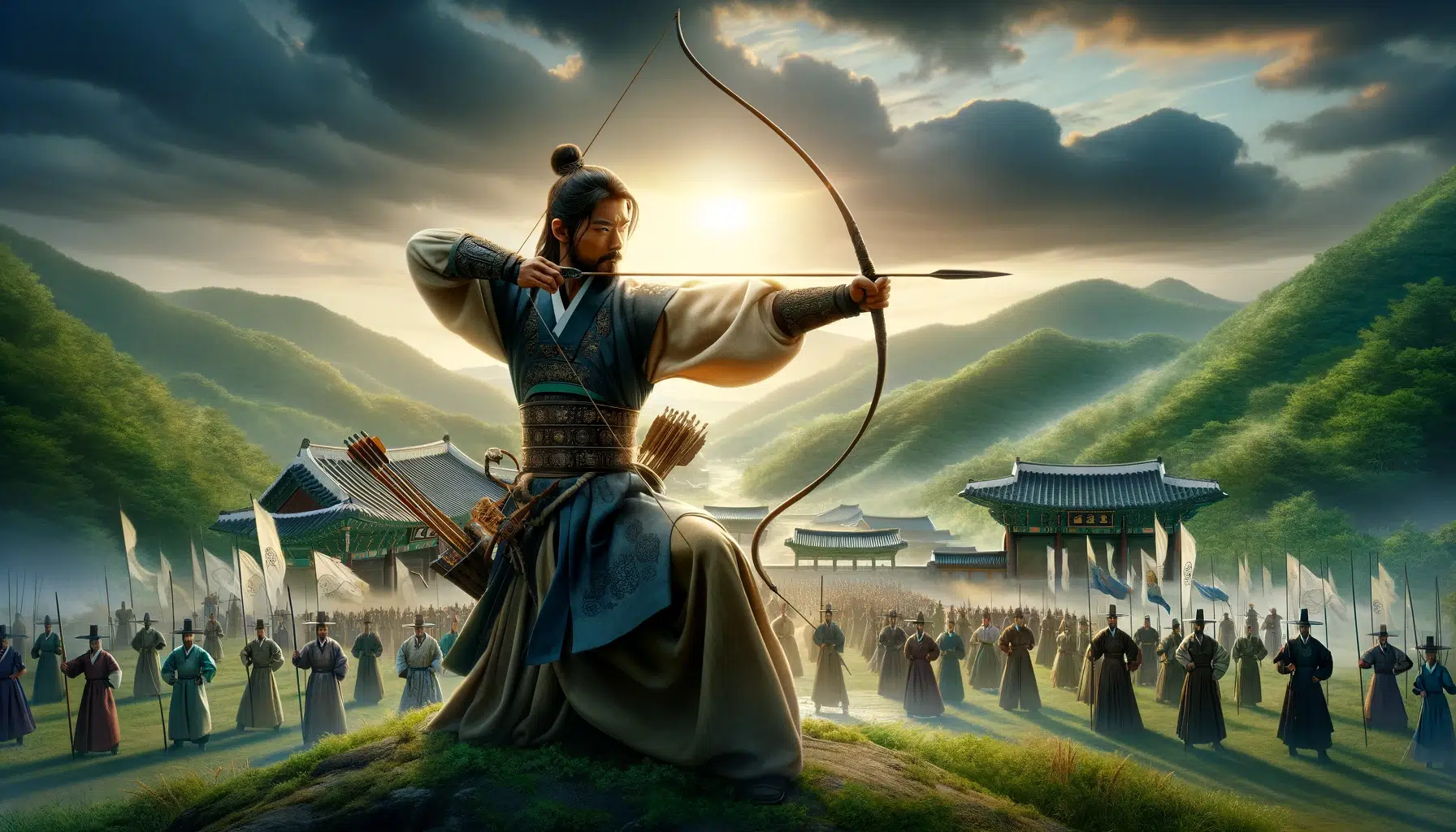
Jumong’s path to establishing the kingdom of Goguryeo was marked by challenges and adversity.
Constantly facing slander and hostility from his half-brothers in Dongbuyeo, Jumong heeded his mother’s advice.
He embarked on a journey to reunify the divided Gojoseon territories.
These territories had been carved up by the Han Chinese.
Thus creating a fragmented land filled with tension and conflict.
Jumong, armed with his exceptional archery talents, set out to unite the Gojoseon people and establish a strong and prosperous kingdom.
As Jumong journeyed, he encountered a pivotal moment.
While crossing a great river, creatures of the sea formed a majestic bridge, symbolizing his destiny and the support of the divine forces guiding him towards his goal.
This event solidified his conviction and propelled him forward with renewed determination.
Gathering a loyal following along the way, Jumong’s charisma and leadership qualities inspired others to join his cause.
In 37 BCE, he successfully established the kingdom of Goguryeo, marking the beginning of a new era in Korean history.
With Goguryeo’s establishment, Jumong’s ambitions expanded beyond the unification of Gojoseon.
He went on to conquer neighbouring kingdoms, steadily expanding the Goguryeo territory and solidifying its power in the region.
Through his visionary leadership, Jumong paved the way for Goguryeo’s growth and prominence.
Establishing a kingdom that would shape the course of Korean history for centuries to come.
Jumong’s Personal Life and Losses
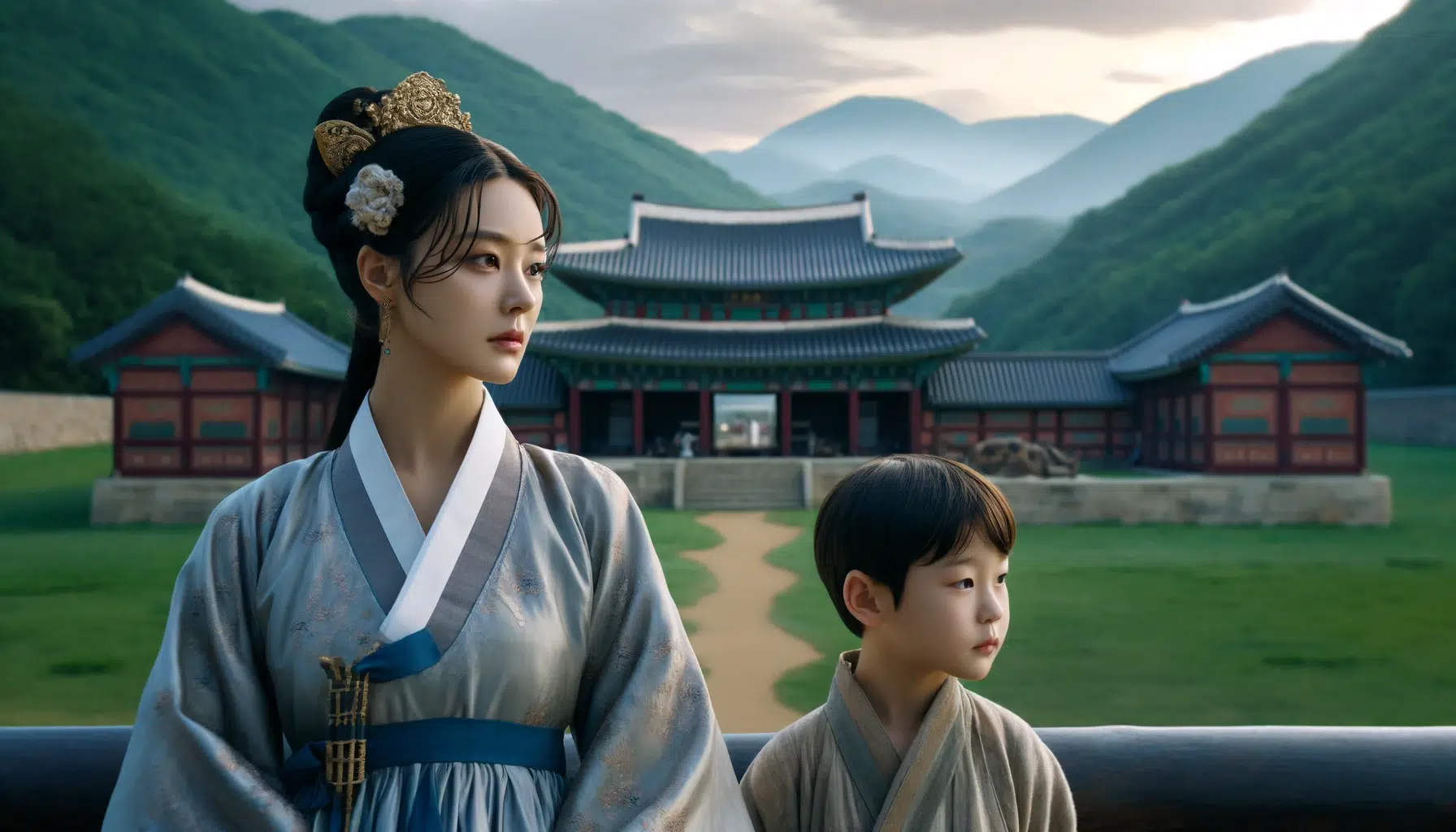
While Jumong was busy conquering new territories, his personal life experienced both joys and sorrows.
During his conquests, his first wife, Ye, and their son, Yuri, remained in Dongbuyeo, the kingdom they called home.
Tragically, Jumong’s mother fell ill and passed away during this time, leaving him devastated.
Upon learning of his mother’s death, Jumong sent for his first wife and son, who arrived five years later.
In an attempt to maintain stability within the kingdom, Ye ascended the throne as queen.
This turn of events caused tension in Jumong’s personal life.
His second wife, Soseono, became jealous and fled with her son.
Determined to establish her own kingdom, Soseono named her newly formed territory the Baekjae Kingdom.
Unfortunately, the trials and tribulations of his personal life took a toll on Jumong.
It is said that he died at the age of 40, leaving behind a legacy of conquests and a kingdom that would shape Korean history.
| Jumong’s Family | Relationship |
|---|---|
| Jumong | Founder of Goguryeo |
| Ye | First Wife and Queen |
| Yuri | Son (with Ye) |
| Soseono | Second Wife |
| Son (name not known) | Son (with Soseono) |
Note: The identity of Jumong’s second wife and her son remains unknown, as historical records do not provide specific names.
Historical and Cultural Controversies
Jumong’s legacy has had a significant historical and cultural impact, yet it is not without controversies.
Chinese researchers claim that Goguryeo history belongs to China, not Korea. And that Jumong was a regular monarch rather than the son of heaven.
These claims have sparked confrontations between scholars from both countries.
Chinese assertions regarding Goguryeo history challenge the established Korean narrative of Jumong’s status as a legendary figure.
However, Korean historians and scholars have vigorously defended their perspective.
They assert the historical authenticity of Jumong’s divine lineage and his role in founding Goguryeo.
Historical foundations and research institutions have been established in Korea to counter the Chinese claims and provide evidence supporting the Korean version of the Goguryeo origin.
These institutions focus on academic research, archaeological findings, and ancient texts to strengthen the historical validity of Jumong’s legacy.
Interestingly, the impact of Jumong extends beyond the Korean peninsula.
Shinto shrines in Japan dedicated to Goguryeo kings, including Jumong, have been meticulously maintained by Japanese-Koreans.
These shrines serve as a testament to the historical and ancestral connection between the two nations.
Thus preserving the cultural heritage of Goguryeo and Jumong in Japan.
A Comparison of Historical Perspectives
| Chinese Claims | Korean Perspective |
|---|---|
| Asserts Goguryeo as part of Chinese history | Considers Goguryeo as a distinct Korean kingdom |
| Downplays Jumong’s status as a mythical figure | Emphasizes Jumong’s divine lineage and leadership |
| Challenges the historical significance of Goguryeo | Highlights Goguryeo’s role in shaping Korean dynasties |
The divergent views regarding Jumong and Goguryeo history reflect the complex and nuanced nature of historical interpretation.
Jumong: The South Korean TV Drama
In 2006, MBC aired a South Korean TV drama based on the legend of Jumong.
Titled “Jumong,” the historical drama gained significant popularity among viewers.
The TV series focused on Jumong’s pivotal role in resisting the Han Chinese and unifying the Gojoseon people under the Goguryeo empire.
Through compelling storytelling and captivating performances, the drama brought Jumong’s journey to life, showcasing his struggles, triumphs, and the establishment of Goguryeo.
“Jumong” offered a unique perspective on Jumong’s history, presenting him as a fully human character rather than a divine figure.
The drama eliminated some of the mythological elements surrounding Jumong’s origins, honing in on his leadership, bravery, and strategic prowess.
It delved into the historical context of Goguryeo’s resistance against the Han Chinese invasion, highlighting the kingdom’s cultural heritage and the fierce determination of its people.
Directed by Lee Joo-hwan and Kim Geun-hong, “Jumong” featured a talented cast that included actors such as Song Il-gook, Han Hye-jin, Kim Seung-soo, and Jeong Jin-yeong.
The performances breathed life into the characters, allowing the audience to connect deeply with the emotional core of the story and the struggles faced by Jumong and his allies.
The TV drama attracted a wide range of viewers, not only in South Korea but also internationally.
Its success demonstrated the global appeal of South Korean television shows and highlighted the growing interest in historical dramas.
“Jumong” served as a platform for cultural exchange, sharing the rich history of Goguryeo and its significant impact on Korean identity.
Through its engaging storytelling, “Jumong” deepened the audience’s understanding of Goguryeo’s resistance to the Han Chinese and shed light on the historical and cultural importance of this legendary kingdom.
The TV series became a testament to the enduring power of historical dramas in shaping our collective appreciation of the past.
Goguryeo’s Expansion and International Impact

Goguryeo, the largest dynasty in Korean history, experienced significant expansion throughout its existence, amplifying its influence on neighboring regions.
The kingdom extended its territory beyond the Korean Peninsula, incorporating parts of China, Manchuria, Mongolia, and even Russia.
This expansion solidified Goguryeo’s position as a dominant regional power, shaping the history and culture of East Asia.
One notable aspect of Goguryeo’s international impact is its influence on Japan.
When Goguryeo fell to the Silla-Tang alliance, many Goguryeo refugees sought refuge in Japan.
These refugees played a pivotal role in preserving and propagating Goguryeo’s cultural heritage in their new homeland.
As a testament to their allegiance, Japanese-Koreans established Shinto shrines dedicated to Goguryeo kings, including the legendary Jumong.
These shrines serve as a reminder of Goguryeo’s enduring legacy and the enduring connection between the two nations.
A Symbol of Korean History and Identity
Jumong has emerged as a symbol of immense significance in Korean history and cultural identity.
His remarkable tale of bravery, exceptional archery skills, and the establishment of a powerful kingdom resonates deeply with Koreans, igniting a sense of national pride.
Jumong’s legend serves as a vivid portrayal of the rich history and heritage of Korea.
Thus showcasing a heroic figure who overcame insurmountable challenges and laid the foundation for a dynasty that would shape the destiny of the country.
The story of Jumong encompasses the essence of Korea’s cultural identity, emphasizing core values such as courage, resilience, and determination.
His unwavering spirit in the face of adversity is a testament to the indomitable Korean spirit, inspiring generations to embrace their heritage with pride and reverence.
Highlights of significance of Jumong’s character and his contributions to Korean history:
- The founding of a powerful kingdom: Jumong’s establishment of the Goguryeo kingdom marked a turning point in Korean history. Through diplomacy, conquest, and strategic alliances, he expanded the kingdom’s territory, leaving an indelible mark on the nation’s landscape.
- Symbolism of archery skills: Jumong’s exceptional expertise in archery represents his ability to overcome challenges and achieve greatness. The bow and arrow, iconic symbols of Korean history, epitomize precision, focus, and determination.
- The embodiment of heroism: Jumong’s heroic persona embodies the spirit of leadership, sacrifice, and dedication to the greater good. His unwavering commitment to his people and the pursuit of justice serves as an inspiration for individuals striving to make a positive impact.
Jumong: A Popular Asian Historical Drama
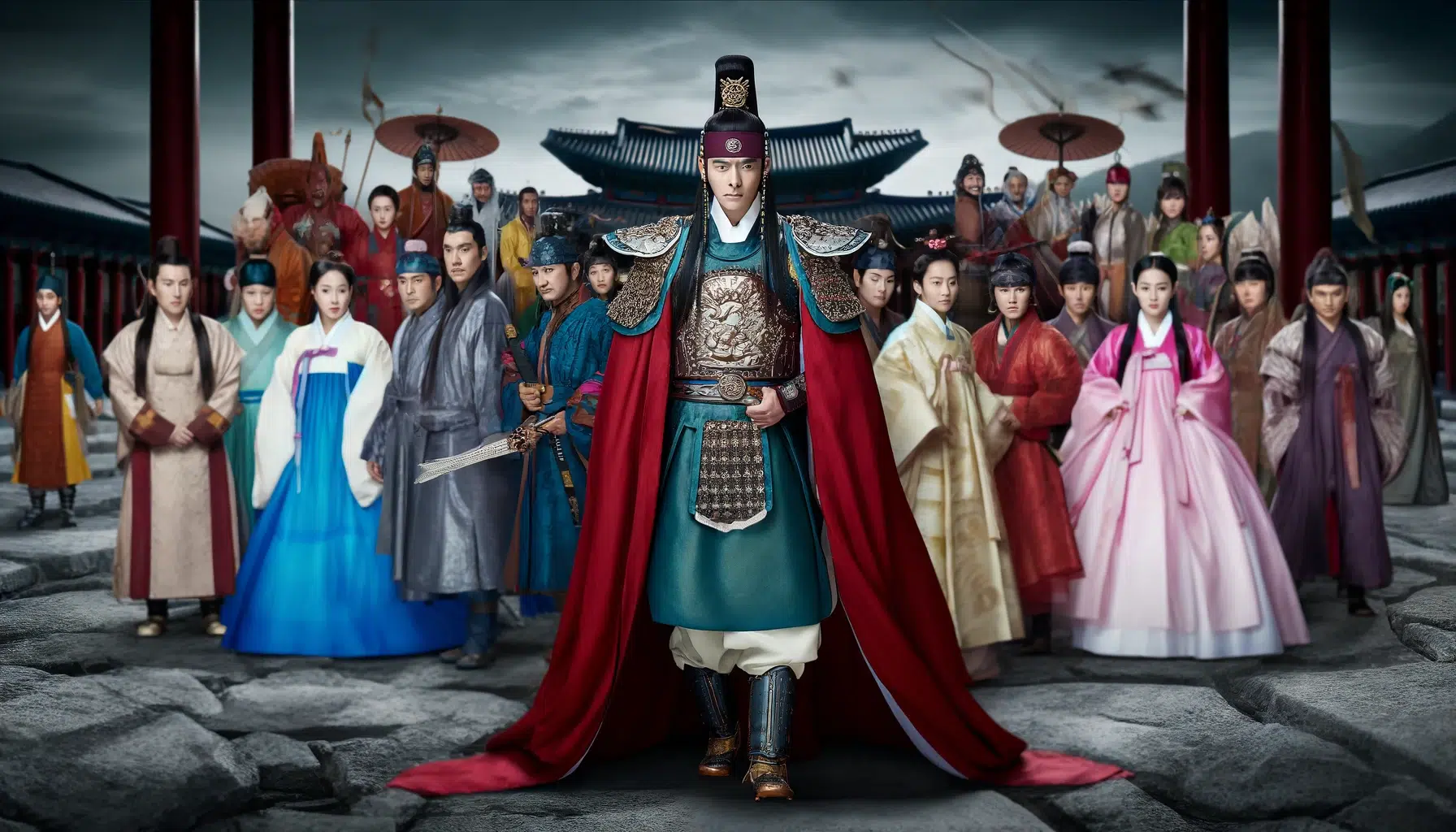
The Jumong TV drama has transcended borders, captivating audiences far beyond South Korea.
With its gripping storyline and compelling characters, Jumong has gained immense popularity, particularly among fans of Asian historical dramas.
This international success is a testament to the universal appeal of captivating storytelling and the power of cultural exchange through the medium of television.
Asian historical dramas have a unique ability to transport viewers to different times and places, immersing them in captivating narratives that showcase the rich history and cultural heritage of the region.
Jumong, with its portrayal of the founding of the Goguryeo kingdom, offers a window into ancient Korean history and the epic journey of its legendary hero.
This popular TV drama has drawn audiences from various countries, fostering a global appreciation for Asian historical dramas and promoting cultural exchange.
The international audience’s enthusiasm for Jumong demonstrates the universal fascination with stories that explore different cultures and historical periods.
Table: International Reception of Jumong
| Country | Notes |
|---|---|
| China | The series gained a significant following in China, contributing to the rising popularity of Korean dramas in the country. |
| Japan | Jumong resonated with Japanese viewers, leading to increased interest in Korean history and culture. |
| Thailand | The drama was well-received in Thailand and played a pivotal role in promoting cultural exchange between South Korea and Thailand. |
| Vietnam | Jumong was widely watched in Vietnam, sparking a renewed interest in Korean historical dramas among Vietnamese audiences. |
A Journey of Bravery and Archery
Jumong’s story is a captivating journey of bravery, archery skills, heroism, and leadership.
His determination and strategic prowess allowed him to overcome obstacles and establish a powerful kingdom that would shape Korean history.
Jumong’s legacy as the founding king of Goguryeo continues to inspire and captivate audiences, both domestically and internationally.
Jumong’s journey was filled with situations that demanded immense bravery.
From facing challenges posed by his half-brothers to leading his followers across treacherous terrains, Jumong exemplified courage in the face of adversity.
His exceptional archery skills were instrumental in his triumph over enemies and the establishment of the Goguryeo kingdom.
Heroism and Leadership of Jumong
Jumong’s heroism shone through as he tirelessly fought for the freedom and prosperity of his people.
His leadership qualities were evident in his ability to inspire and unite others under a common cause.
Jumong’s vision and strategic acumen guided Goguryeo to become one of the most influential dynasties in Korean history.
Legacy of Jumong
Jumong’s legacy as the founding king of Goguryeo is a testament to his enduring impact on Korean history.
Through his feats of bravery, archery prowess, heroism, and leadership, Jumong left a lasting imprint on the cultural identity and national pride of the Korean people.
His story continues to be celebrated and cherished, reflecting the indomitable spirit of a legendary figure who shaped the destiny of a nation.
Conclusion
The legend of Jumong and the founding of Goguryeo hold immense significance in Korean history and culture.
Jumong’s legacy as a legendary hero, archer, and king continues to resonate with audiences and showcase the rich heritage of Korea.
His tale of bravery, archery skills, and the establishment of a powerful kingdom has become a source of national pride.
The Jumong TV drama has played a crucial role in popularizing this historical figure and his story.
Through the dramatic retelling, Jumong’s journey to unify the Gojoseon territories and resist the Han Chinese has captivated a global audience.
The success of the Jumong TV drama highlights the universal appeal of Korean historical dramas and their ability to bridge cultural gaps.
Overall, Jumong’s story stands as a testament to the enduring power of legends and their ability to shape our understanding of the past.
The legacy of Jumong and the Goguryeo kingdom continue to inspire and educate people about Korean history and its cultural significance.
As the legend lives on, Jumong’s heroic feats and accomplishments continue to be celebrated in the realm of Korean historical drama and beyond.