
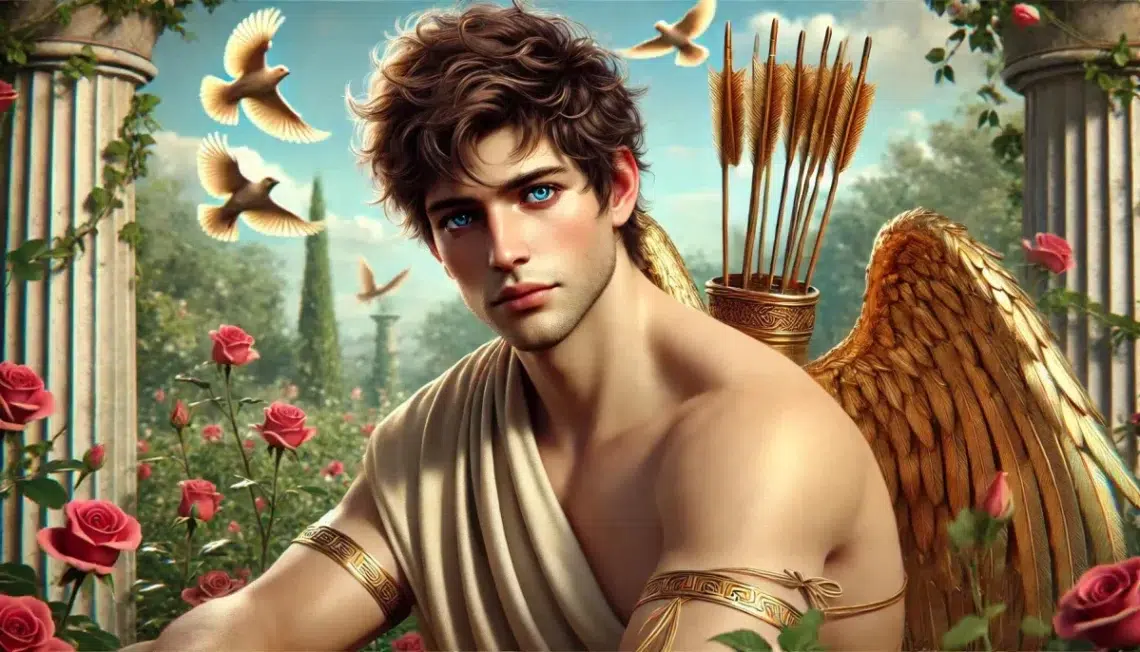
Eros Greek God of Love and Desire
Who was Eros in Greek mythology?
Eros was the god of love and desire, known for using his arrows to inspire passion among gods and mortals.
In early myths he appeared as a primordial force of attraction, while later traditions describe him as the son of Aphrodite and Ares.
His most famous story, the myth of Eros and Psyche, explores love, trials, and transformation.
What Is Eros the God Of?
Eros was the Greek god of:
-
Romantic love
-
Desire and attraction
-
Passion
-
Fertility
In later Roman mythology, he became known as Cupid.
Origins of Eros in Greek Mythology

Some myths say Eros is one of the oldest gods, born from Chaos.
Other stories say he is the son of Aphrodite, the goddess of love, and Ares, the god of war. This would mean Eros has several siblings. Ares and Aphrodite, two powerful gods in Greek mythology, have several children together.
- Eros (Cupid): The god of love and attraction. Eros inspires romantic love and desire, influencing both gods and mortals to fall in love.
- Phobos: The personification of fear and panic. Phobos often accompanies his father, Ares, into battle, spreading fear among warriors.
- Deimos: The personification of terror and dread. Like Phobos, Deimos also accompanies Ares on the battlefield, adding to the chaos and fear.
- Harmonia: The goddess of harmony and concord. Harmonia represents balance and unity, often seen as a force that reconciles opposing elements.
- Anteros: The god of mutual love and requited love. Anteros punishes those who scorn love and rewards those whose love is returned.
- Himeros: The god of unrequited love and longing. Himeros embodies the intense desire for love that is not returned.
Each of these children reflects different dimensions of love, fear, and harmony.
Characteristics of Eros
Eros is playful and often causes trouble with his arrows. He can make people fall in love suddenly and deeply. His arrows come in two types: gold-tipped, which inspire love, and lead-tipped, which cause indifference.
Eros is the Greek god of love and attraction. He creates feelings of love and desire among gods and mortals by shooting arrows to make people fall in love.
He helps Aphrodite in many myths making people fall in love as his mother wishes like in the story of Psyche. Eros falls in love with Psyche and faces many challenges to be with her.
He represents the power and unpredictability of love. He reminds us that love can strike at any time and change our lives. His playful and sometimes mischievous nature shows that love can be both joyful and challenging.
Eros is an important figure in Greek mythology, symbolizing the force of love that binds all beings.
Perspectives from Hesiod and Homer
Hesiod and Homer have different perspectives on Eros, the god of love.
Hesiod sees Eros as a primeval force. In Hesiod’s “Theogony,” Eros is one of the first gods to emerge from Chaos. He represents the power of love and creation in the universe. Hesiod views Eros as essential for life and growth.
In Greek mythology, Chaos is the primeval void from which everything originates. Chaos exists before the creation of the world and all the gods. It represents the formless, empty state of the universe before anything else comes into being. From Chaos, the first primordial gods emerge, including Gaia (Earth), Tartarus (the Abyss), and Eros (Love).
The concept of Chaos emphasizes the idea that the universe starts from a state of disorder and emptiness.
Homer’s perspective on Eros is less clear. Homer does not focus much on Eros in his epic poems.
Instead, Homer mentions Aphrodite more often when discussing love and attraction. However, when Homer does refer to Eros, he shows him as a playful and mischievous god. Eros influences the hearts of gods and mortals, causing them to fall in love.
His works, including “The Iliad” and “The Odyssey,” allude to Eros’ power to guide emotions and actions. They often illustrate the tumultuous and passionate consequences of his sway over human and divine relationships.
Both Hesiod and Homer recognize Eros’s influence, but they highlight different aspects. Hesiod emphasizes Eros’s role in creation and the cosmos. Homer, on the other hand, focuses on Eros’s playful and sometimes troublesome nature. Despite these differences, both poets agree that Eros holds great power. He can inspire love, desire, and even chaos.

Contrasting Representations in Greek Literature
Greek literature presents Eros as a dual figure, embodying both the tender aspect of love as well as its chaotic, destabilizing power.
On one hand, he is depicted as a primordial deity in Hesiod’s Theogony, a force of creation and binding.
- Creation: In the cosmic order, Eros is a connective force, bringing entities together, facilitating birth and life.
- Harmony: Eros is sometimes portrayed as harmonious, encouraging mutual attraction and unity among gods and mortals alike.
Conversely, in works like Plato’s Symposium, Eros can be volatile.
- Desire: Here, he personifies intense desire that can lead to turmoil and irrationality.
- Discord: In contrast to harmonious representations, Eros incites passions that disrupt order and reason.
Through such contrasting representations, Greek literature underscores the multifaceted nature of love.
The Myth of Eros and Psyche

The affair between Eros and Psyche stands as a quintessential narrative of love’s trials and ultimate triumph.
Their legend starts with Psyche, a mortal of remarkable beauty, provoking the envy of the goddess Aphrodite.
In a vengeful scheme, Aphrodite dispatches her son Eros to induce Psyche to fall in love with a monster. However, the twist of fate unfolds when he himself falls for Psyche, setting in motion a saga of love’s complexities.
He secretly becomes Psyche’s husband, visiting her only under the cover of night and forbidding her to gaze upon him.
Curiosity and outside influence lead Psyche to betray this trust, causing Eros to abandon her. Desolate, Psyche undergoes arduous tasks set by Aphrodite in hopes of winning back her divine lover.
Through perseverance and assistance from the gods, Psyche surmounts the challenges.
The couple’s fierce dedication and Psyche’s transformation into a deity symbolize that love’s true essence transcends the physical realm.
Their union receives Zeus’s blessing, demonstrating that even the will of gods may bend to the strength of love. Eros and Psyche’s bond endures as a testament to the daunting and transformative power of love within mythology.
Eros’ Symbols and Attributes

As an ancient symbol of love and desire, Eros often depicted with various attributes that signify his influence and character.
His iconography is rich and diverse:
- Bow and Arrows: These are his most famous attributes, representing the power to incite love and passion in gods and mortals.
- Wings: Wings denote the swift nature of love’s onset, as well as his ability to travel rapidly, spreading desire.
- Flaming Torch: Sometimes carried by Eros, it symbolizes the burning flame of passion that he can ignite within the heart.
- Blindfold: Occasionally, he is portrayed blindfolded to represent love’s blindness, the universal idea that affection does not discriminate.
- Dolphins, Roses, and Sparrows: They’re all sacred to Eros, symbolizing playfulness, beauty, and amorousness respectively.
Each symbol found in his iconography communicates aspects of the complexities and whims of love.
Influence on Greek Worship and Rituals
Eros, the fabled Greek god of love, significantly influenced ancient Greek worship and rituals.
His presence was emblematic of love’s pervasive role in human existence.
As such, he was revered through various practices:
- Festivals like the Erotidia celebrated his role in fertility and procreation.
- Couples offered votive gifts and tokens to invoke his’s favor in both starting and preserving relationships.
- Artistic depictions of Eros were common in household shrines, symbolizing a domestic plea for harmony and affection.
- Poets and orators called upon Eros in their works to exemplify the intensity of passion, often beseeching the deity’s influence for inspiration.
In essence, Eros personified a divine force shaping mortals’ lives, compelling public veneration and private devotion.
Eros and Cupid: What’s the Difference?

While Eros originated in Greek mythology, his influence stretched across cultures, leading to the emergence of Cupid as his Roman counterpart.
The Romans, renowned for integrating Hellenic deities into their own pantheon, embraced Eros’s essence but adapted his image.
Cupid, also known as Amor in Latin, retained the fundamental attributes of love and desire.
Significant similarities between Eros and Cupid include:
- Both are depicted with wings, signifying the fleeting and unpredictable nature of love.
- Each wields a bow and arrows, with which they strike the hearts of gods and mortals to instill love or desire.
- They play critical roles in numerous myths, orchestrating romantic connections that are both celebrated and lamented.
While Eros is often portrayed as a stunningly beautiful young man, Cupid is commonly presented as a mischievous child.
This visual distinction underscores a nuanced interpretation of love’s power in Roman culture – as playful and innocent rather than deeply passionate.
Nonetheless, the essence of their influence remains deeply interlinked, underscoring the universality of love in human storytelling.
Artistic Depictions Through the Ages
Visualizing Eros in Sculpture
Throughout history, he has inspired countless artists.
In ancient times, sculptures often depicted him as a mischievous child, the embodiment of impulsive love through delicate marble forms.
Renowned pieces like the statue of Eros sleeping highlighted vulnerability and playful innocence associated with the god.
Eros in Paintings
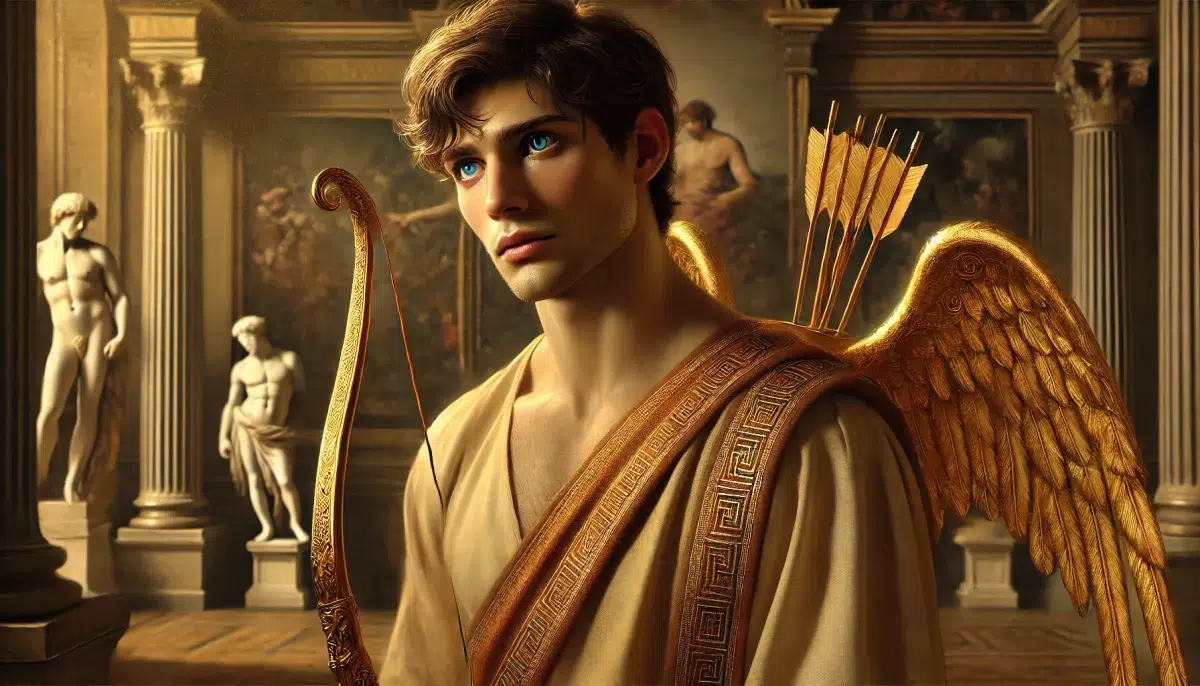
Renaissance artists embraced Eros anew, infusing works with allegorical meaning and sensual overtones.
Paintings from this era frequently showed him as a winged youth, an archetypal figure of desire and attraction, indicative of the period’s fascination with classical mythology.
Intricate portrayals by masters like Titian and Caravaggio emphasized his dual nature—innocent yet provocatively powerful.
How the Meaning of Eros Changed Over Time
In the tapestry of philosophical discourse, Eros has not remained a mere mythical figure.
From the classical musings of Plato the philosophical evolution of love and desire is as rich as it is complex. Plato portrays Eros as a path to the divine through the pursuit of beauty and virtue.
In the narratives of Sartre he depicts desire as fundamental to human identity.
It traces an intellectual journey through the Middle Ages.
Theologians such as Augustine grappled with love’s place in the moral cosmos, to the Enlightenment, where thinkers like Rousseau reimagined Eros within the bounds of reason and social contracts.
The conceptualization of Eros within philosophy reveals a multifaceted understanding transforming over time.
Thus continually influencing and reflecting societal norms and personal introspection.
From Ancient Myth to Modern Interpretations
The legacy of Eros, the Greek god of love, transcends centuries, permeating multiple dimensions of culture and thought.
Eros began as a primordial deity in Greek mythology, symbolizing the fundamental power of love and desire.
In ancient myths, he was capable of stirring both gods and mortals, wielding an influence that transcended the boundaries of the earth and Olympus.
As literature evolved, he became a popular figure in poetry and philosophy, embodying the concept of romantic and, sometimes, tragic love.
His capricious nature was shown as both inspiring and dangerous, evoking passion and chaos in the hearts of individuals.
In the realm of art, Eros inspired myriad depictions, from the classical sculptures of antiquity to the cherubic representations of the Renaissance, reflecting changing perceptions of love’s embodiment.
His iconography, characterized by the bow and arrows, still symbolizes Valentine’s Day, a modern festival of love.
Modern interpretations of Eros continue in films, books, and psychology—where his Roman counterpart, Cupid, often serves as shorthand for love’s complexities.
Whether as an inexorable force in myth or a metaphor for emotional connection, Eros’s legacy remains robust, emphasizing the enduring power and allure of love in human culture.