Medieval Powerhouse: English Longbow Draw Weight
![]() Introduction to the English Longbow: A Medieval Marvel
Introduction to the English Longbow: A Medieval Marvel
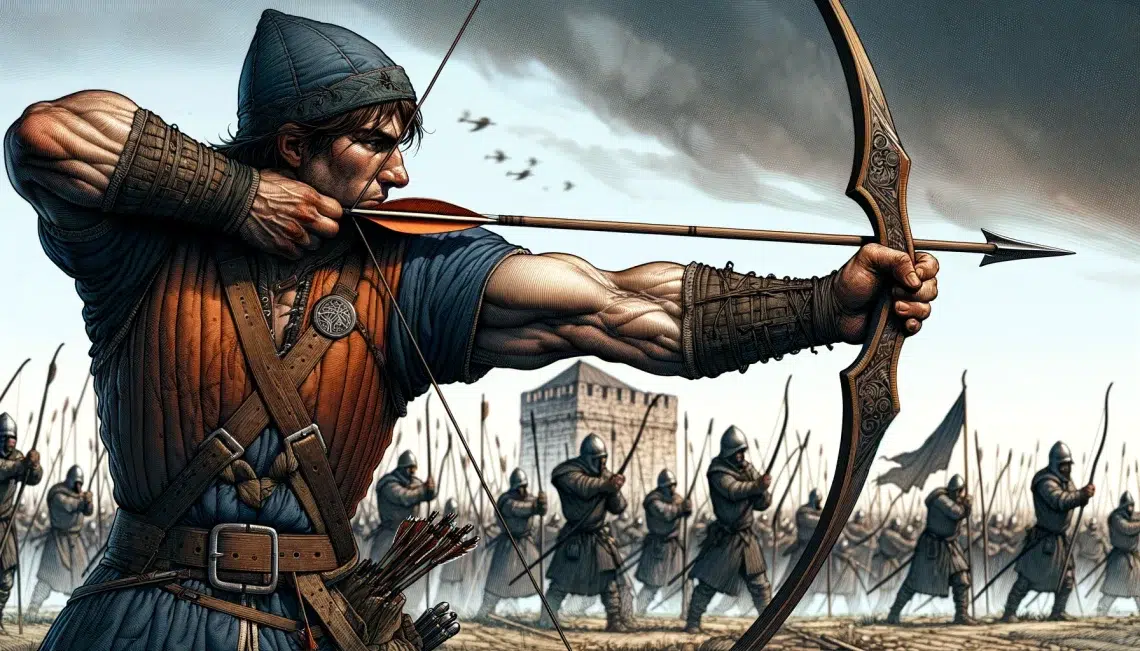
In medieval times, the English Longbow draw weight determined its power and range, making it a formidable weapon in warfare.
Crafted from yew wood, this tall, powerful bow measured up to six feet and demanded extraordinary skill and might from its wielder.
Designed for long-range combat, it boasted a significant draw weight—usually between 80 to 120 pounds—giving the arrows shot from it enough force to penetrate the armor of an enemy.
Countless battles were influenced by the longbow’s superiority, not least among them the famous conflicts of the Hundred Years’ War.
Its legacy is a testament to the strategic prowess and martial innovation of medieval society.
The Importance of Draw Weight in Archery
Draw weight in archery is the force required to pull the bowstring to its full length. The English Longbow, a formidable weapon of the Middle Ages, stands out in military history for its impactful role in warfare. A higher draw weight meant the arrow could be released with greater velocity, causing more damage upon impact and penetrating armor more effectively. Additionally:
- Draw weight affected the archer’s ability to shoot accurately over long distances.
- It was a measure of an archer’s strength and skill, as handling heavier draw weights required significant physical conditioning and practice.
- The design and construction of the Longbow were tailored to maximize draw weight without sacrificing the bow’s integrity or the archer’s stamina.
- It played a pivotal role in the battlefield tactics of medieval armies, with the English masters of the longbow often dictating the outcome of engagements.
Learn more about: Bow Draw Weight in Archery – Part 2
The English Longbow’s Role in Warfare
The English longbow, a formidable weapon, emerged as a pivotal factor in medieval warfare. It gained legendary status during the Hundred Years’ War between England and France, particularly at the battles of Crécy, Poitiers, and Agincourt.
- The longbow’s draw weight, often exceeding 100 pounds, enabled remarkable range and penetration power.
- Massed volleys of English arrows could decimate opposing forces before they closed to melee distance.
- The longbow’s influence extended beyond the battlefield, shaping military tactics, and fortification design.
- Its deployment required skilled archers, capable of precise, rapid shooting, thus changing the social composition of armies.
The weapon’s dominance was such that it played a critical role in the development of infantry-centric English armies, notably affecting the outcome of numerous confrontations during the medieval period.
How the English Longbow Draw Weight Affected Combat Efficiency
In the medieval battlefield context, the English longbow’s draw weight proved pivotal in determining its combat efficiency. Archers who mastered bows with higher draw weights could propel arrows over greater distances, piercing armor more effectively. This capability allowed English longbowmen to:
- Engage opponents from advantageous positions, often out of enemy range
- Inflict severe damage before enemies closed into melee distance
- Disrupt enemy formations with powerful volleys, leading to battlefield superiority
Such advantages often translated into decisive victories, with the draw weight playing a critical role in the longbow’s legendary status as a medieval military technology.
Factors Influencing Longbow Strength
The strength of the medieval English longbow, a key weapon on battlefields, was determined by several factors:
- Material: Good longbow wood, typically yew, possessed a balance of strength and flexibility. The heartwood resisted compression, while the sapwood endured stretching.
- Craftsmanship: Skilled bowyers shaped bows to optimize force without compromising the wood’s integrity. Their techniques enabled the production of reliable, powerful longbows.
- Design: The bow’s dimensions, including its length, width, and tapers, directly influenced draw weight. Proper design translated to significant propulsion energy for arrows.
- Maintenance: Consistent care ensured longbows maintained their draw weight over time. Bows were regularly oiled to protect against moisture and inspected for cracks or weaknesses.
Understanding these aspects is crucial to appreciating the longbow’s role in medieval combat and its reputation as a formidable weapon.
Comparative Perspectives: Longbow vs. Crossbow Draw Weights
The longbow and crossbow represent distinct technological solutions to medieval warfare, each with its own draw weight implications.
Longbow draw weights typically ranged from 80 to 160 pounds, demanding significant physical strength and training from the archer.
Comparatively, crossbows had draw weights varying widely from 150 to 1200 pounds.
However, this mechanical behemoth was eased by cranking mechanisms, allowing the use by individuals with less physical prowess.
This trade-off between the raw power provided by the strenuous longbow and the mechanical advantage of the crossbow defined their respective roles on the battlefield.
Legendary Accounts and Historical Records
The English longbow, a medieval emblem of warfare, boasts a rich legacy ensconced in both legend and history.
Famed stories such as Robin Hood have immortalized the longbow, attributing almost mythical precision and power to its bearers. Historical records, however, offer a more tangible testament to its might.
Chroniclers from the Hundred Years’ War document the longbow’s draw weight, often exceeding 100 pounds, which allowed English archers to pierce the armor of French knights at ranges upwards of 200 yards.
These accounts, corroborated by unearthed longbows from the Mary Rose, showcase the formidable and influential weapon that dominated medieval battlefields.
The Longbow’s Legacy
The English longbow has left a substantial influence on modern archery and weaponry. Today’s archers recognize the longbow for its contributions to:
- Form and Technique: Archers emulate the historical draw and stance, valuing strength and endurance.
- Bow Design: Influences in composite bow materials reflect the longbow’s efficiency, enhancing power and range.
- Sporting Traditions: The longbow is celebrated in competitive archery, fostering a respect for its historical significance.
- Military Tactics: The deployment and volley fire tactics of longbowmen echo in modern military practices.
- Cultural Icon: It remains a symbol of medieval warfare prowess, inspiring representations in film, literature, and art.
The Physics Behind the Longbow’s Draw Weight
When an archer pulls back on a longbow, they are storing potential energy in the curved limbs of the bow.
The material properties of the wood, often yew or elm, play a crucial role in this energy storage mechanism.
The wood must exhibit both tensile strength to resist the pulling force without snapping and flexibility to return to its original shape. This combination allows for the efficient transfer of the stored energy to the arrow upon release.
The draw weight, measured in pounds, indicates the force required to pull the bowstring back to a certain draw length, typically 28 inches for an English longbow.
The mechanics behind this draw weight involve hook’s law, where the force exerted on an elastic object is directly proportional to the extent of its deformation, assuming within the elastic limit of the material.
Hence, the draw weight is a metric of the bow’s stiffness and the energy it can muster to propel an arrow, which is directly influenced by the physical properties of the wood and the bow’s design.
Modern Experiments with Longbow Draw Weight
In recent years, enthusiasts and researchers have reproduced medieval longbows to explore their capabilities. Volunteers, often experienced archers, have engaged in experiments using exact replicas crafted from yew and other traditional materials. These modern experiments aim to:
- Measure the force required to draw the bowstring back to varying lengths
- Test accuracy and maximum range under controlled conditions
- Assess the physical demands placed on archers during medieval warfare
These experimental archaeology projects provide valuable insights, confirming historical accounts of the longbow’s potency as a medieval weapon.
Conclusion: Reverberating Strength – The Longbow’s Place in History
The English longbow signifies more than a mere weapon; it embodies a revolutionary advance in medieval warfare dynamics. Its formidable draw weight, harnessed by dexterous archers, enabled English forces to win critical battles like Agincourt, etching the longbow into military legend. Its design heralded an era where technology and skill synergized to forge new tactical possibilities. Consequently, the English longbow’s legacy is indelible, its cultural and historical impact echoing through time, illustrating humanity’s incessant quest for innovation in the art of war.