
English Longbow Archers in Hundred Years’ War
Introduction to the English Longbow Archers
The English longbow archers played a pivotal in warfare during the Hundred Years’ War.
Crafted from yew tree wood, it measured up to six feet tall, fitting the height of the user for optimal force. Its simple design belied its devastating impact on the battlefield.
Capable of piercing armor at considerable distances, the longbow’s high draw weight often exceeded 100 pounds.
Mastery of the longbow required years of training, resulting in archers capable of rapid and precise shooting.
he deployment of these bows by skilled English archers dramatically shifted military tactics of the period.
Tracing the Longbow’s Roots

The longbow, a formidable medieval weapon, boasts deep historical roots.
Historians surmise English longbows evolved from earlier Welsh designs, which gained prominence during Norman invasions of Wales.
These bows were crafted from yew, ash, or elm, with a D-shaped cross-section enabling both power and range.
Longbows’ influence expanded notably after the Norman conquest of England in 1066, when their use in warfare became more systematic.
Over time, English bowyers refined the design, and by the 13th century, the longbow had become integral to English military tactics, setting the stage for its defining role in the Hundred Years’ War.
Materials of Warfare: Yew and Other Woods
In the Hundred Years’ War, the English longbow was paramount, with yew as the wood of choice due to its tensile strength and flexibility.
The heartwood provided compressive force, while the sapwood resisted tension, making a deadly combination for long-range projectiles.
Other woods like ash and elm were also used but lacked the superior properties of yew.
Environmental availability often dictated material choice, with imported yew from the continent being highly prized.
The reliance on such materials underscores the strategic importance of natural resources in medieval warfare.
The Craftsmanship: Carving History
English longbow archers, renowned for their battlefield prowess, owe partly to their fine-crafted yew bows.
These precisely made weapons, requiring years to master, stood at the heart of English military tactics.
Skilled artisans chose high-quality wood, paying careful attention to the grain for optimal strength and flexibility.
The bow’s iconic D-shape enabled the storage of significant energy, allowing the propulsion of arrows over long distances with remarkable accuracy.
Each bow became an extension of the archer, hand-crafted not only to suit individual needs but also to etch into history the tales of battles that shaped nations.
Selecting and Preparing the Bowstring
In the Hundred Years’ War, longbow archers paid meticulous attention to their bowstrings, understanding that the string’s quality was paramount for peak performance.
Selecting the right material was crucial, with most bowstrings made from strong, flexible hemp or linen fibers. Artisans favoured these fibers for their durability and elasticity, essential for withstanding the high poundage of English longbows.
Selecting a suitable material, craftsmen meticulously prepared the bowstring, a task that demanded precision. They carefully twisted fibers together to create a consistent and even strand, ensuring a reliable draw and release.
Moreover, craftsmen often waxed the strings with beeswax to minimize moisture absorption and prevent fraying, ensuring functionality in various weather conditions.
Proper maintenance of the string was a constant task, as any weakness or damage could significantly hinder the effectiveness of an archer’s shot.
Learn more about: Stringing a Bow in Archery
The Expert Touch
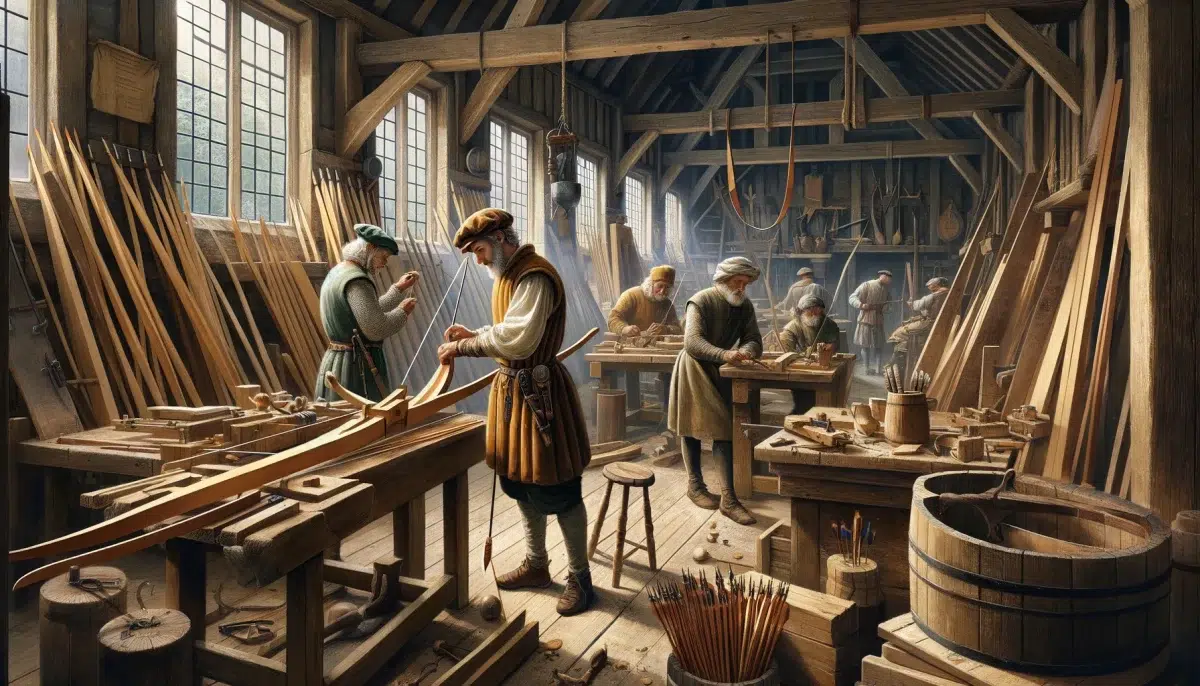
Tools used by the Bowyer
Bowyers, skilled in crafting English longbows, supported archers in the Hundred Years’ War with their expertise.
Key tools used by bowyers included:
- Drawknives for shaping yew staves.
- Tillering sticks to fine-tune bow flexibility and strength.
- Rasps and files for detail work and smoothing surfaces.
Techniques of the Bowyer
The meticulous process involved:
- Selecting high-quality yew with an ideal heartwood to sapwood ratio.
- Carefully drying the wood to prevent warping.
- Gradually shaping the bow to create the distinctive ‘D’ cross-section.
- Testing and adjusting tiller for even limb curvature and tension.
Bowyers played a pivotal role in the effectiveness of the English longbow, applying centuries of collective knowledge to produce weapons of formidable power and accuracy.
Their craft was not only a trade but an essential element of medieval warfare strategy.
Anatomy of the Longbow
Dimensions and Design
The traditional English longbow, a height-matching weapon, usually stood about 6 feet tall.
Crafted primarily from yew, its design capitalized on both the dense heartwood and lighter sapwood, forming a natural composite material.
The D-shaped cross-section maximized strength while minimizing weight.
Longbows had a draw weight ranging between 80-150 pounds, requiring significant strength and skill. The stave’s subtle tapering from the center to the tips optimized flexibility and power.
Each bow was tailored to the individual archer, reflecting a blend of craftsmanship and personalized weapon design.
The Physics of Longbow Power
The longbow’s might hinged on its draw weight, generating forces up to 180 pounds. This power stemmed from the elastic potential energy stored in the wood when drawn.
The bow’s design allowed it to store a substantial amount of energy, which translated into high launch velocities for arrows.
Limb elasticity and bow shape were critical factors.
Yew wood was favored for its perfect balance of tension and compression, handling the physical stresses efficiently.
Each release effectively converted stored energy into kinetic energy, propelling arrows with lethal speed and force, enabling English archers to strike at long ranges with devastating effect.
The Role of Arrows and Arrowheads
The English longbow archer’s effectiveness hinged on their arrows and arrowheads, each designed for specific purposes.
Arrows were carefully crafted from woods like ash or birch, with fletching from goose feathers to stabilize flight.
Broadheads, meant for cutting and causing maximum injury, were used against lightly armored opponents, while bodkin points, designed to pierce heavy armor, were favored against knights and men-at-arms.
- Arrows of ash or birch ensured durability and flight consistency
- Goose feathers for fletching aided aerodynamic stability
- Broadheads inflicted wide, debilitating wounds against light armor
- Bodkin points, with their narrow profile, could penetrate plate armor
Through meticulous selection and use of arrows and arrowheads, English longbowmen maximized their impact on the battlefield.
Skills and Drills
English Longbow archers of the Hundred Years’ War underwent rigorous training.
Their skills were honed through:
- Strength Training: Pulling the heavy yew bows required exceptional upper body strength. Daily exercises were designed to build the muscles necessary for the 100-pound draw weight.
- Accuracy Drills: Precise shooting was cultivated by constant practice, often starting in childhood, with targets set at varying distances to simulate battlefield conditions.
- Speed Shooting: Efficiently nocking, drawing, and releasing were essential, and archers drilled to shoot rapidly without sacrificing accuracy.
- Group Tactics: Coordinated volleys were a strategic element in battles. Archers trained to shoot in large formations, synchronizing their shots for maximum impact.
- Mock Battles: Drills included mock encounters to replicate the stress and confusion of real combat, training archers to maintain composure and focus.
These disciplined routines were fundamental in mastering the longbow, providing the English forces with a significant advantage on the battlefield.
Longbowmen Legends

Stories of Famous Archers and Battles
- Robin Hood: Legendary figure, often depicted as an expert longbowman stealing from the rich to give to the poor. His popularity showcases the longbow’s cultural impact.
- The Battle of Crécy (1346): English archers devastated the French army with their longbows, demonstrating formidable tactical prowess on the battlefield.
- The Battle of Agincourt (1415): Led by King Henry V, English longbowmen crushed the numerically superior French forces, becoming immortalized by Shakespeare’s play, Henry V.
- Sir John Hawkwood: A mercenary leader and strategic mastermind, Hawkwood’s exploits during the Italian campaigns showcased the adaptability of the longbow in various combat situations.
Learn more about: Famous Archers in History: Legends of the Bow and Arrow
The Longbow in Modern Times
While no longer a battlefield staple, the English longbow maintains cultural significance.
Historical reenactments and ceremonial displays often feature longbows, showcasing the skills of yesteryears’ archers. In modern sport, techniques derived from medieval longbow use enrich competitive archery disciplines.
Moreover, traditional bowyers continue crafting longbows, maintaining the ancient craft and its heritage.
Collectors and enthusiasts preserve historical longbows as artifacts, ensuring that the longbow’s storied past remains accessible for future generations to appreciate and study.
The Enduring Symbolism of the English Longbow
The English longbow epitomizes medieval warfare’s innovation and effectiveness.
Its significance extends beyond its tangible contributions to battlefield victories; the longbow symbolizes a nexus of technological advancement, social dynamics, and military strategy.
Even centuries after the Hundred Years’ War, the longbow persists in cultural memory as a testament to the strategic acumen of English archers and the pivotal role they played in shaping military history.
This enduring legacy cements the longbow as an icon of England’s martial heritage and a subject of fascination for historians and military enthusiasts alike.