Artemis: Ancient Greek Goddess of Archery
Artemis is a famous goddess from Greek mythology. She is known as the goddess of hunting, the wilderness, the moon, and keeping herself pure.
People in ancient Greece worshipped her a lot because she was powerful and important.
Introduction to Greek Goddess Artemis
As the goddess of hunting, Artemis was often shown with a bow and arrows. She spent a lot of time in the forests, hunting and protecting the animals.
Artemis also had a special connection to the moon. This made her different from other gods and goddesses.
Besides hunting and the moon, she valued her freedom. She chose never to marry, which was unusual for gods.
Her stories in Greek myths are full of adventure and show her as a strong, independent figure. Artemis is interesting because she stands for many things: nature, freedom, and strength.
Even today, people find her stories exciting and meaningful.
Learn more about Greek mythology:
- Greek Mythology Symbols
- Most Popular Greek Myths in Greek Mythology
- Gods and Archery in Greek Mythology Books
- God of Archery: Norse, Greek & Roman Mythology
Origins and Family of Artemis
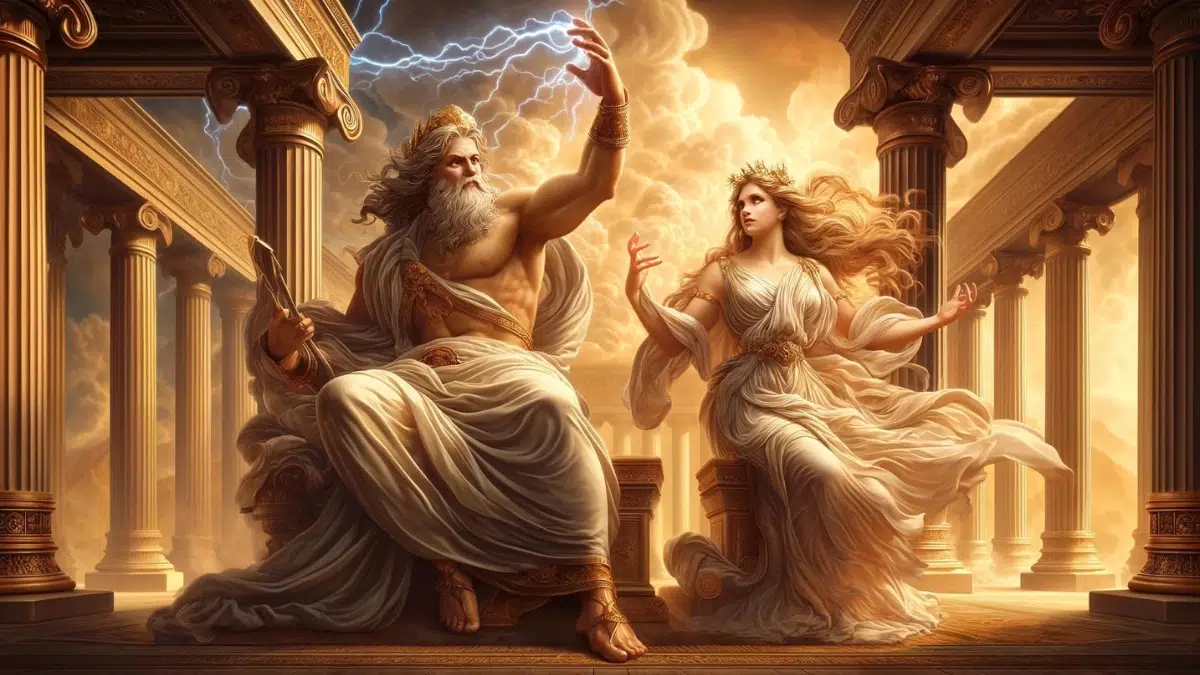
Artemis was born to Zeus, the king of the gods, and Leto, a kind Titaness.
Her birth story is unique and exciting. Zeus and Hera, his sister would marry after Zeus ascended to the throne of the gods.
This union was to solidify his status and power among the Olympians. Their marriage was portrayed as tumultuous due to Zeus’s numerous affairs with other goddesses and mortal women.
Hera was often jealous of Zeus’s other loves. One of them was being Leto.

Hera and Her Curse on Leto
When Hera found out Leto was pregnant with Zeus’s children, she was furious. She decided to make things very hard for Leto.
Hera put a powerful curse on Leto. She said Leto couldn’t give birth on any land that was connected to the earth. This curse made Leto’s search for a safe place to have her babies very difficult.
She wandered a lot, looking for a spot where Hera’s curse wouldn’t reach. Finally, Leto found the floating island of Delos. It was neither mainland nor a true island. Since it wasn’t connected to the earth, she could give birth there.
According to mythology Zeus would anchor the island so Leto could give birth. Here, under the palms on Delos, Artemis was born. Legends say that right after her birth, she helped her mother deliver her twin brother, Apollo.
It highlights her role as a protector and nurturer from the very beginning.
Twins Artemis and Apollo

Artemis and Apollo were close as siblings. Apollo became the god of the sun, music, and healing. Like Artemis, he was also very important in Greek mythology. They often worked together in stories and protected each other.
Despite being Zeus’s daughter, Artemis lived a life quite separate from the other gods on Mount Olympus. She preferred roaming the forests and mountains. This love for nature came from her mother, Leto, who also loved the outdoors.
Her family shows a mix of powerful and caring qualities.
Her Parents Zeus and Leto
Artemis’ relationship with her father Zeus was typically positive. Zeus, as the ruler of the gods, gave her hunting skills and independence.
Zeus gifted her a bow and arrow and the freedom to roam the wilderness. This became her signature weapons and symbols of her status as a huntress and protector of the natural world.
These gifts were not just symbols of her future domains but also tools that shaped her character. She quickly mastered the art of archery, becoming synonymous with the bow.
Leto’s kindness and strength were seen in the goddess’s protective nature. Together, they influenced her to become a goddess admired by many for her bravery and freedom.
Attributes and Symbols of Artemis
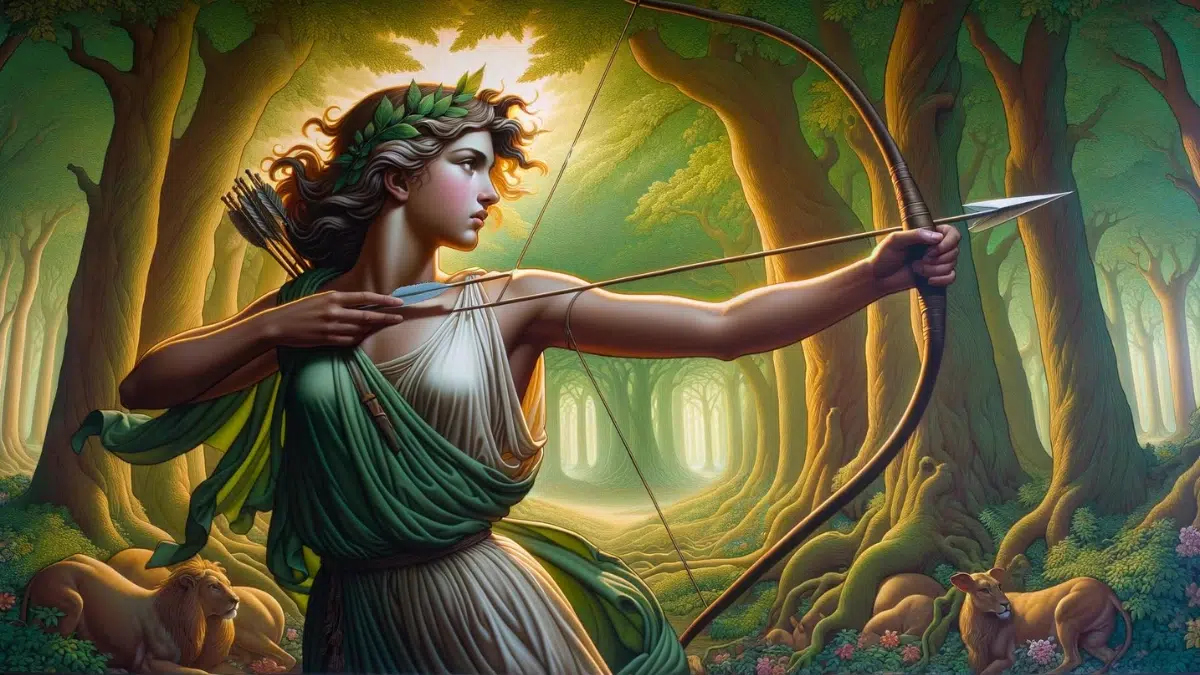
Artemis is often seen with symbols that show who she is and what she stands for.
The most common symbols associated with Artemis are the bow and arrow.
Artemis’ mastery of archery began with a divine gift from her father, Zeus. As a young goddess, she was bestowed with a silver bow and arrows.
The bow represented her strength, independence, and her role as a protector and hunter. These represent her skills as a goddess of hunting. She is known for her sharp aim and quick movements in the forest.
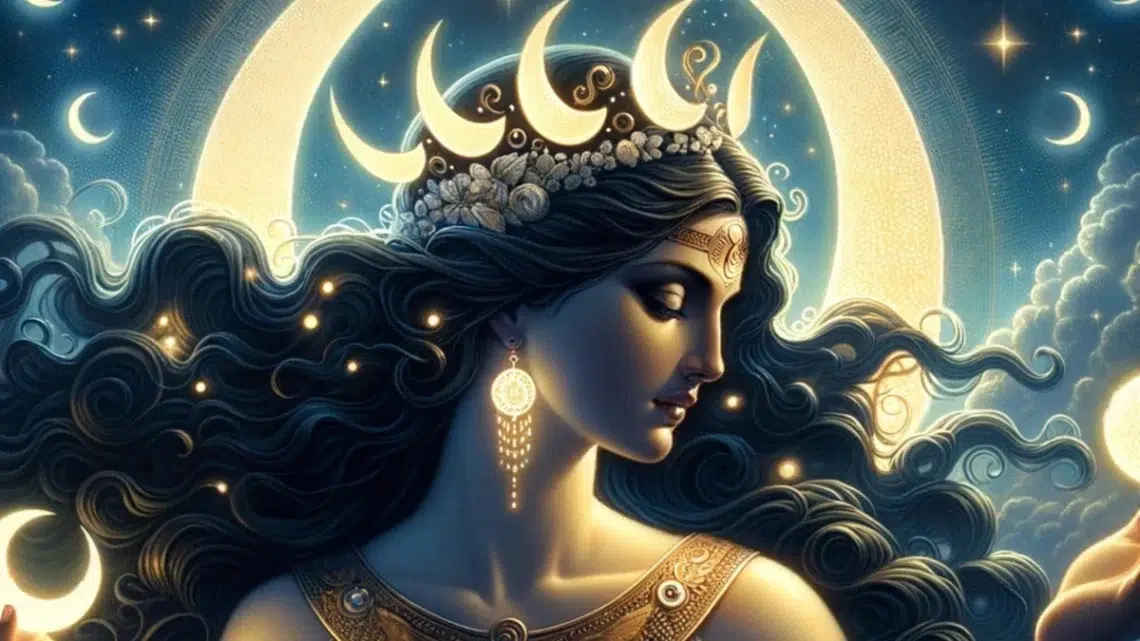
Another important symbol is the crescent moon. This connects her to the night and highlights her association with the Moon. The moon also shows her quiet and mysterious side.
Connection with Nature and Wildlife

Artemis spent her days roaming the forests and mountains, establishing a deep connection with the environment and its creatures. This bond with nature was not merely recreational.
It formed the foundation of her role as a protector of wildlife and the wilderness. Her affinity with animals, particularly deer, became a defining characteristic, often depicted in art and literature.
Deer are symbols of the natural world she protects and loves, showing her gentle side.
She is usually shown as a young woman dressed in a short tunic. This outfit is practical for moving freely in the woods. It reflects her active and independent nature.
They remind us of her abilities as a hunter, her connection to the moon, and her love for animals and nature. They also show that she values freedom and independence above all.
The Formation of Artemis’ Ideals and Vows
During her formative years, Artemis would develop strong ideals and values defining her as a deity. She requested from Zeus to remain eternally chaste, thus becoming one of the three virgin goddesses of Olympus.
This vow of chastity was not just a personal choice but a powerful statement of her independence and autonomy.
From her early years, Artemis embodied the ideals of female empowerment and purity.
Her resolve to forge her own path, free from the traditional roles assigned to women in both mortal and divine realms. It made her a symbol of female strength and independence.
It sets the stage for her role in Greek mythology as a powerful, independent, and nurturing deity.
Other strong women in Greek Mythology:
- Atalanta: Fabled Archer to Legendary Heroine
- Diana: Goddess of Hunt in Roman Mythology
- Hippolyta: Queen of the Amazons in Greek Mythology
- Legacy of Archers: Women in Greek Mythology
- Penthesilea: Amazon Queen Who Died in Trojan War
Myths Involving Artemis
There are many myths involving Artemis. Over time, many stories have several versions, with not everyone agreeing in the correct one!
The Punishment of Actaeon

Actaeon was a skilled hunter who once accidentally stumbled upon Artemis bathing in a secluded forest. Shocked by this intrusion, Artemis, who valued her privacy highly, quickly punished him.
She splashed water on Actaeon and turned him into a stag. Suddenly, he found himself with antlers and covered in fur. Confused and scared, Actaeon ran away but soon heard barking.
It was his own hunting dogs, who didn’t recognize their master as a stag. They chased him down and, not knowing it was Actaeon, they tragically attacked and killed him.
This story shows Artemis’ need for respect and privacy. This myth shows the swift justice of the gods.
The Story of Orion
Orion was a giant and a great hunter, who became close friends with Artemis. However, there are several versions as to how he died.
Orion was a hunter and boasted that he could defeat any animal on Earth. This claim upset Gaia, the Earth goddess, who sent a giant scorpion to stop him and killed him.
Another version says Artemis killed him by accident because her brother Apollo tricked her. Artemis and Orion were very close, and Apollo, Artemis’ brother, grew jealous.
Apollo challenged Artemis to hit a distant target in the ocean, which was actually Orion’s head. Not knowing this, she shot and killed Orion.
When she discovered the truth, she was filled with grief and placed Orion’s image in the stars as a constellation. This myth shows how Artemis’ actions were deeply influenced by her emotions and relationships.
It myth highlights the complex relationships between the gods.
The Tale of Callisto

Callisto was a beautiful nymph and a follower of Artemis. She had sworn to remain chaste. However, Zeus, the king of the gods, fell in love with her.
He tricked Callisto by disguising himself as Artemis and took advantage of her. When Callisto became pregnant, Artemis discovered the truth. Angry and feeling betrayed, she banished Callisto from her group.
Callisto gave birth to a son named Arcas. Hera, Zeus’s wife, was furious about Zeus’s affair and Callisto’s child. She transformed Callisto into a bear.
Years later, Arcas, while hunting, almost killed his mother, not knowing she was a bear. To save them, Zeus placed Callisto and Arcas in the sky as constellations.
Callisto became Ursa Major (the Great Bear), and Arcas became Ursa Minor (the Little Bear).
This myth highlights themes of betrayal, punishment, and transformation.
Her Role in the Trojan War

During the Trojan War, Artemis played a key role by stopping the Greek fleet from sailing to Troy. She was upset because Agamemnon, the Greek leader, had killed a sacred deer in her grove and boasted about his hunting skills.
To teach him a lesson, Artemis made the winds die down so the ships couldn’t move. The only way to calm her anger was for Agamemnon to sacrifice his daughter, Iphigenia.
At the last moment, Artemis showed mercy. She replaced Iphigenia with a deer at the altar and saved her. Artemis’ actions here show her power and how seriously the gods took respect.
This myth highlights Artemis’ power over nature and her demand for respect.
The Punishment of Niobe
Niobe, queen of Thebes was very proud of her 14 children. She claimed superiority in motherhood over the goddess Leto, Artemis’ mother, who had only two children.
This angered Artemis and her twin brother, Apollo. They decided to punish Niobe for her pride. Apollo and Artemis descended from Mount Olympus. Apollo used his arrows to kill Niobe’s seven sons, while Artemis killed her seven daughters.
Niobe was devastated by the loss of her children. She fled to Mount Sipylus, where she turned to stone from grief.
Even as a stone, Niobe continued to cry. Streams of water flowed from the stone, symbolizing her endless sorrow.
This myth shows the consequences of excessive pride and the swift justice of the gods. Artemis and Apollo’s actions remind mortals to respect the gods and their families.
Goddess of the Hunt

Artemis is known as the goddess of hunting. She loves the wild and spends much of her time in forests and mountains.
With her bow and arrows, she hunts deer, boar, and other wild animals. She is an excellent hunter and never misses her target.
Artemis values nature and protects it fiercely. She ensures that hunters respect the animals and the forests. If anyone disrespects nature, she punishes them swiftly.
She is not just a hunter but also a protector. Artemis also helps protect the young and vulnerable animals. She looks after newborns and makes sure they are safe.
Many myths show her gentle side, where she cares for animals and helps them grow. She trains her followers, including nymphs and young hunters, to respect and care for nature.
They learn to hunt responsibly and understand the balance of the wild.
Skilled and Famous Archer
Artemis is always shown with her bow and arrows. She is a skilled hunter and never misses her target. She spends much of her time in the forests, hunting animals and protecting wildlife.
Artemis’s bow and arrows were gifts from her father, Zeus. They symbolize her strength and independence. Many myths describe her incredible archery skills. For example, she once shot a giant from a great distance, saving the gods.
Artemis taught archery to others, too. She trained young hunters and nymphs, sharing her knowledge and skills.
As the goddess of archery, she represents precision, focus, and the wild spirit of the hunt. Her talents made her a respected and powerful figure in Greek mythology.
Artemis stood out as an independent and powerful deity. Her skill in archery, typically associated with male gods and heroes, challenged the traditional gender norms.
Connection and Association to the Moon
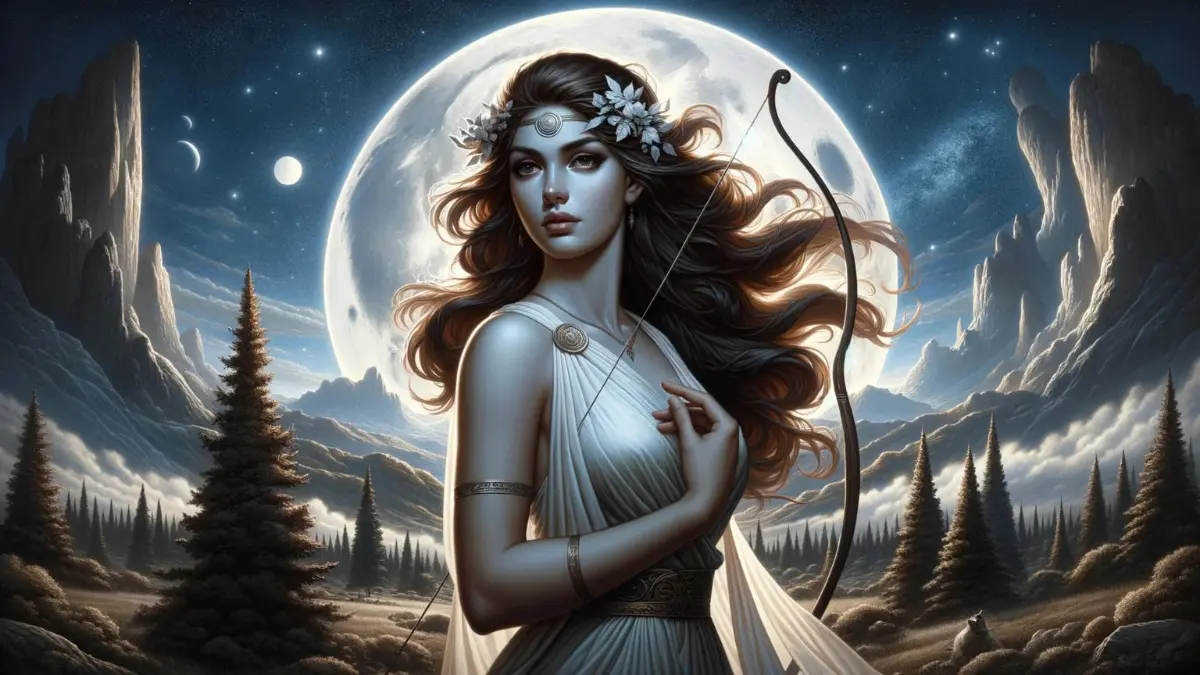
Artemis is also associated with the moon, particularly as a symbol of female power and independence.
She is often depicted with a crescent moon on her forehead or with the moon itself as a symbol of her connection to the night sky. She has a special connection to the night and the moon.
Artemis’ twin brother, Apollo, is the Sun God. While he brings light during the day, Artemis brings light at night.
Artemis watches over travelers and animals at night. People often prayed to her for protection during nighttime journeys. The moon’s phases reflect her changing moods and the natural cycles of life.
Artemis’ role as eventually expands to protection of women and children, and child birth.
She helps women during childbirth and looks after young girls. Her gentle and nurturing side shines through in these stories.
But is she the Goddess of the Moon?
Debate Over Moon Goddess
Some claim that Artemis is the Moon goddess. Others state that Selene is the Titan goddess of the moon. Selene is the oldest of the two goddesses. Selene was born during the time when the Titans ruled the Cosmos.
Selini simply means “moon” in Greek. So she may represent the actual moon. She is the sister of Helios, the Sun God and Eos, the Dawn Goddess.
Literature notes that Selene represents the actual Moon itself, while Artemis represents the moon’s cycles.
Over time Apollo, Artemis’s brother became known as the Sun God. That would make sense that his sister then became the Moon Goddess.
In art, Artemis is often depicted with a crescent moon on her forehead or carrying a torch to symbolize her moonlight.
So the debate continues!
The Goddess and Her Nymphs
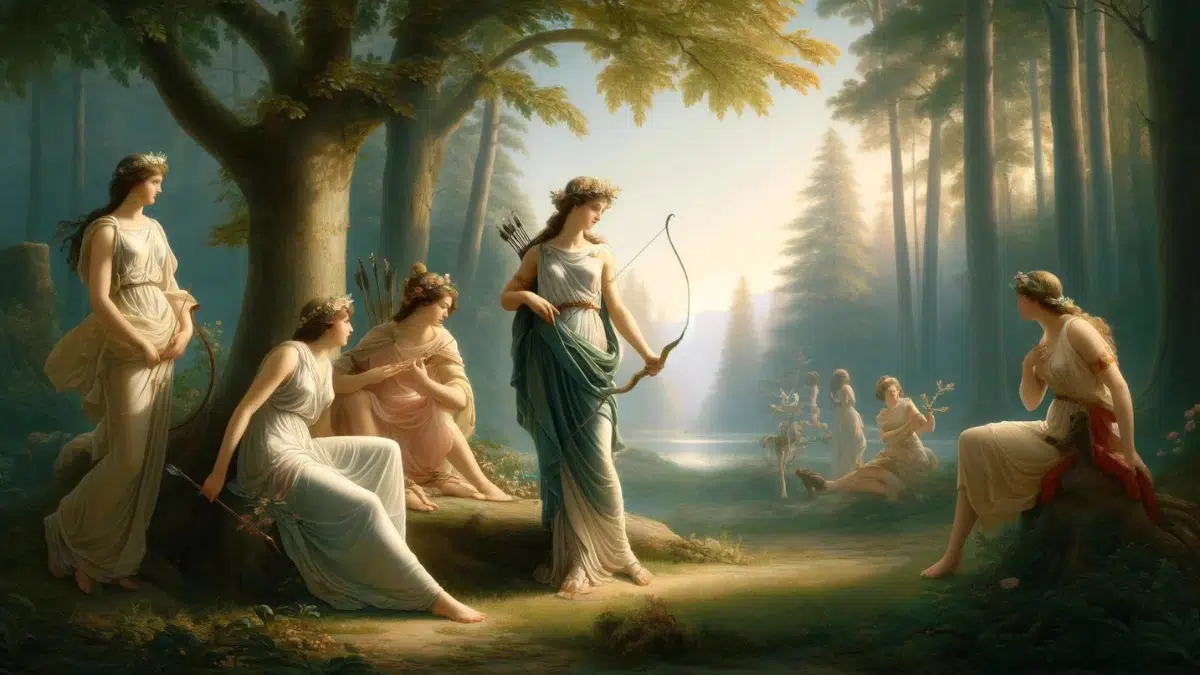
Artemis often spent time with nymphs in the forests and mountains. Nymphs are nature spirits who live in trees, rivers, and mountains.
They were her close companions and followed her everywhere. Together, they hunted, danced, and enjoyed the beauty of nature.
Artemis and her nymphs formed a tight-knit group. They valued freedom, adventure, and the wild. The nymphs admired Artemis for her strength, independence, and hunting skills.
In return, Artemis protected them and taught them how to hunt and care for the forest.
Another story tells of the nymph Daphne. She was a follower of Artemis who wanted to remain free and unmarried. Apollo, Artemis’s brother, fell in love with Daphne and chased her.
To escape, Daphne prayed to her father, a river god, who turned her into a laurel tree. This story shows the nymphs’ desire for freedom and their loyalty to Artemis.
The nymphs shared many adventures with Artemis. They helped her in hunting and explored the wilderness together. They supported each other and lived in harmony with nature.
Artemis and her nymphs represent the beauty of the natural world and the joy of living freely. Their stories highlight themes of loyalty, protection, and the strong bond between the goddess and her companions.
Worship and Cults of Artemis
People in ancient Greece worshipped Artemis widely. They built many temples and held festivals in her honour.
One of the most famous temples was the Temple of Artemis at Ephesus. This temple was huge and one of the Seven Wonders of the Ancient World.
People traveled from far away to visit it. Many cities had special places called sanctuaries where people prayed to Artemis. They offered gifts and sacrifices to show their respect and ask for her help.
Hunters prayed to Artemis for success in their hunts. Women prayed to her for safe childbirth and protection.
Festival of Artemisia
The most important festival for Artemis was called the Artemisia. This festival took place in many cities, but the biggest celebration was in Ephesus.
People held parades, sang songs, and performed dances. They also had athletic competitions and hunting games to honour Artemis.
The Artemis Cult
In Brauron, a city near Athens, there was a special cult of Artemis. Young girls called “arktoi” participated in rituals and ceremonies.
They dressed in bear costumes and acted out stories from Artemis’ myths. This rite of passage helped prepare them for adulthood. The worship of Artemis showed her importance in everyday life.
People saw her as a protector and provider. Her connection to nature, hunting, and childbirth made her a vital goddess for many. Artemis’ followers valued her strength, independence, and care for the natural world.
They showed their devotion through prayers, offerings, and festivals. Her worship brought communities together and highlighted her role as a powerful and beloved goddess in Greek mythology.
Conclusion
Artemis is a powerful and beloved goddess in Greek mythology. She represents hunting, nature, and the moon.
Her stories show her strength, independence, and compassion. People worshipped her widely, building temples and holding festivals.
Artemis continues to inspire with her fierce and caring spirit. Her legacy lives on in myths and culture.
Learn more about: