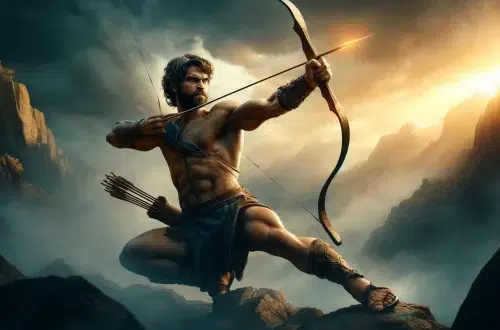

Apollo Greek God of Archery and Prophecy
Apollo is one of the most important and complex gods in Greek mythology. He is the son of Zeus, the king of the gods, and Leto, a titaness.
Apollo has a twin sister, Artemis, who is the goddess of the hunt.
Who Was Apollo in Greek Mythology?
Apollo was the Greek god of archery, prophecy, music, healing, and the sun. He represented order, reason, and youthful strength among the Olympian gods.
Apollo was known for:
-
Archery and divine punishment
-
Prophecy at Delphi
-
Music and the lyre
-
Healing and plague
-
Light and the sun
He guided heroes like Odysseus and punished wrongdoers with his arrows, yet also protected cities and brought truth through prophecy.
The Birth of Apollo
Apollo’s birth story is as fascinating as it is miraculous, showcasing the challenges and triumphs that mark the lives of gods in Greek mythology.
His mother, Leto, was a Titaness who caught the eye of Zeus, the king of the gods.
However, Zeus’s wife, Hera, became jealous of Leto and forbade her from giving birth on land or any island at sea.
Desperate and wandering, Leto finally found a place to rest on the floating island of Delos, which was neither mainland nor a true island.
It was said that Delos was anchored to the ocean floor by Zeus himself to provide sanctuary to Leto.
There, amidst olive branches, Leto gave birth to twins: first Artemis and then Apollo, who was born under the palm tree at the sacred lake.
Apollo’s birth was accompanied by signs of his future greatness.
The island of Delos was said to have bloomed with flowers, and swans circled around it.
From the moment of his birth, Apollo was destined to be a powerful figure among the Olympian gods, embodying beauty, strength, and divinity.
What Was Apollo the God Of?

Apollo as the God of Music and the Arts
Apollo loved music and was an expert at playing the lyre, a stringed musical instrument.
He often used it to bring joy and harmony.
Apollo was also the leader of the Muses, the goddesses of the arts and sciences.
He inspired poets, musicians, and artists to create beautiful works.
Whenever he played his lyre, everything around him seemed to stop and listen, even the rivers and mountains.
His role as a patron of the arts made him a symbol of harmony and creativity.
Apollo as the God of Prophecy and Truth
Apollo had a special connection to prophecy, the ability to see the future.
He spoke to mortals through oracles, sacred places where people came to ask the gods for advice.
The most famous of these was the Oracle of Delphi.
People from all over Greece traveled there to ask questions, and Apollo would answer them through the Pythia, a priestess who served as his voice.
This role made Apollo very important to the Greeks, as he guided them with his wisdom and knowledge of the future.
Apollo was perhaps most famous for his role as the god of prophecy.
He had the power to reveal the future to mortals, a gift he could bestow upon those he favored.
His most important prophetic site was the Oracle of Delphi, located on the slopes of Mount Parnassus.
This place was considered the center of the world in ancient Greek culture.
People from all across Greece and beyond would come to Delphi to consult the oracle, seeking guidance for everything from important state matters to personal decisions.
The oracle, often a woman known as the Pythia, would deliver prophecies in a trance-like state, believed to be Apollo’s voice speaking through her.
These messages, however, were famously ambiguous and open to interpretation, leading to many stories of misinterpretations and the complex fates they produced.
Apollo’s ability to foresee and influence the future made him a pivotal figure in Greek mythology and religion.
His prophecies could determine the outcomes of wars, the fates of heroes, and the rise and fall of cities.
This immense power highlighted his importance not just as a god of physical healing and artistic achievement, but as a central figure in the spiritual and political life of ancient Greece.
Apollo as the God of Healing and Medicine
Apollo was also known as a healer. He taught humans about healing and the use of medicinal plants. Many prayed to him for health and recovery from illness.
Apollo’s son, Asclepius, learned the art of healing from him and became a god of medicine too. This shows that Apollo was not just about causing diseases with his arrows but also about curing them.
His dual role as a bringer of both sickness and health highlighted his power over life and well-being.
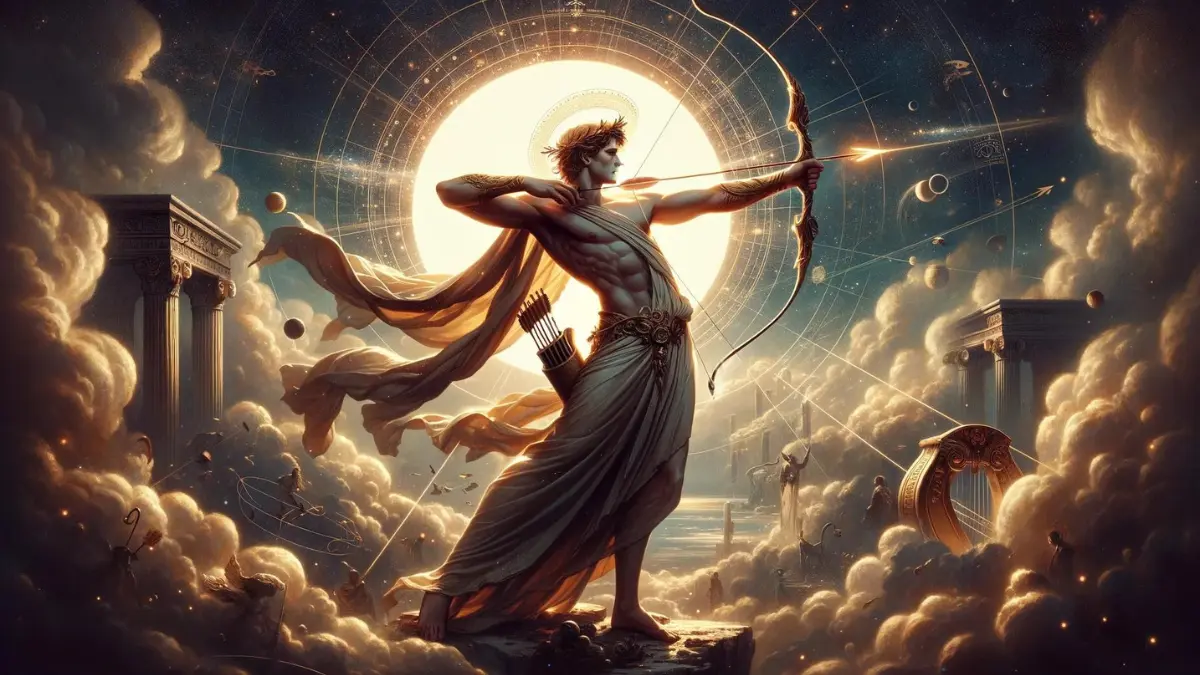
Apollo as the God of Light and the Sun
Apollo was often associated with the sun and light, which are essential for life.
Each morning, he was believed to ride his golden chariot across the sky, bringing the sun’s light to the Earth. This daily journey made days brighter and helped plants grow.
His connection to the sun also symbolized truth and knowledge, shedding light on darkness and ignorance.
As a god of light, Apollo was seen as a guardian of truth, making sure that nothing stayed hidden in the shadows.
Apollo as the God of Archery
Apollo was also revered as a master archer, skilled in using the bow and arrow. This role highlights his ability to protect and also to bring sudden afflictions to mortals.
According to mythology, Apollo carried a silver bow, crafted for him by the god Hephaestus, and his arrows could strike with deadly precision.
He used his archery skills in various myths, sometimes to defend the Olympian gods from monsters and other threats.
For instance, during the battle with the giant serpent Python, he used his arrows to defeat the creature, which had been terrorizing the area around Delphi.
This act of bravery established his power as both a protector and a warrior.
Apollo’s expertise with the bow made him a symbol of protection and swift justice, showing how he could deliver both harm and healing with his arrows.
What Are Apollo’s Main Symbols?

The Lyre
The lyre is one of Apollo’s most iconic symbols. It is a small stringed musical instrument that Apollo played beautifully. He received the lyre as a gift from Hermes, another god, as part of a peace agreement.
Apollo used the lyre to spread joy and harmony wherever he went. The sound of the lyre was so enchanting that it could soothe even the wildest creatures and bring peace to troubled hearts.
For the ancient Greeks, the lyre represented not just musical talent but also the order and balance that Apollo brought to the world through his music.
The Laurel Wreath
The laurel wreath is another powerful symbol associated with Apollo. It represents victory, honour, and peace.
According to myth, Apollo fell in love with Daphne, a nymph who transformed into a laurel tree to escape his advances. In her honour, he made the laurel his sacred plant.
Winners of the Pythian Games, a series of athletic and musical competitions held in Delphi to honour Apollo, were awarded crowns made of laurel branches.
This tradition linked Apollo with success and high status in both arts and athletics.
The Bow and Arrow

Apollo’s bow and arrow signify his role as a hunter and a protector. With his bow, Apollo could strike down threats from afar, defending the gods and humans alike.
This weapon also represents the suddenness of the plagues and diseases he could send as punishment to those who angered him.
However, Apollo could also use his arrows to cleanse and purify, demonstrating his ability to both harm and heal.
This duality in his character adds depth to his image as a complex deity with extensive influence.
The Raven
The raven is a lesser-known but significant symbol of Apollo. The story goes that the raven was originally white, and it served as Apollo’s messenger.
However, after delivering bad news about his lover’s unfaithfulness, Apollo turned the raven’s feathers black in his wrath.
Since then, the raven has symbolized his prophetic powers and his connection to the truth, no matter how unwelcome it might be.
Ravens are often seen as omens in mythology, and their presence is tied to Apollo’s role as a god of prophecy.
Famous Myths About Apollo
Apollo and the Python
One of Apollo’s most famous myths is the battle with the monstrous serpent, Python. This giant snake was sent by Hera to chase Apollo’s pregnant mother, Leto, to prevent her from giving birth.
After Apollo was born, he sought revenge.
When he was just four days old, he tracked down Python to the Oracle of Delphi and killed it with his powerful arrows. This victory was significant because it allowed Apollo to claim Delphi as his own.
Establishing it as his major cult center where he could communicate with humans through the Oracle.
Apollo and Daphne
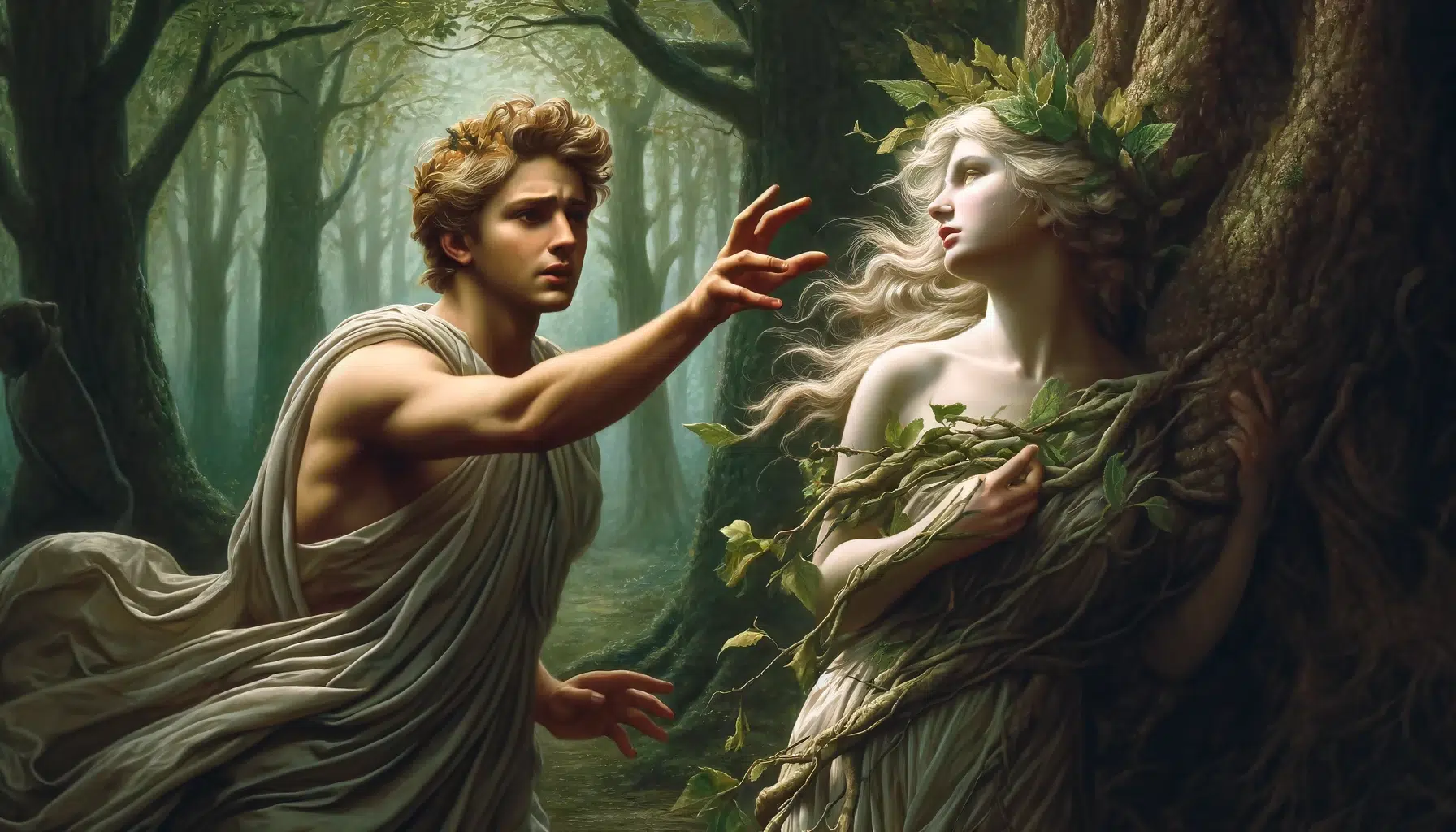
The story of Apollo and Daphne is a tale of unrequited love. Apollo was struck by one of Cupid’s arrows, causing him to fall deeply in love with Daphne, a beautiful nymph.
However, Daphne did not return his feelings and wished to remain independent. As Apollo pursued her, she prayed to her father, the river god Peneus, for help.
He answered her prayers by transforming her into a laurel tree.
Heartbroken, Apollo declared the laurel tree sacred and made it his emblem, using its leaves to crown heroes and poets.
The Contest with Marsyas
This myth showcases Apollo’s musical talent and his competitive spirit.
Marsyas, a satyr, found the flute that Athena had discarded and challenged Apollo to a music contest.
The Muses judged the contest.
Apollo played the lyre, and Marsyas played the flute. Each was very skilled, but Apollo turned the competition in his favor by singing while playing the lyre.
Impressed, the Muses declared Apollo the winner.
Apollo, angered by Marsyas’ challenge, punished him severely, reflecting the god’s less forgiving nature when his authority was questioned.
Apollo’s Role in the Trojan War
During the Trojan War, Apollo played a significant role by siding with the Trojans.
He sent a plague to the Greek camp as punishment when his priest’s daughter was captured.
Apollo also guided the arrow shot by Paris that fatally wounded Achilles, the Greeks’ greatest warrior.
This act significantly shifted the war’s outcome in favor of the Trojans for a time.
Apollo’s involvement in the war highlights his protective nature over his followers and his willingness to intervene directly in mortal affairs.
Apollo and the Ancient Olympics

Apollo, as the god of physical prowess and competition, connects deeply with the Olympics.
While Zeus is typically the main deity honoured at the Olympic Games, Apollo plays an essential role. Especially in the artistic competitions added later.
The ancient Olympics originally started as an athletic festival to honour Zeus. Over time, they grew to include artistic competitions in music, poetry, and dance.
These were fields where Apollo was highly respected in. This expansion gave poets and musicians a chance to win laurels. A prize symbolizing Apollo’s favour.
These competitions took place in the sanctuary of Zeus at Olympia to celebrate all Greek gods.
According to myths, Apollo even participated in the first Olympic Games.
He would compete in boxing and racing. Thus showcasing his athletic and competitive nature alongside his artistic talents. This story not only emphasized his athletic abilities but also his role in promoting the Olympic spirit of competition and excellence.
Apollo’s involvement highlights the blend of physical and artistic excellence that the Olympics sought to promote.
Thus embodying the Greek ideal of a balanced and well-rounded individual.
Sacred Sites of Apollo

Delphi: The Center of His Worship
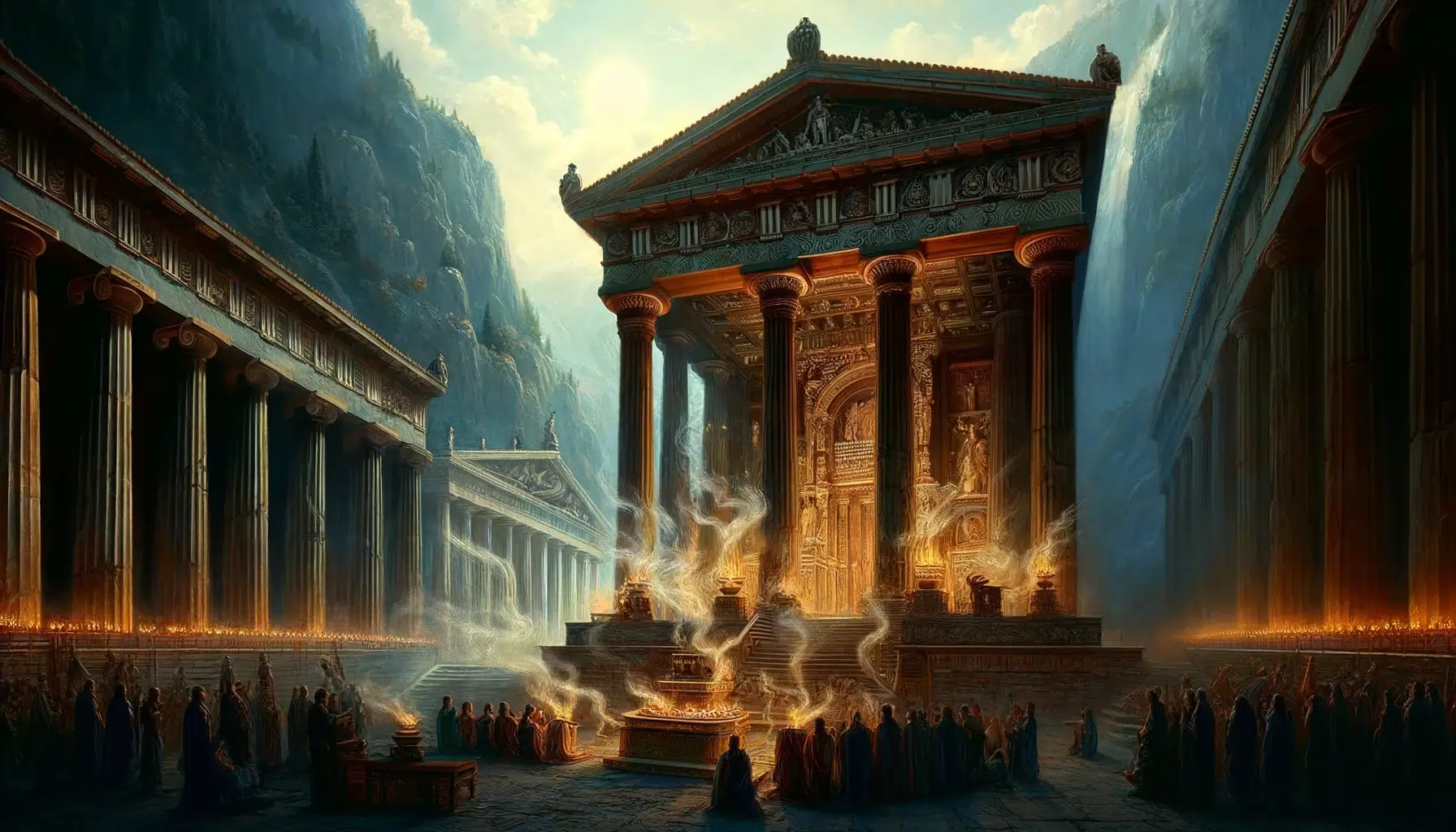
Delphi was the most famous sacred site of Apollo.
Located on the slopes of Mount Parnassus, it was considered the center of the world by the ancient Greeks.
At Delphi, Apollo’s temple housed the Oracle, the holy priestess Pythia, who delivered prophecies from the god himself.
People from all over the ancient world visited Delphi to ask questions about their future.
The site was also known for the Pythian Games, similar to the Olympic Games, which featured contests in music, poetry, and athletics.
Delphi’s significance in Greek culture and religion was immense, reflecting Apollo’s major roles as a god of prophecy, music, and healing.
The Temple of Apollo at Delos
The island of Delos was Apollo’s mythical birthplace, making it a key location for his worship.
The Temple of Apollo here was an important religious site.
Delos was considered so sacred that no one was allowed to be born or die on the island to maintain its purity.
The temple itself was a beautiful structure, often visited by pilgrims who came to pay homage to Apollo and his twin sister, Artemis.
Delos hosted festivals and games in honour of Apollo, which attracted visitors from across the Greek world.
The sanctity and celebrations of Delos underscored his importance in Greek mythology and his connections to birth and youth.
Other Notable Temples and Sanctuaries
Apollo was worshipped throughout the Greek world, and many temples were dedicated to him.
For example, the Temple of Apollo Epicurius at Bassae is famous for its unique blend of architectural styles.
It was built to honour Apollo as a healer after a plague.
In Corinth, a large temple stood on the Acrocorinth, reflecting his role as a protector.
These sites show how Apollo’s influence extended across various aspects of life.
From health and protection to art and prophecy, reinforcing his widespread veneration in the ancient world.
Apollo in Art and Literature
Apollo was a favourite subject in the art of ancient Greece and Rome.
Artists often depicted him as a young, handsome man, symbolizing beauty and perfection.
He is usually shown with a lyre, a bow and arrows, or a laurel wreath, highlighting his roles as the god of music, archery, and victory.
Sculptures like the Apollo Belvedere, a Roman copy of a Greek original, portray him in a graceful stance.
Thus embodying the ideal of youthful male beauty.
This image became a standard for artistic representations of young men in classical art.
Frescoes and vases from the time also show Apollo interacting with other gods, battling monsters, or driving his chariot across the sky.
This emphasizes his dynamic role in mythology.
Renaissance Revival
During the Renaissance, Apollo’s myths found new life in art and literature as symbols of intellectual and artistic pursuit.
Artists like Raphael and Titian drew on stories of Apollo to embody the Renaissance ideals of balance, harmony, and enlightenment.
He was often depicted in scenes that celebrated his musical abilities and his association with the Muses.
Thus inspiring artists and thinkers of the time.
This period saw a significant revival of classical themes and a reimagining of him as not just a mythical figure but also an icon of the humanistic values that the Renaissance celebrated.
Modern Literature and Media
In modern times, Apollo continues to appear in literature, films, and even video games.
Authors like Rick Riordan have brought Apollo into the 21st century.
With books like “The Trials of Apollo,” Apollo transforms into a mortal teenager.
These stories often highlight his human qualities, making him relatable to contemporary audiences.
In film and music, Apollo’s symbolism conveys themes of light, knowledge, and the arts.
His enduring presence in modern media shows that Apollo’s appeal lies not just in his mythological roles.
But also in his ability to represent universal human concerns and aspirations.
Why Apollo Still Matters Today
Apollo, the Greek god of music, prophecy, healing, and the sun, is a fascinating figure in Greek mythology.
Through his many roles, he has influenced various aspects of life and culture, from arts and sports to medicine and knowledge.
His stories are of adventure, challenges, and lessons that still resonate with us today.
Apollo’s influence extends beyond the ancient myths into modern times.
Appearing in art, literature, and media, reminding us of the lasting impact of these ancient stories.
As we explore his tales and symbols, we understand more about the values of ancient Greece and the timeless appeal of its mythology.
Apollo’s legacy teaches us about the importance of balance, wisdom, and the pursuit of excellence.
Ideals that are still relevant and inspiring.