
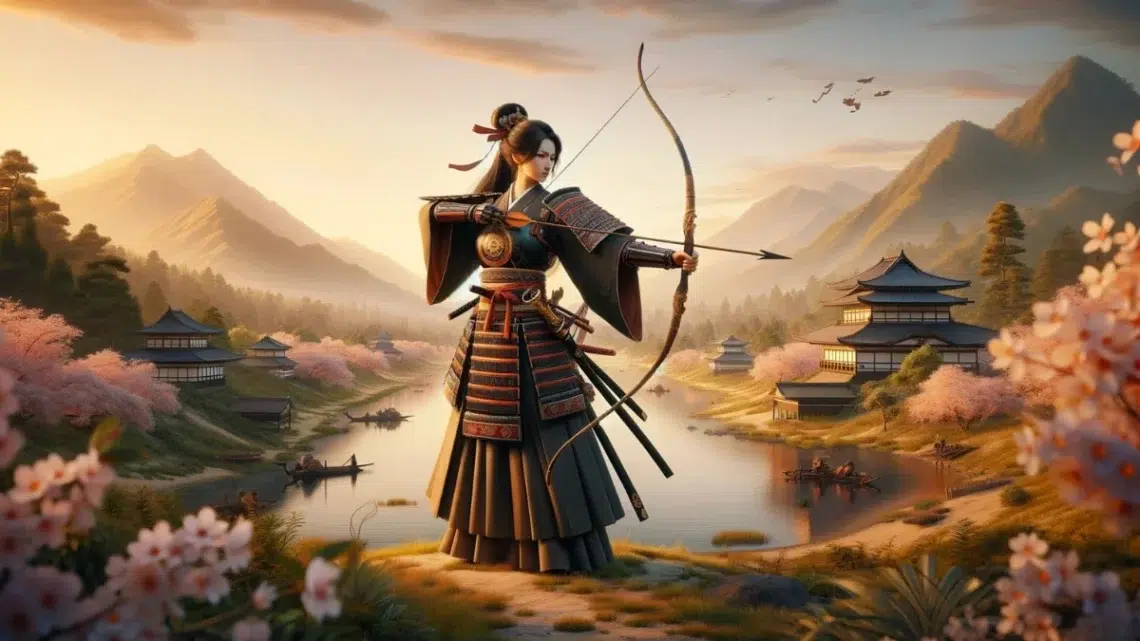
Tomoe Gozen: Female Samurai Archer
Early Life and Historical Context of Tomoe Gozen
Tomoe Gozen was born around 1157, during the late Heian period. This was a time of aristocratic dominance, cultural flourish, and the rise of the samurai class.
Her birthplace remains uncertain, though she is often associated with the province of Shinano. As a female member of the samurai class, Tomoe was an aberration; women were not commonly trained for combat.
Yet, Tomoe’s skills in archery and martial arts were exceptional, making her a warrior of significant repute.
She emerged during the Genpei War (1180-1185), a conflict pivotal in Japanese history for laying the feudal groundwork that would define the country’s social structure for centuries.
Tomoe served under Minamoto no Yoshinaka, playing a key role in his campaign to wrest power from the Taira clan.
Her participation in this struggle illustrates the blurred lines of gender roles in the chaos of war, and her prowess on the battlefield cemented her legacy as a seminal figure of the era.
Tomoe Gozen in the Tale of the Heike: Myth vs. History
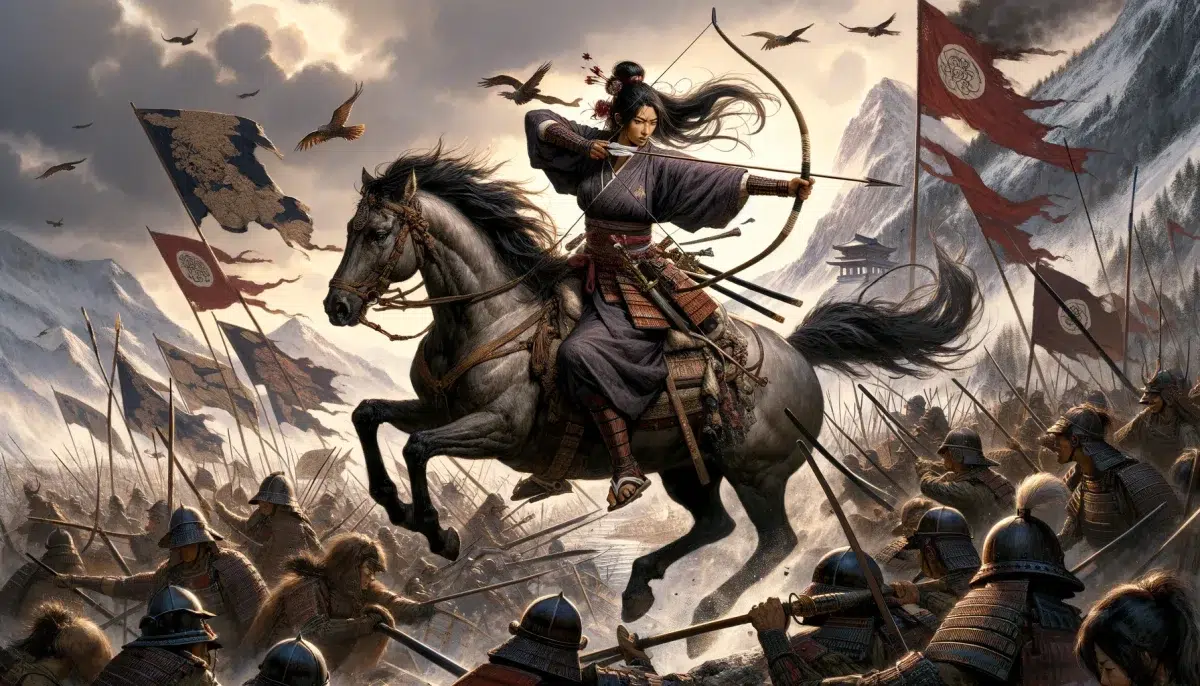
Tomoe Gozen’s existence is shrouded in both historic facts and legendary embellishments.
Historical records indicate that she was indeed a female samurai who lived in the late 12th century.
The Tale of the Heike, an epic account of the Genpei War, references her exploits as a warrior, describing her as a remarkably strong archer and horsewoman.
However, the accuracy of these tales is debated.
- Mythical depictions in the Tale of the Heike often portray Tomoe Gozen performing feats that border on the superhuman, perhaps reflecting the narrative’s goal to entertain and inspire rather than to record factual history.
- Historical accounts suggest that while she was a capable warrior, her deeds may have been exaggerated over time, morphing into the legendary figure known today.
- Scholars debate to what extent Tomoe Gozen’s portrayal in the Tale of the Heike is a romanticized interpretation of an actual female warrior’s life and experiences during the tumultuous era of the Genpei War.
The Weapons and Skills of a Female Samurai Archer
While the samurai class was dominated by men, female warriors like Tomoe Gozen were skilled in various martial disciplines. Their arsenal included:
- Yumi: A longbow used for combat at range, designed to be shot from horseback.
- Ya: Arrows specifically crafted for warfare, often with heads that could pierce armor.
- Katana & Wakizashi: Swords for close combat, used with deadly precision.
- Naginata: A pole weapon adept for slicing and thrusting, favored for its versatility.
These female samurai trained rigorously in kyujutsu (archery), kenjutsu (swordsmanship), and tantojutsu (knife fighting). Mastery over these complemented their battlefield acumen, making them respected and formidable opponents in warfare.
Learn more about: Famous Archers in History: Legends of the Bow and Arrow
The Role of Women in Samurai Culture
Traditionally, samurai culture is recognized for its strict, male-dominated hierarchy. Yet, within this rigorous social structure, women held significant roles that often go overlooked.
They were custodians of the household, ensuring the preservation of family wealth and the education of their children in martial and cultural disciplines.
Notably, women in samurai families were also trained in self-defense and the use of weapons such as the naginata, a polearm expertly wielded for home protection. Their warrior role is exemplified by Tomoe Gozen, highlighting the capacity for women to rise to prominence in martial prowess within samurai society.
Learn more about: Nakano Takeko: Female Samurai in Edo Period
Legendary Battles and Feits: Tomoe Gozen’s Prowess in Combat
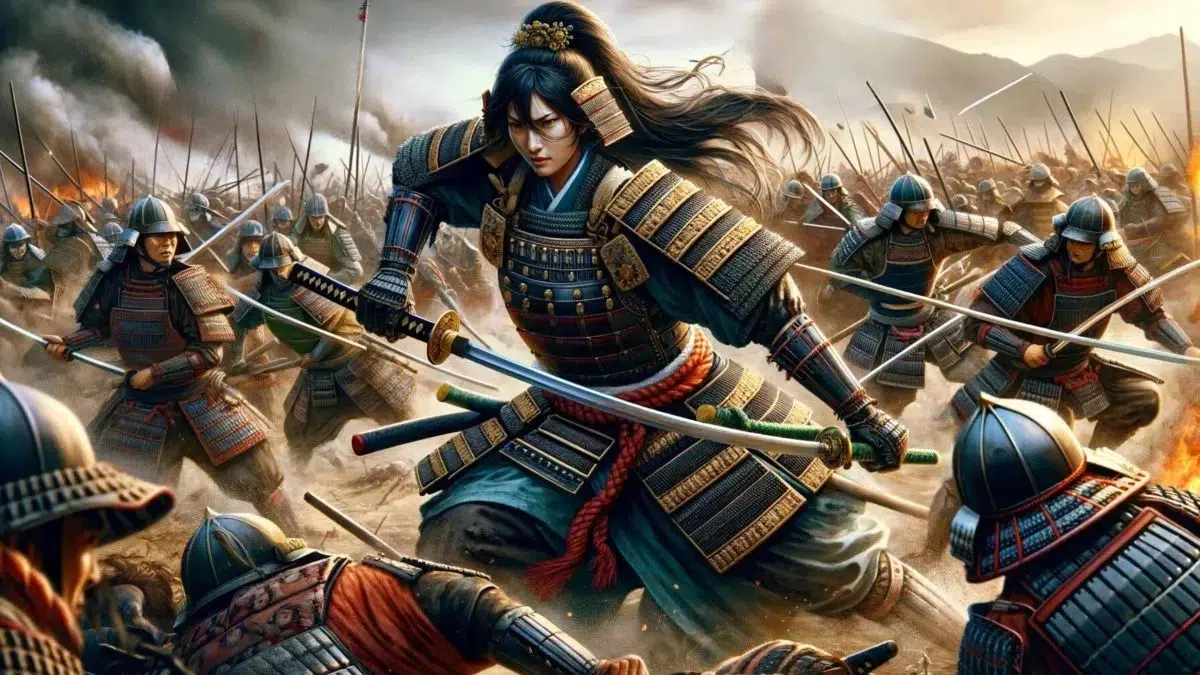
Tomoe Gozen, a name etched in the annals of samurai lore, exhibited exceptional combat skills that transcended the gender norms of feudal Japan.
Her military might is not only legendary but substantiated by vivid historical accounts:
- Battle of Awazu (1184): In the icy grips of winter, Tomoe’s might shone brightly as she decimated opponents on the battlefield, claiming the heads of several prominent warriors.
- Unmatched Archery: Her arrow never missed its mark. Enemies fell before her precise shots, her prowess as an archer both feared and respected.
- Expert Horsewoman: Mounted on horseback, she was a whirlwind of deadly grace, her swordplay both fluid and lethal.
Her legendary feats are emblematic of a warrior who, despite any barriers, rose to become a paragon of the samurai spirit.
Partnership in War and Legend
Tomoe Gozen, often lauded as the epitome of the onna-bugeisha, found not only a commander but also a partner in Minamoto no Yoshinaka.
Together, they intertwine in the fabric of samurai lore:
- Yoshinaka, a general of the Minamoto clan, recognized Tomoe’s exceptional martial prowess and entrusted her with prominent roles in his campaigns.
- They fought side by side in the Genpei War, a critical conflict at the end of the Heian period that led to the rise of the shogunate in Japan.
- Tomoe was known not only for her archery but also for her ability to ride into battle and confront enemies head-on.
- Their partnership featured mutual respect and shared ambitious goals to secure Minamoto supremacy over their rivals.
- The tale of Tomoe Gozen and Yoshinaka transcended historical records to become part of the epic “The Tale of the Heike,” immortalizing their exploits.
Their legendary partnership continues to captivate audiences, symbolizing a unity that defied the strict gender roles of their time.
The Iconography of Tomoe Gozen in Art and Literature
Tomoe Gozen’s depiction across various mediums resonates with her legendary status as an onna-bugeisha. In classical Japanese art, she is often portrayed in the heat of battle. Often adorning samurai armor, a symbol of her martial prowess.
Ukiyo-e prints and paintings capture Tomoe wielding a naginata, her weapon of choice, or a bow, reinforcing her skill as an archer. Kabuki and Noh theater offer dramatic reenactments of her life, embellished with the period’s aesthetic.
Literary works, from epic tales like the “Heike Monogatari” to modern novels, imbue Tomoe with traits of fearlessness and loyalty. Poets laud her beauty and strength, crafting an emblematic figure that transcends her historical roots.
The Final Years of Tomoe Gozen: Fact and Fiction
Distinguishing between fact and fiction in Tomoe Gozen’s later years is challenging.
Historical records are scarce, and much of what we know comes from the epic Heike Monogatari:
- Tomoe’s fate after the Genpei War is uncertain. Some accounts claim she became a nun, while others suggest she continued to fight.
- Legend portrays her as undefeated in battle, a representation blending realism with idealism.
- Oral traditions romanticize her final years, often depicting a peaceful retirement, contrasting with her warrior life.
- Fiction often amplifies her exploits, further blurring the lines between actual history and folklore.
Despite numerous theories, Tomoe Gozen’s final years remain a compelling mix of history and myth.
Modern Day Legacy: Tomoe Gozen’s Impact on Japanese Culture
Tomoe Gozen endures as a cultural icon, reflecting the timeless valor of Japanese warriors.
Her legacy in Japan is multifaceted, encompassing:
- Literature and Arts: The epic Tale of the Heike immortalizes her, and continues to influence manga, novels, and artwork, inspiring a portrayal of strong femininity and martial prowess.
- Women Empowerment: Tomoe’s legendary status emboldens women in modern society, challenging gender roles and exemplifying female empowerment within traditional and contemporary contexts.
- Martial Arts: Her legacy resonates within the martial arts community, often cited as a paragon of skill and courage, particularly influencing practitioners of kyudo (archery) and naginatajutsu.
- Popular Media: Tomoe Gozen’s story adaptation into films, anime, and video games, maintains her presence in Japanese popular culture and introducing her tale to global audiences.
- Cultural Festivals: Traditional festivals and reenactments celebrate her story, ensuring that her legacy as a warrior continues to be honored and remembered
Tomoe Gozen’s place in Japanese culture is indelible, serving as an enduring symbol of grace, strength, and indomitable spirit.
The Influence of Tomoe Gozen on Gender Roles and Feminism
The story of Tomoe Gozen transcends centuries, symbolizing empowerment in a male-dominated era. Feminism finds a historical icon in her, challenging the entrenched gender roles of feudal Japan.
As a female warrior, Tomoe disrupts traditional narratives, embodying capabilities and virtues typically ascribed to men. Thus reshaping perceptions of femininity and strength.
Her legend inspires women to defy restrictive societal constructs, fostering a belief in potential untethered from gender. Tomoe’s enduring legacy validates the female quest for equality and continues to influence gender discourse in modern feminism.
Learn more about:
Reimagining Tomoe Gozen in Popular Media: Films, Novels, and Comics
Tomoe Gozen’s legendary status has inspired various adaptations across popular media, immortalizing her as a cultural icon. Filmmakers have explored her tale through historical dramas, emphasizing her martial prowess and strategic acumen.
In novelist circles, she’s often a strong female lead, exemplifying warrior virtues in reimagined contexts. Comics and graphic novels have also embraced Tomoe, presenting stylized illustrations that capture her fierce essence.
Each medium contributes uniquely to her mythos, ensuring her story evolves with the times while honoring her historical significance.
The Timeless Appeal of Tomoe Gozen, the Female Samurai
Tomoe Gozen’s legend embodies a fusion of strength, skill, and loyalty. Her fabled exploits continue to captivate and inspire audiences, transcending centuries.
Through literature, film, and various cultural representations, she is celebrated. Thus showcasing the timeless allure of a warrior whose narrative challenges gender norms. In the heart of collective memory, Tomoe endures not just as a historical figure, but as an everlasting icon of grace and valor. This in the face of insurmountable odds.
Her story, rich with themes of honor and prowess, resonates deeply, affirming her as an undying emblem of samurai heritage.


