
Review and Fix Any Beginner Archery Mistake
Introduction to Archery and the Importance of Technique
Archery is an art, blending focus, power, and precision. It easy to make an archery mistake. Perfecting this sport isn’t just about having the best bow or quality arrows, it’s largely influenced by an archer’s technique. Good technique is the cornerstone of archery; it ensures safety, improves accuracy, and enhances the overall archery experience. Let’s review the most common archery mistakes and how to correct them.
Even the smallest technical error can offset an arrow’s trajectory.
With repetition and proper guidance, archers can embed correct movements into muscle memory, making shots more consistent and precise. Therefore, recognizing and correcting common technique mistakes is crucial for any archer looking to aim true and shoot consistently.
Archery Mistake #1: Incorrect Stance and Posture
Having a proper stance and posture is essential in archery. An incorrect form can affect accuracy and lead to inconsistent shots. To correct this mistake:
- Stand with feet shoulder-width apart for a stable base.
- Align your feet perpendicular to the target, as if on parallel lines.
- Maintain a straight back without slouching, ensuring your shoulders are level.
- Position your head so that your eye can focus directly on the sight.
- Keep your weight evenly distributed on both feet.
- Relax your body; tension can throw off your aim.
- Consistently practice this correct posture to build muscle memory.
By refining your stance and posture, you’ll enhance stability and precision, laying the foundation for accurate arrow release.
Lear more about: Get Started with Beginner Archery – Part 1
How to Correct Your Stance for Improved Accuracy
A proper stance sets the foundation for accurate shooting. Archers often neglect stance, but adjusting it can significantly enhance precision. Here’s how:
- Stand perpendicular to the target with feet shoulder-width apart for stability.
- Distribute weight evenly on both feet; avoid leaning forward or backward.
- Align the hip and shoulder with the direction of the target to maintain a consistent shooting posture.
- Relax the body, especially the shoulders, to prevent muscle strain that can disrupt aim.
- Consistently practicing the corrected stance will imprint muscle memory, leading to improved shot accuracy over time.
Archery Mistake #2: Inconsistent Anchor Points
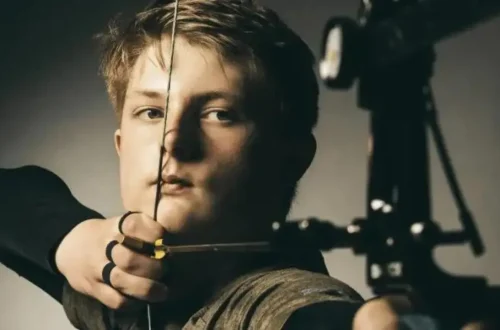
The anchor point is where the hand or string consistently meets the face which secures shot precision. An inconsistent anchor point leads to erratic arrow flights and frustrating inconsistency on the target. Archers should:
- Identify a comfortable and repeatable spot on their face to anchor to, like the corner of the mouth or under the chin.
- Practice drawing the bow to the same point every time, using a mirror or coach for feedback.
- Use kinesthetic awareness; how the position feels is key to replicating it shot after shot.
Achieving a consistent anchor point is essential for improving accuracy and becoming a skilled archer.
Finding and Maintaining Your Anchor Point
An anchor point is the position on an archer’s face where they consistently draw the string back to, providing stability and accuracy.
Many beginners neglect this crucial step.
- Identify Your Anchor Point: Usually, it’s a spot on the jaw or cheek that feels natural when the string hand makes contact.
- Practice Consistency: Repetition is key. Each time you draw the bow, ensure your hand touches the same spot.
- Use Reference Points: Physical features like the corner of your mouth or the tip of your nose serve as guides.
- Check Alignment: Ensure your bow arm, string hand, and anchor point are in a straight line.
- Seek Feedback: A coach or experienced archer can observe and suggest adjustments to perfect your technique.
Consistency in finding and maintaining the anchor point can significantly enhance your shooting accuracy.
Archery Mistake #3: Poor Bow Grip and Hand Position
An improper bow grip can lead to inconsistent shots and undue tension in the archer’s arm.
Many archers mistakenly grip the bow too tightly, believing they can control the shot better. This can result in the bow moving during the shot, which affects accuracy.
Here’s how to correct this common archery mistake:
- Hold the bow with a relaxed grip, using just enough pressure to prevent the bow from falling.
- Position the bow handle against the meaty part of the thumb on the bow hand.
- Ensure your fingers are loosely curled, not gripping, and your knuckles form a 45-degree angle with the bow.
- Keep your wrist straight, without any bends, to maintain a neutral position.
- Practice this proper grip repeatedly until it becomes second nature, and watch your shooting stability improve.
Adjusting Your Grip for Better Control and Precision
A common archery mistake is gripping the bow too tightly, leading to tension and inaccuracy.
To enhance control and precision, archers should:
- Relax their hand: A gentle grip allows the bow to naturally rotate upon release.
- Maintain a consistent grip position: Place your hand the same way each time to ensure repeatability.
- Use a wrist sling: This encourages a looser grip, preventing the bow from falling and increasing stability.
- Focus on finger placement: Your index finger’s knuckle should be at a 45-degree angle to the bow handle.
- Let the bow’s pressure rest against the thumb’s base: It should lie along the lifeline without clenching.
By fine-tuning their grip, archers can vastly improve their shot accuracy and consistency.
Archery Mistake #4: Not Following Through with the Shot
In archery, follow-through is as crucial as the release. Abandoning the shot too soon can cause the arrow to veer off course. Here’s how archers can ensure they’re following through properly:
- Maintain your form: After releasing the arrow, keep your bow arm steady and your drawing hand by your face.
- Stay focused: Keep aiming until the arrow hits the target. Let your gaze follow the arrow, not your hands or the bow.
- Relax: Tension can disrupt the shot. Relax your muscles after the release, but don’t drop your stance too soon.
Practicing proper follow-through will lead to more consistent accuracy and better overall shooting form.
Learn more about: Enhancing Focus with Mindful Archery Practices
The Role of Follow-Through in Archery Success
Improper follow-through can derail an arrow’s trajectory.
Archers must maintain their form even after the arrow has left the bow. This means keeping the drawing hand steady, the bow arm outstretched, and the eyes on the target until the arrow hits.
Releasing tension too soon can cause the arrow to fly off course.
It’s akin to the follow-through in a golf swing or a baseball pitch—essential for accuracy. Practice holding your position after each shot to embed this critical habit, ensuring each arrow reaches its intended mark with greater consistency.
Archery Mistake #5: Neglecting Mental Preparation
Many archers focus solely on their physical technique, overlooking the mental aspect of archery.
Mental preparation is just as critical as physical skills. A calm, focused mind enhances stability, aim, and accuracy.
To address this:
- Practice relaxation techniques, like deep breathing or meditation, before shooting.
- Visualize successful shots to build confidence and muscle memory.
- Set realistic goals and develop a consistent pre-shot routine to create a sense of predictability and control.
- Learn to manage stress and distractions by simulating competition settings during practice.
Mental Strategies for Focus and Consistency in Archery
In archery, mastering the mental game is crucial. Archers should cultivate a pre-shot routine, mentally visualizing the entire process before releasing the arrow.
Deep breathing techniques can also help in maintaining calmness and focus. Encouraging self-talk reinforces confidence, while setting small, achievable goals keeps motivation high.
It’s vital to learn to dismiss distractions—focusing on the target, not what surrounds it. Reflecting on each shot honestly aids in consistent improvement.
Lastly, practicing mindfulness can significantly enhance focus and the ability to maintain it throughout competitions or practice sessions.
Conclusion: Recap and Encourage for Continued Practice
Archery is a skill honed over time, with each arrow nocked contributing to an archer’s development.
Acknowledging common mistakes—such as inconsistent anchor points, neglecting form, poorly maintained equipment, tension in the grip, and not following through—is the first step to improvement.
As archers refine their technique and seek guidance to correct these missteps, they lay the foundation for greater accuracy and enjoyment. Remember, the target isn’t just a piece of paper; it’s a marker of progression.
Keep practicing, stay patient, and let every shot be an opportunity to learn. Aim true, and shoot with confidence!