
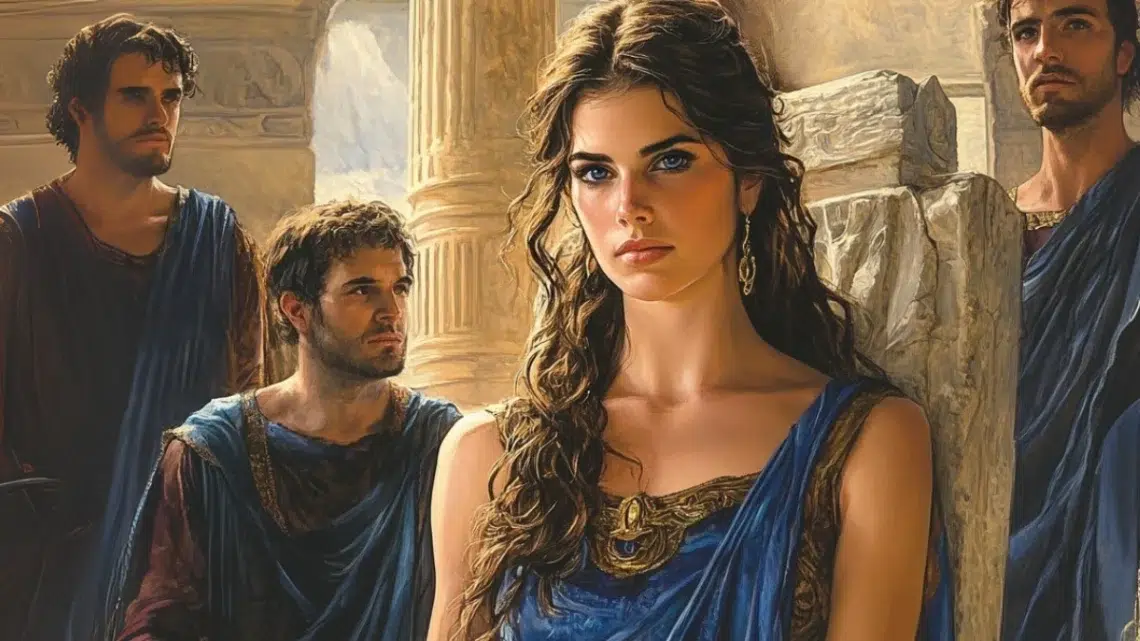
Penelope: Loyal Queen of Ithaca & Wife of Odysseus
Penelope isn’t a warrior, goddess, or monster-slayer — yet she’s one of Greek mythology’s most quietly powerful women.
Known for her loyalty, cleverness, and endurance, Penelope held her kingdom together for 20 years while her husband, Odysseus, struggled to return from the Trojan War.
But there’s more to her story than just weaving and waiting.
Who Was Penelope?
Penelope rules as the Queen of Ithaca. She marries Odysseus, the clever king and war hero. Many call her the most faithful woman in Greek myth. She is most known from Homer’s Odyssey, where her intelligence and faithfulness shine as she navigates danger, deceit, and heartbreak.
She lives during the time of the Trojan War. When Odysseus leaves for war, she stays behind. She raises their son, Telemachus. She protects the palace and holds the kingdom together.
Penelope does not fight with weapons but fights with patience and intelligence. She thinks quickly and sees through lies, knowing how to wait, but she also knows how to act.
Poets praise her calm mind and strong heart. She becomes a symbol of loyalty for generations. In stories, she resists pressure, tricks suitors, and trusts her own mind.
Penelope does not follow the same path as other women in myth. She does not betray and she does not give in. She stays strong even when others lose hope.
Many people try to control her. But Penelope chooses her own way, even when the gods stay silent.
Family and Parentage

Penelope was born into nobility, and comes from Sparta, with strong family ties to other well-known figures in Greek myth.
-
Father: Icarius of Sparta — a powerful king and a skilled runner
-
Mother: Periboea or Polycaste, depending on the source
-
Cousin: Helen of Troy — Penelope and Helen are both granddaughters of Sparta’s royal line
Penelope was offered in marriage after Odysseus beat other suitors in a footrace arranged by her father.
She belongs to a royal family. Her father is Icarius, a powerful Spartan king. He loves racing and holds contests to find her a husband.
Her mother is sometimes Periboea. Some sources say Polycaste. Myths do not always agree. But all agree that Penelope holds noble blood.
She grows up among strong and clever people. Her cousin is Helen of Troy. Helen becomes known for beauty and tragedy. Penelope becomes known for faith and strength.
Penelope’s father wants her to stay in Sparta. He hopes she never leaves. But Odysseus wins a race and her hand in marriage. When she leaves, Icarius begs her to stay.
Penelope does not speak. She pulls her veil over her face. That small act says everything. It shows she follows Odysseus. It shows her loyalty starts early.
Icarius builds a statue at the place where she stands. Some say it still marks her decision.
The Weaving Trick

When Odysseus leaves for Troy, Penelope stays in Ithaca. She raises their son, Telemachus. She rules the palace while Odysseus fights and travels.
Years pass. Many believe Odysseus dies. Over 100 suitors filled her palace, pressuring her to choose a new husband. They eat his food and demand his throne. They want Penelope to choose one of them.
Penelope refuses. She says she must finish weaving a funeral shroud for Laertes, Odysseus’s father. The suitors agree to wait.
Each day, she weaves. But each night, she unwove her day’s work in secret. She hides her trick for three years, outsmarting everyone — until a servant revealed her trick. The suitors grow angry.
Penelope cannot delay them any longer. But she still does not give in. She stays calm and waits for a sign.
She never stops hoping Odysseus will return.
Odysseus Returns and Penelope Tests Him

Odysseus finally returns after twenty long years. He arrives in secret and wears a disguise so no one knows who he is. Penelope still wasn’t convinced it was truly him.
Athena, Goddess of Wisdom helps him plan. He enters the palace as a beggar. The suitors mock him. They do not fear him. But Penelope watches. She senses something strange.
To test him, she announces a contest. She declared she would marry whoever could string Odysseus’s great bow and shoot an arrow through twelve axe heads.
None of the suitors can do it. The bow is too strong. Too heavy. Too much for any of them.
The beggar steps forward. Penelope allows it. He strings the bow with ease and fires the arrow. It flies through all twelve axe heads.
Odysseus reveals himself. He and Telemachus fight and defeat the suitors.
After the dramatic slaughter of the suitors, Penelope still does not rush to him. She gives one final test.
Penelope still tested him one final time by mentioning their secret bed, which couldn’t be moved.

She tells a servant to move their marriage bed. Odysseus reacts in shock. He says no one can move it. He built it around a living olive tree. Only Penelope knows this secret.
Now she believes him. Her heart finally rests. She welcomes him home.
Penelope’s Legacy and Later Myths

Penelope became a symbol of faithfulness, especially in classical and Renaissance literature. Writers admire her for her strength and wisdom. She stays faithful for twenty years and protects her home without force. She uses patience, not violence.
In Greek myth, this makes her rare. Many women fall, break, or betray. Penelope stays steady.
She often stands beside two other women. One is Helen, her cousin. The other is Clytemnestra, Helen’s sister. Helen causes war. Clytemnestra kills her husband. Penelope stays loyal and wise.
But not all later writers keep her story pure. Some claim she sleeps with the suitors. Others say she gives birth to Pan, the wild god. These stories do not appear in Homer’s Odyssey. They come much later.
But not all later myths stayed loyal to her image:
-
Some writers claimed Penelope was unfaithful and gave birth to Pan, the wild god of the woods, by Hermes (or even all the suitors!).
-
These versions were later additions and contradict Homer’s portrayal, likely created to challenge or parody her virtuous legacy.
Most scholars reject them. They see these versions as unfair. They twist her story to fit darker views of women.
What Penelope Symbolizes

Penelope stands as a rare figure in Greek myth:
-
She’s not defined by violence or tragedy, but by clever endurance
-
She represents the power of intellect, patience, and quiet strength
Penelope stands for loyalty. She also stands for wisdom, patience, and quiet strength and does not fight battles. She fights pressure, fear, and time.
Many people see her as the perfect wife. But she is more than that. She is also a leader, a thinker, and a strategist, showing how to hold power without force. She leads with calm and plans with care, facing danger with grace.
Her weaving becomes a symbol too. It shows the power of time, pattern, and control. Each thread becomes a delay. Each night becomes a choice.
The olive tree in her bed is another strong symbol. It shows roots and shows love that does not move. It shows truth that no one else can fake.
Even her silence speaks. When her father asks her to stay, she covers her face. That quiet moment tells her story. She chooses her path without a word.
Penelope also stands for memory. She keeps Odysseus alive in stories, in actions, and in her heart. She reminds us that strength can be soft. And that waiting, when done with purpose, can be an act of power.
She’s often compared to Clytemnestra (who killed her husband, Agamemnon) and Helen (who caused the Trojan War).
In contrast, Penelope upheld honour and loyalty through turmoil — making her one of mythology’s most remarkable mortal women.
Fascinating Facts About Penelope
- Her name may mean “duck”
- The word Penelope might come from penelops, a kind of duck in ancient Greek. Ducks often represent faithfulness and family, a symbol of fidelity in ancient Greece. This fits her story well.
- She is Helen’s cousin
- Penelope and Helen both come from Sparta. Their fathers are brothers. While Helen becomes famous for her beauty and scandal, Penelope becomes known for her loyalty and calm.
- She raises Telemachus alone
- For twenty years, Penelope runs the household. She raises her son without help from Odysseus. She keeps him safe while dealing with constant pressure from the suitors.
- She rules without being queen in name
- Though Odysseus is king, she holds power in his absence. She manages the palace, controls supplies, and makes major choices. She does this while under threat and with little support.
- She delays the suitors for years
- Her weaving trick lasts for three years. Every night, she unpicks her work by torchlight. No one notices until a servant tells on her
- She has a rare kind of power
- Penelope does not fight with weapons. She fights with time, language, and silence. She outlasts her enemies without lifting a sword
Final Thoughts
Penelope may not have fought with sword and shield, but she won her battles with wit, wisdom, and quiet strength.
In a world of gods and monsters, her story reminds us that patience can be powerful, and loyalty can shape legends.