Ogun Yoruba Orisha and God of Iron, War & Forge
Ogun stands as a towering figure in Yoruba mythology and beyond, known as the orisha of iron, warfare and craftsmanship. He wields tools, forges metal and clears the path for creation itself.
From the blacksmith’s fire to the warrior’s blade, he governs the power of iron that shapes both weapons and civilization.
Ogun’s story spans West Africa and reaches into the African diaspora, symbolizing strength, innovation and challenge. In this blog, you’ll explore where he comes from, how he looks and what he means as a god of iron and war.
Background (Origins & Parentage) of Ogun
In Yoruba tradition, Ogun (also spelled Ògún) holds an important place as a primal orisha. He features among the earliest divine beings to descend to earth to order the world.
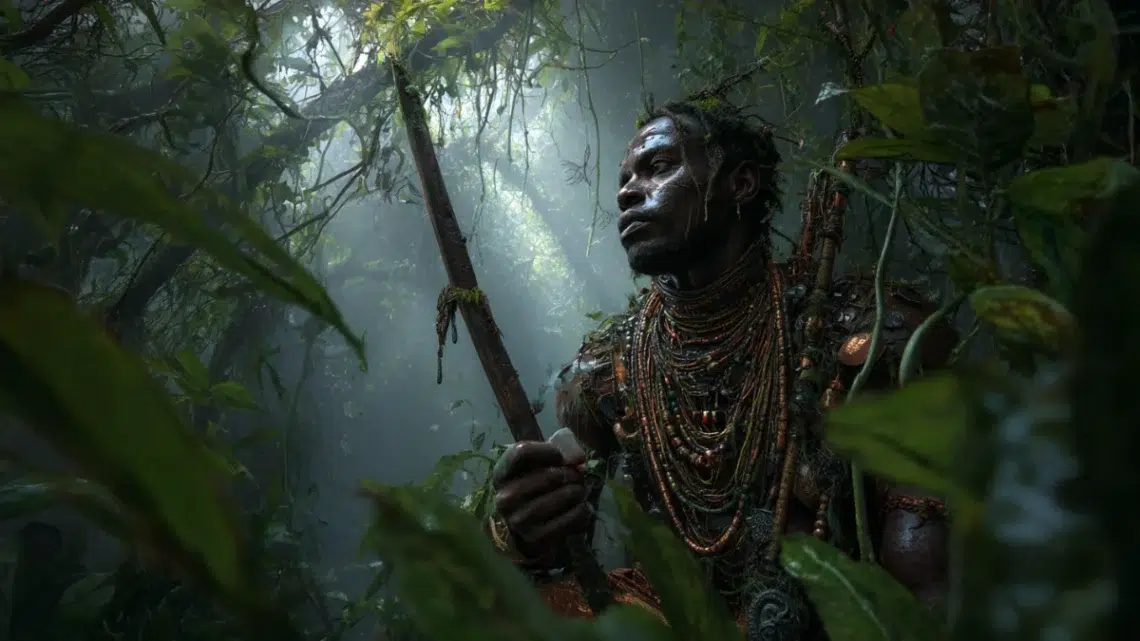
According to myth, the surface of the earth started as watery chaos, and the orishas tasked with shaping land found their tools inadequate. It is said that Ogun withdrew into a mountain to forge iron tools, an axe, a machete, and then used them to clear the dense forest so that other deities could settle the earth.
Various accounts link him as a son of Oduduwa or of Oduduwa and Oxalá, marking him as part of a central family of Yoruba deities.
His role as “Osin Imole” (the first orisha to come to earth) emphasizes his primacy and foundational role in Yoruba cosmology.
Through his origin, Ogun becomes more than a warrior: he represents the forging of human civilization, the introduction of metal, and the transformation of earth into habitable land.
Describe What He Looks Like

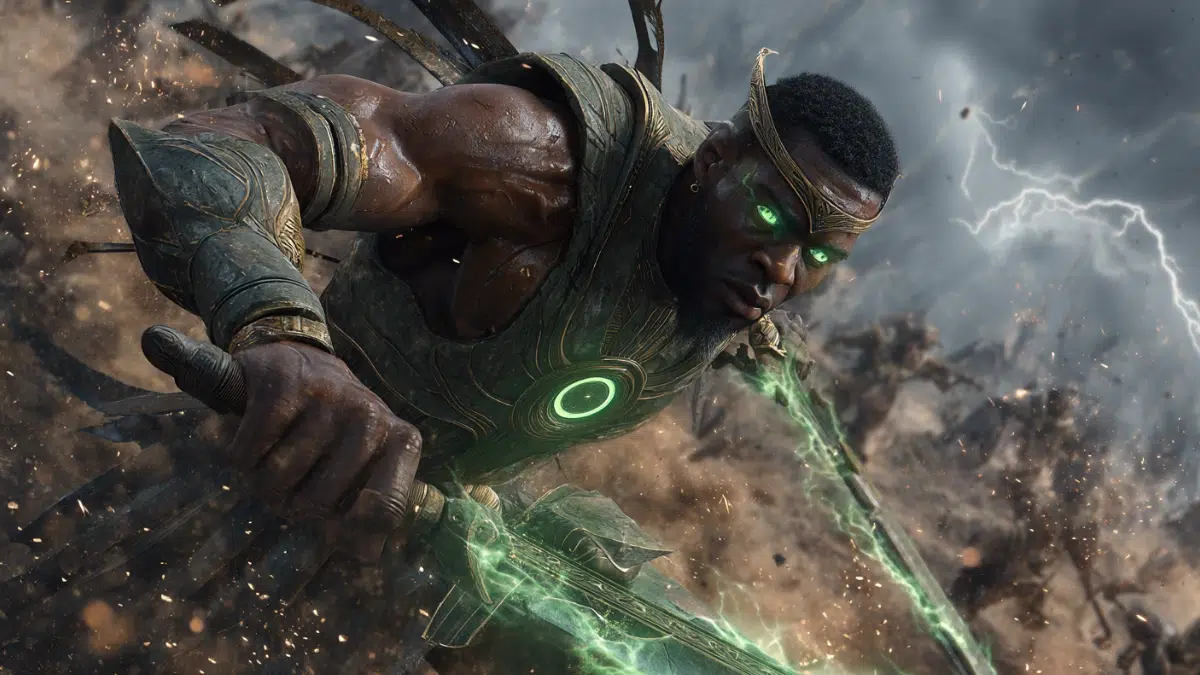
Ogun often appears as a robust, powerful figure, embodying strength and raw craftsmanship. He frequently carries tools of his trade: a machete, an axe, a hammer, or an anvil. These items mark his role as blacksmith and warrior alike.
His colours vary by tradition, often incorporating red, black and green, or the combination of iron’s metallic hue with fiery tones. In many diaspora practices, his devotees dress in red or black and carry items of iron to honour him.
Symbolically, iron itself is one of his chief emblems. Bags or altars dedicated to him may hold knives, swords, wrenches or any iron implement. In Yoruba ritual, people might kiss a piece of iron when invoking him.
He is also associated with the dog, the palm frond and fire. The dog symbolizes hunting, loyalty and path‐clearing; the palm frond stands for his forge and the tools of his trade.
All these visual and symbolic motifs underline his dual nature: creator and destroyer, craftsman and warrior, pathway‑maker and boundary‑setter.
Roles and Influence of Ogun
Ogun’s role spans multiple domains. He is the patron deity of blacksmiths, metal‑workers, hunters and warriors. Wherever iron tools are used for agriculture, war, pr transport, his power is present.
In warfare and hunting, Ogun is invoked for victory, protection and strength. He clears the way physically (through his tools) and metaphorically (through his courage). According to tradition, during the early forming of the world, he cleared the great forest with his iron tools so the other orishas could settle the land.
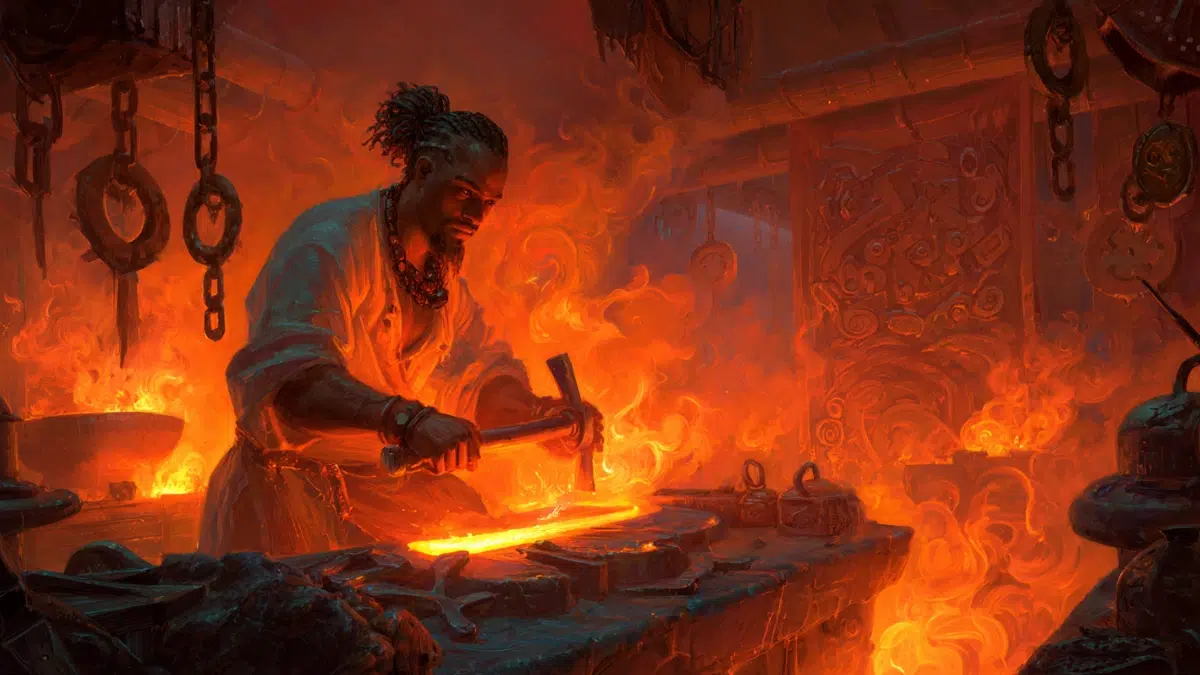
In craftsmanship, his influence makes possible technology, metalwork, forging and invention. Blacksmiths and tool‑makers regard him as their patron, offering sacrifices and dedicating their forges to him. Through the diaspora (Brazil’s Candomblé, Cuba’s Santería, Haiti’s Vodou) Ogun’s identity spreads and adapts, merging with Christian saints like St. George and St. Peter.
In war and justice, Ogun punishes liars, oath‐breakers and those who misuse tools or weapons. He embodies moral strength as well as physical strength. In modern societies he remains symbolic of industry, engineering and innovation—making him still relevant.
Associated Myths of Ogun

Myth 1: Ogun Clears the Way for the Orishas
At the beginning of time in Yoruba mythology, the earth is covered in thick forests and swampland, making it uninhabitable. The supreme being, Olodumare, sends the orishas, the divine spirits, to shape and organize the world. But when the orishas arrive, they struggle. The terrain is too wild, the land too tangled. Their tools fail, and they cannot move forward.
Ogun, known for his strength and skill, separates from the others and retreats into the mountains. There, he works alone, forging new tools out of iron, a material not yet known to the other gods. He creates a machete, an axe, and other cutting tools. With these, he returns and clears a path through the dense wilderness. Trees fall, roots are chopped, and slowly, land appears—firm and ready for settlement.
The other orishas follow behind him, settling the land now made open and workable. Because of this feat, Ogun earns the title “Osin Imole”—the first of the orishas to descend and make the world habitable. He becomes the patron of iron, innovation, and strength.
This myth shows Ogun not just as a warrior, but as a civilizing force. He clears the way, not just physically, but spiritually—making space for community, growth, and life. His actions represent human effort overcoming chaos, and why he remains a key figure in Yoruba tradition, symbolizing both conflict and progress.
Myth 2: Ogun and the War Against the King of Irê
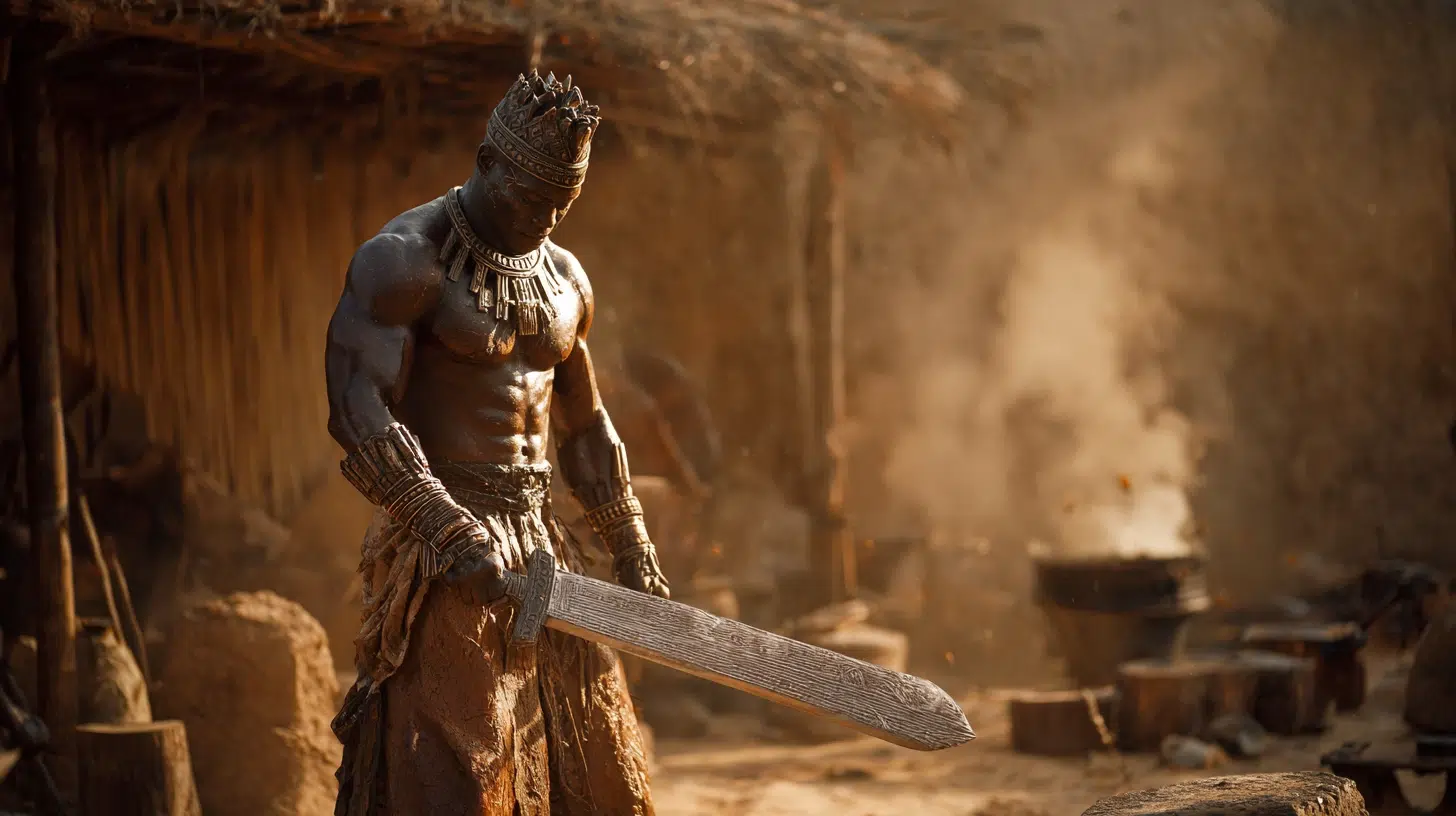
In one story, Ogun lives among humans in the town of Irê, where he is chosen as king because of his wisdom, strength, and connection to iron. At first, he rules fairly. The townspeople benefit from his protection and the tools he forges. But as time passes, they begin to disrespect him, ignoring rituals and taking his gifts for granted.
In a moment of fury and betrayal, Ogun draws his sword. Some versions say he strikes down several townspeople in a violent rage. Realizing what he has done—and how far they have fallen—he becomes overwhelmed with shame. Rather than continue ruling, Ogun leaves the town and vanishes into the earth.
But he doesn’t die. In Yoruba belief, Ogun “wo ilê sun” — meaning “he entered the earth to rest.” His spirit remains present and powerful. From beneath the ground, he still listens to prayers, accepts offerings, and guides those who call his name.
This myth shows Ogun’s deep connection to justice, loyalty, and the sacred power of leadership. When his role is abused, he doesn’t seek more blood—he withdraws, becoming a hidden yet permanent presence.
Even today, people believe that Ogun resides in the iron tools used in work and battle. This story is retold in places like Irê-Ekiti in Nigeria, where festivals honour his retreat and ongoing spiritual power.
Myth 3: The Olojo Festival and Ogun’s Sacred Day
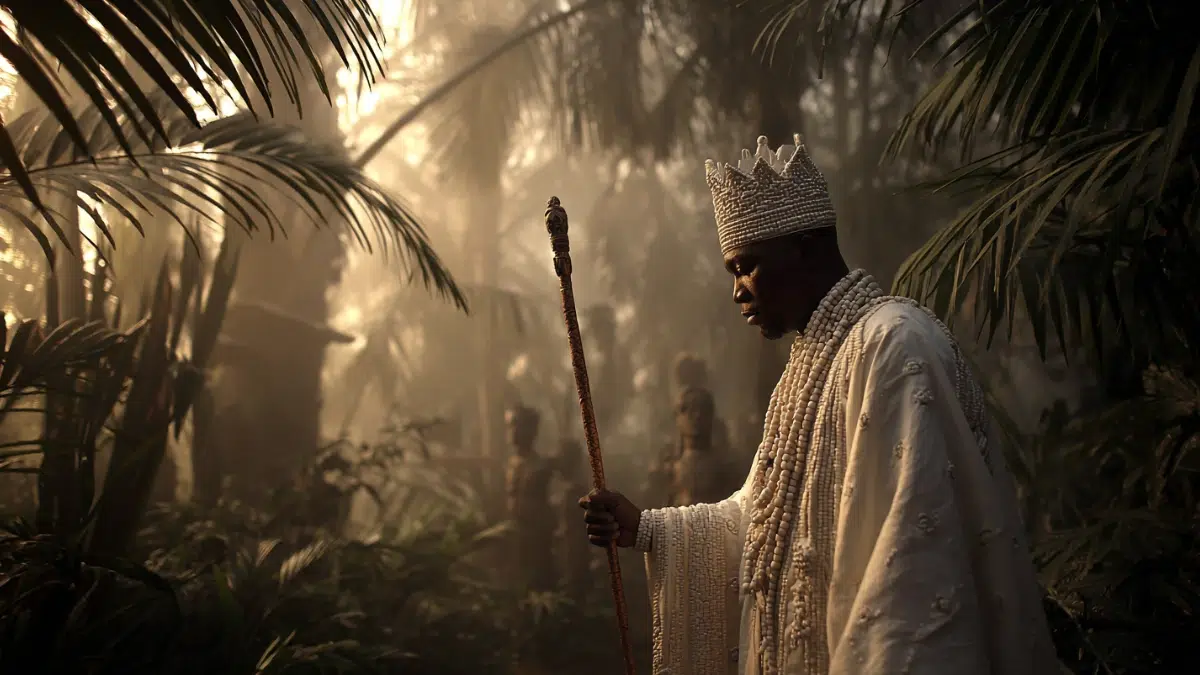
Each year in the sacred city of Ile‑Ife, the Olojo Festival celebrates Ogun’s legacy and his role as the orisha who cleared the earth for life. Olojo means “Owner of the Day,” referring to Ogun as the one who claimed the first usable day on earth by opening paths for the gods and humans.
During this multi-day festival, the Ooni of Ife (the spiritual king) enters seclusion to pray and fast. On the main day, the Ooni emerges in full traditional dress, including the Are crown, believed to be hundreds of years old and containing spiritual power. He walks the streets of Ile‑Ife barefoot and without head covering, offering prayers for peace, protection, and community renewal.
Drummers, worshippers, and local chiefs follow in procession, chanting praises to Ogun and other orishas. Devotees wear red or black, carry iron tools, and offer dogs, kola nuts, or palm wine—traditional items linked to Ogun’s worship.
This festival honours Ogun not only as a war god, but as a symbol of renewal. It reminds the community that tools, roads, and civilization itself would not exist without Ogun’s effort.
The Olojo Festival is more than a ritual—it’s a living link to Yoruba identity, faith, and resilience. In celebrating Ogun, the people renew their connection to the orisha who makes way for life to grow.
Interesting Facts of Ogun

Ogun’s name appears in many languages and traditions: Ogum, Ogou, Oggun, Gu.
In the diaspora, Ogun is often syncretized with Christian saints—St. George in Brazil, St. Michael in Haiti.
Wikipedia
Practitioners might swear oaths by kissing a piece of iron in his name.
Tools, weapons and modern machines are all under his domain—he is as much the god of engineers and mechanics as he is of warriors.
His gendered legacy: though war‐like and masculine in many portrayals, Ogun also supports builders, tool makers, path‑makers – blending creation and destruction.
Dogs and palm fronds appear in his symbolism; in some places, dogs are not allowed as pets in shrines to Ogun.
Conclusion
Ogun stands at the intersection of war and industry, of destruction and creation. As the orisha of iron and war, he cuts paths through forests, forges the tools that shape civilization and stands as the patron of warriors, builders and craftsmen alike.
His story from West Africa to the New World reminds us that the power of metal, the tool of humanity, carries both risk and possibility. Ogun still matters today—wherever the forge fires burn, wherever history’s warriors tread, and wherever machines hum—the god of iron keeps watch.