Greek Myths About the Stars: Orion to Sagittarius
The night sky has always fascinated humans, serving as a canvas for stories like the Greek myths about the stars, beliefs, and mysteries.
In ancient Greece, the stars were not just distant lights; they were characters from myth and legend. Each with a story that explained their place in the cosmos.
Greek myths about the stars are some of the most well-known tales, linking the stars to gods, heroes, and creatures from their rich mythology.
These myths helped ancient people understand the world around them. They offer explanations for natural phenomena and reflect the values and lessons of their culture.
Learn more about:
Introduction to Greek Myths About the Stars
Greek mythology is filled with stories of love, heroism, tragedy, and transformation, and many of these tales are immortalized in the stars.
Greek myths about the stars include Orion, Perseus, and Cassiopeia. They represent legendary figures whose deeds were so significant that they earned a permanent place in the heavens.
Others, like Draco and Pegasus, depict mythical creatures whose roles in the myths were essential to the gods and heroes of ancient Greece.
These myths are more than just stories. They are cultural touchstones that connect us to the ancient world. The constellations provide a way to explore these myths, allowing us to see the same stars that inspired the Greeks thousands of years ago.
As we look up at the night sky, we are reminded of the timeless nature of these stories and the enduring human desire to find meaning in the stars.
Each constellation carries with it a tale of adventure, love, or warning, offering a glimpse into the ancient Greek worldview and their connection to the cosmos.
Orion: The Mighty Hunter

Greek Myths About the Stars: Orion
Orion, a giant and legendary hunter, is the son of Poseidon. Known for his unmatched hunting skills, Orion boasts that he can kill any creature on Earth. This arrogance angers Gaia, the Earth goddess, who sends a giant scorpion to stop him. In one version, Orion tries to flee but is ultimately stung by the scorpion’s deadly tail.
In another version, Artemis, the goddess of the hunt, mistakenly kills Orion with an arrow, tricked by her twin brother Apollo. Moved by his tragic fate, Zeus places Orion among the stars as a constellation, forever drawing his bow in the night sky.
Orion’s myth connects to Scorpius, the scorpion that battles him. Their constellations appear opposite each other in the sky, symbolizing their eternal chase. The Pleiades, a star cluster, also flee from Orion’s pursuit, highlighting his relentless nature as a hunter.
Location and Viewing Tips
Orion is one of the easiest constellations to spot, especially during winter in the Northern Hemisphere. Look for the three bright stars in a straight line—Orion’s Belt—then find his shoulders and feet marked by other bright stars.
The constellation is visible from November to February, rising in the east and setting in the west.
Symbolism and Interpretation
Orion represents the strength and skill of a hunter but also the danger of hubris. His story warns against pride and reminds us of the power of nature. The constellation’s bright stars symbolize an enduring legacy and eternal struggle.
Sagittarius: The Archer
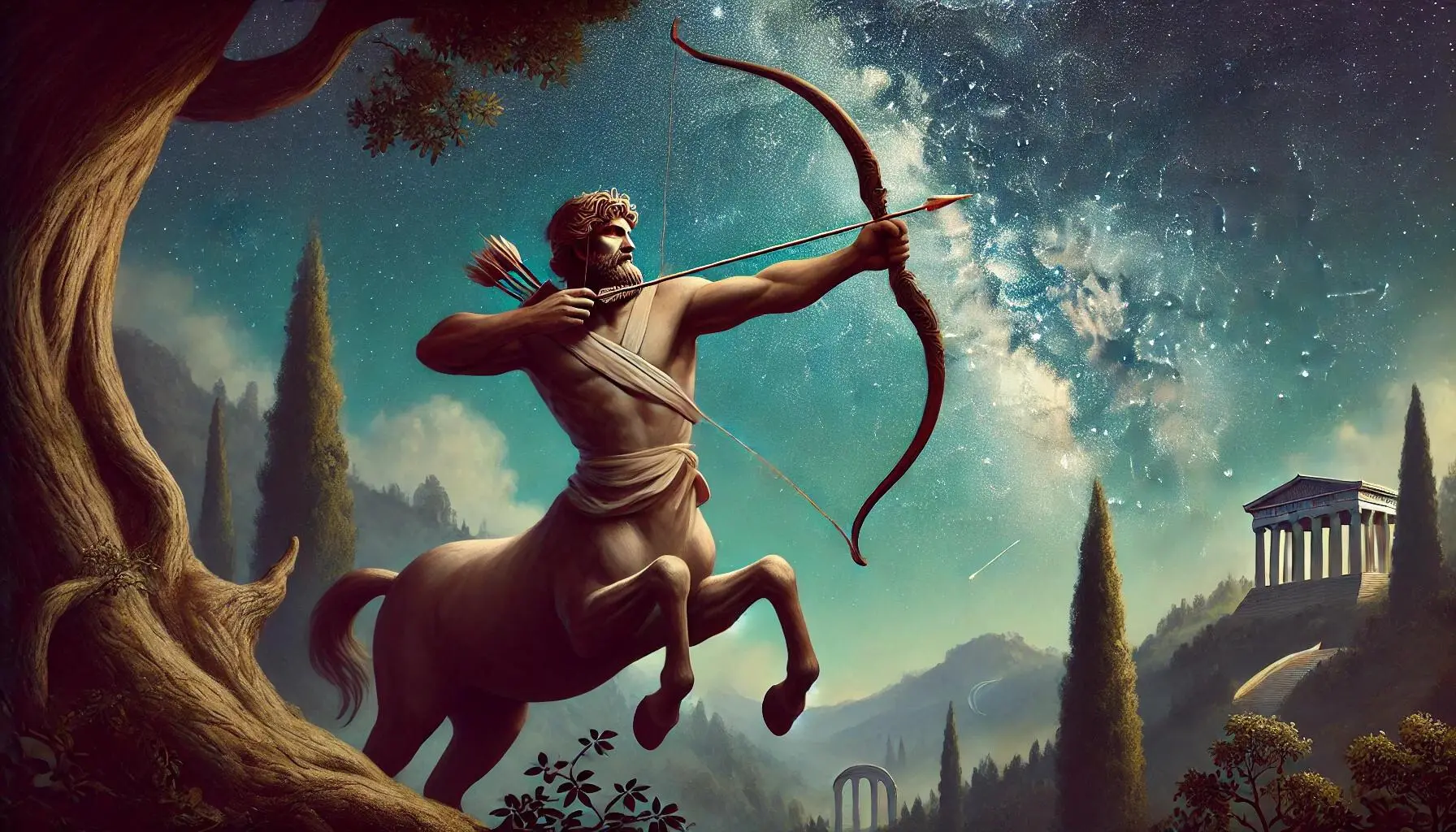
Greek Myths About the Stars: Sagittarius
Sagittarius, the Archer, is often associated with the centaur Chiron, known for his wisdom and skill in archery, known for his wisdom and skill in archery. Unlike other centaurs, who are wild and unruly, Chiron is noble and teaches many Greek heroes, including Achilles and Hercules.
According to myth, Chiron is accidentally wounded by a poisoned arrow shot by Hercules. Immortal and unable to die, Chiron suffers greatly until he trades his immortality with Prometheus, allowing him to finally find peace.
To honour his contributions and wisdom, Zeus places Chiron in the sky as the constellation Sagittarius, where he draws his bow toward the heavens.
Location and Viewing Tips
Sagittarius is visible in the Southern Hemisphere and the lower Northern Hemisphere during summer months. The constellation is best known for its asterism, the Teapot, which resembles a small, tilted teapot.
To find Sagittarius, look to the south of the Summer Triangle in the Milky Way, where the Teapot’s spout appears to pour out steam.
The constellation is most prominent in July and August, and it lies near the centre of the Milky Way, making it a rich area for stargazing with many deep-sky objects, including the famous Lagoon Nebula.
Symbolism and Interpretation
Sagittarius represents wisdom, teaching, and the duality of human nature, blending the wild and the refined.
The archer’s aim toward the stars symbolizes the pursuit of knowledge and higher truths. As a centaur, Sagittarius also reflects the balance between instinct and reason, embodying the struggle between animalistic desires and noble aspirations.
The constellation reminds us of the importance of wisdom, the pain of sacrifice, and the pursuit of a higher purpose.
Cassiopeia: The Vain Queen
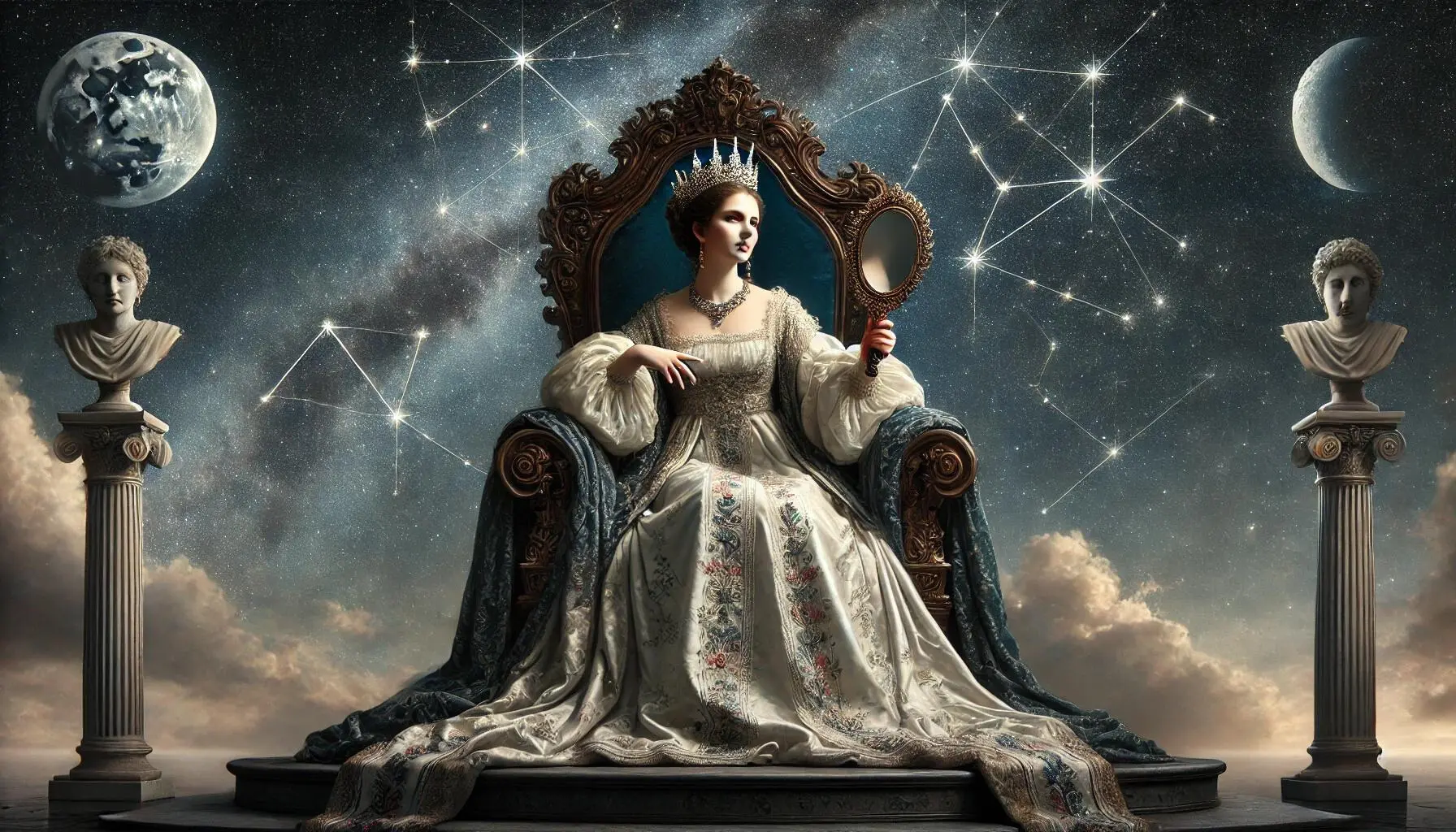
Greek Myths About the Stars: Cassiopeia
Cassiopeia, the queen of Ethiopia, claims she is more beautiful than the Nereids, sea nymphs who serve Poseidon. This boast angers the sea god, who sends a terrible sea monster to ravage her kingdom.
To appease Poseidon, Cassiopeia and her husband, King Cepheus, decide to sacrifice their daughter, Andromeda.
However, the hero Perseus saves Andromeda by slaying the monster. To punish Cassiopeia for her vanity, Poseidon places her in the sky. As a constellation, she sits on her throne, sometimes upside down, as a reminder of her arrogance.
Cassiopeia’s myth connects to the stories of Andromeda, Perseus, and Cepheus, her husband. All these figures have their own constellations nearby, forming a family group in the night sky.
Location and Viewing Tips
Cassiopeia is visible year-round in the Northern Hemisphere, opposite the Big Dipper. Look for five bright stars forming a distinctive “W” or “M” shape, depending on the time of year.
This constellation is easiest to spot during autumn evenings.
Symbolism and Interpretation
Cassiopeia symbolizes vanity and the consequences of pride. Her myth warns against boasting and shows how arrogance can lead to downfall. Her upside-down position in the sky serves as a constant reminder of her mistake, making her a symbol of caution.
Andromeda: The Chained Princess
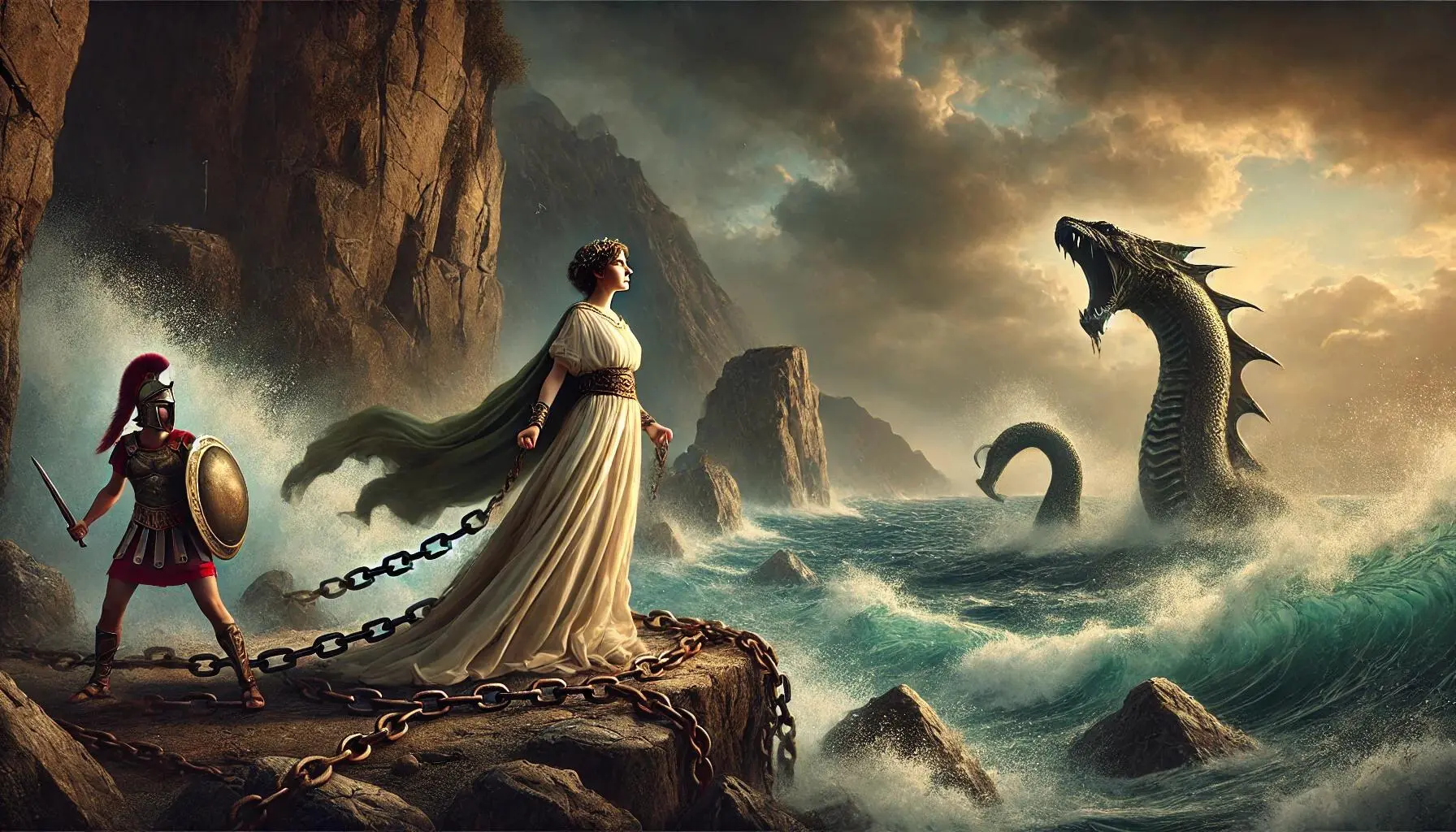
Greek Myths About the Stars: Andromeda
Andromeda, the daughter of Queen Cassiopeia and King Cepheus, becomes the unfortunate victim of her mother’s vanity.
After Cassiopeia angers Poseidon by claiming to be more beautiful than the sea nymphs, the god sends a sea monster, Cetus, to attack their kingdom. To save their people, Andromeda’s parents chain her to a rock as a sacrifice to the monster.
However, the hero Perseus arrives just in time, armed with the head of Medusa. He turns the monster to stone, rescues Andromeda, and later marries her. To honour her, the gods place Andromeda among the stars.
Andromeda’s myth closely ties with those of Cassiopeia, Cepheus, Perseus, and Cetus, all of whom have constellations near hers. Her story is part of a larger narrative that includes Perseus’s adventures, such as slaying Medusa and his encounter with Atlas.
Location and Viewing Tips
Andromeda is visible in the Northern Hemisphere from late summer through winter. It is located near Cassiopeia and Pegasus. The easiest way to find Andromeda is by locating the Great Square of Pegasus, then tracing two bright stars outward.
The constellation also includes the famous Andromeda Galaxy, visible to the naked eye under dark skies.
Symbolism and Interpretation
Andromeda represents innocence and the consequences of others’ actions. Her story shows how one can become a victim of pride and how courage can bring salvation. The constellation symbolizes hope, rescue, and the idea that even in the darkest times, help may come.
Perseus: The Heroic Slayer

Greek Myths About the Stars: Perseus
Perseus, one of the greatest heroes in Greek mythology, is the son of Zeus and the mortal Danaë.
King Polydectes sends Perseus on a dangerous mission to slay Medusa, a Gorgon whose gaze turns people to stone. Medusa, the fearsome Gorgon, plays a central role in his heroics.
With help from the gods, Perseus obtains winged sandals from Hermes, and a reflective shield and sword from Athena, Goddess of Wisdom. Using the shield to avoid Medusa’s deadly gaze, Perseus beheads her and places her head in a bag.
On his journey home, he encounters Andromeda, chained to a rock as a sacrifice to the sea monster Cetus. Perseus uses Medusa’s head to turn Cetus to stone, rescues Andromeda, and later marries her. To honour Perseus, the gods place him among the stars.
Perseus’s story ties into other myths, including the tales of Andromeda, Cassiopeia, and Cepheus, all of whom appear in nearby constellations.
Location and Viewing Tips
Perseus is visible in the Northern Hemisphere from late summer through winter. It lies near Andromeda and Cassiopeia, forming part of the story in the night sky. Look for the constellation between the “W” shape of Cassiopeia and the bright star Capella in Auriga.
Perseus contains the famous variable star Algol, also known as the “Demon Star,” which represents the eye of Medusa.
Symbolism and Interpretation
Perseus symbolizes bravery, cleverness, and divine favour. His myth represents the triumph of good over evil, showing that courage and the right tools can overcome any challenge. The constellation stands as a reminder of heroism and the rewards of perseverance.
Pegasus: The Winged Horse
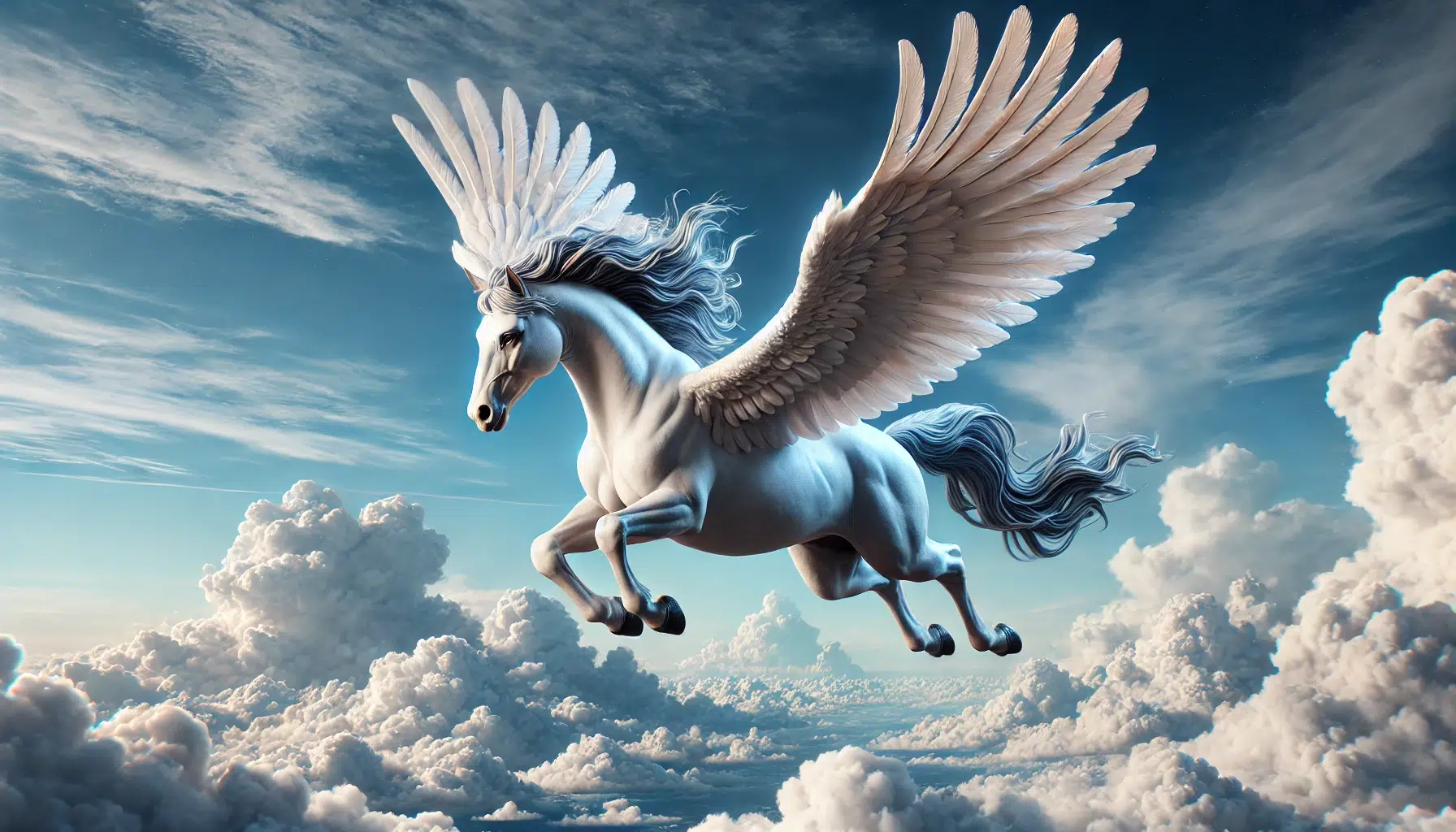
Greek Myths About the Stars: Pegasus
Pegasus, the majestic winged horse, springs forth from the blood of Medusa after Perseus beheads her. Born from the union of Poseidon and Medusa, Pegasus represents the divine and the heroic.
After his birth, Pegasus flies to Mount Helicon, where he strikes the ground with his hoof, creating the Hippocrene, a spring sacred to the Muses. The hero Bellerophon later tames Pegasus with the help of Athena’s golden bridle. Together, they defeat the Chimera, a monstrous creature terrorizing the land.
Bellerophon, emboldened by his success, attempts to fly Pegasus to Mount Olympus, but Zeus sends a gadfly to sting Pegasus, causing Bellerophon to fall. Pegasus, however, continues his journey and reaches Olympus, where Zeus transforms him into a constellation.
Location and Viewing Tips
Pegasus is visible in the Northern Hemisphere during autumn and early winter. The constellation is best known for the Great Square of Pegasus, a large asterism made up of four bright stars.
To find Pegasus, locate the square and look for its surrounding stars, which form the body and legs of the winged horse. The constellation lies near Andromeda and Pisces.
Symbolism and Interpretation
Pegasus symbolizes freedom, inspiration, and the connection between the mortal and divine. His myth highlights the themes of ambition and the dangers of hubris, reminding us of the balance between human aspiration and respect for the gods.
The constellation represents the soaring spirit and the idea that some dreams reach the heavens.
Ursa Major and Ursa Minor: The Great and Little Bears
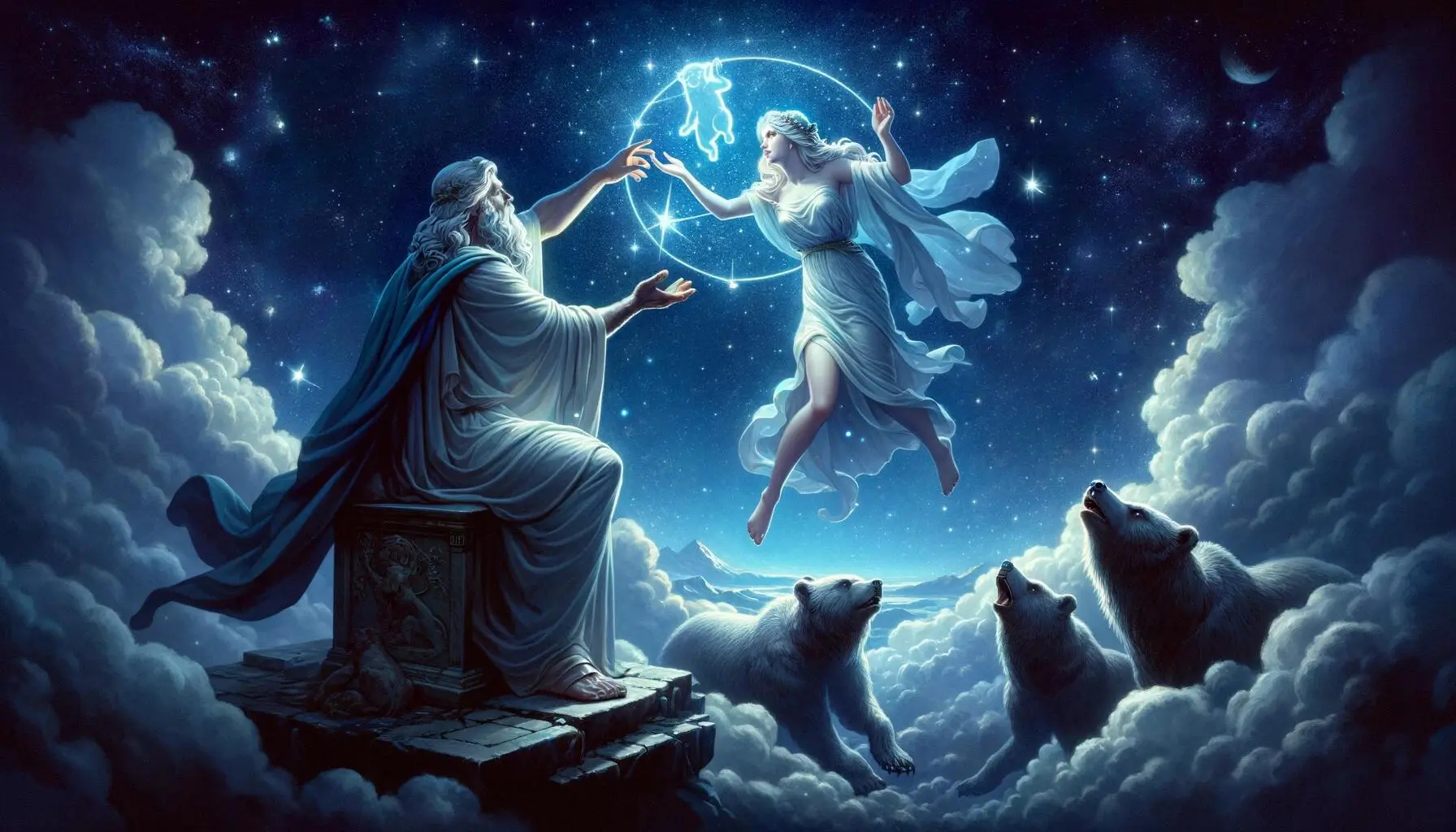
Greek Myths About the Stars: Ursa Major and Minor
Ursa Major and Ursa Minor are two of the most famous constellations in the night sky, known as the Great Bear and the Little Bear.
In Greek mythology, these constellations tell the story of Callisto, a nymph who catches the eye of Zeus. Hera, Zeus’s jealous wife, transforms Callisto into a bear. Years later, Callisto’s son, Arcas, almost kills her while hunting, unaware that the bear is his mother.
To prevent the tragedy, Zeus transforms Arcas into a bear and places them both in the sky as Ursa Major and Ursa Minor. The constellations represent mother and son, together in the heavens.
The myth also intersects with the story of the huntress Artemis, who is sometimes said to have turned Callisto into a bear.
Location and Viewing Tips
The constellations are linked to navigation, with Polaris being crucial in guiding explorers for centuries.
Ursa Major is visible year-round in the Northern Hemisphere and is one of the most recognizable constellations, featuring the Big Dipper asterism. Ursa Minor is also visible year-round and contains Polaris, the North Star, at the end of its tail.
To find Ursa Minor, locate the Big Dipper, then trace a line from its “pointer” stars (Dubhe and Merak) to Polaris. The Little Dipper, which forms Ursa Minor, is fainter but equally significant for navigation.
Symbolism and Interpretation
Ursa Major and Ursa Minor symbolize protection, guidance, and the bond between mother and child. The constellations also represent the enduring presence of the North Star, a symbol of stability and direction.
The myth warns of the consequences of jealousy and the lengths to which the gods will go to protect those they love.
The Pleiades: The Seven Sisters
Greek Myths About the Stars: Pleiades
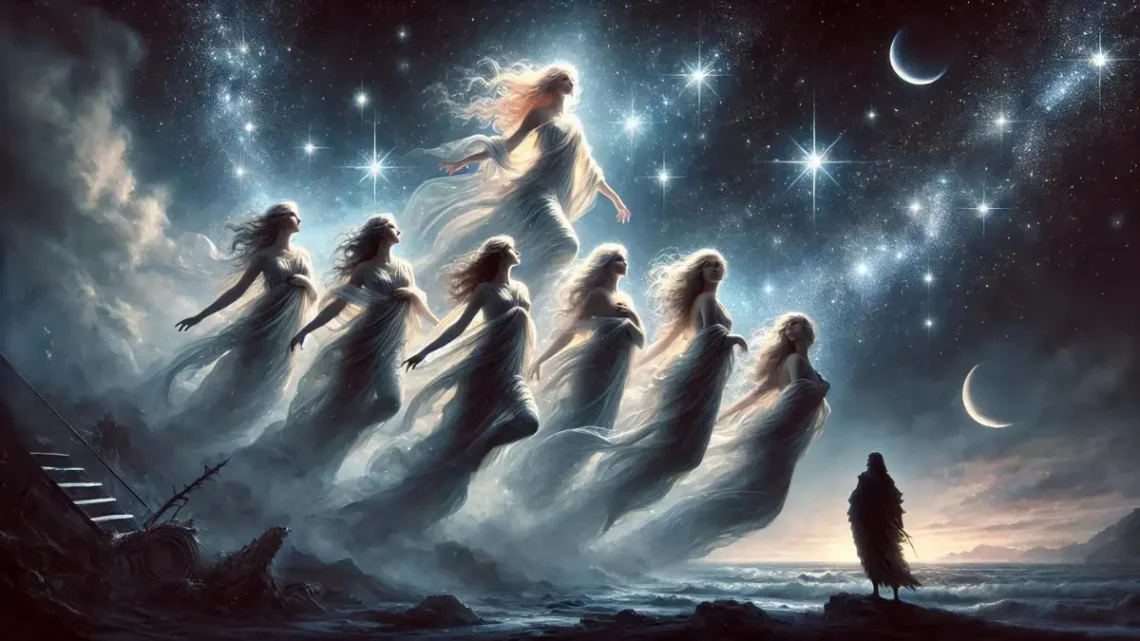
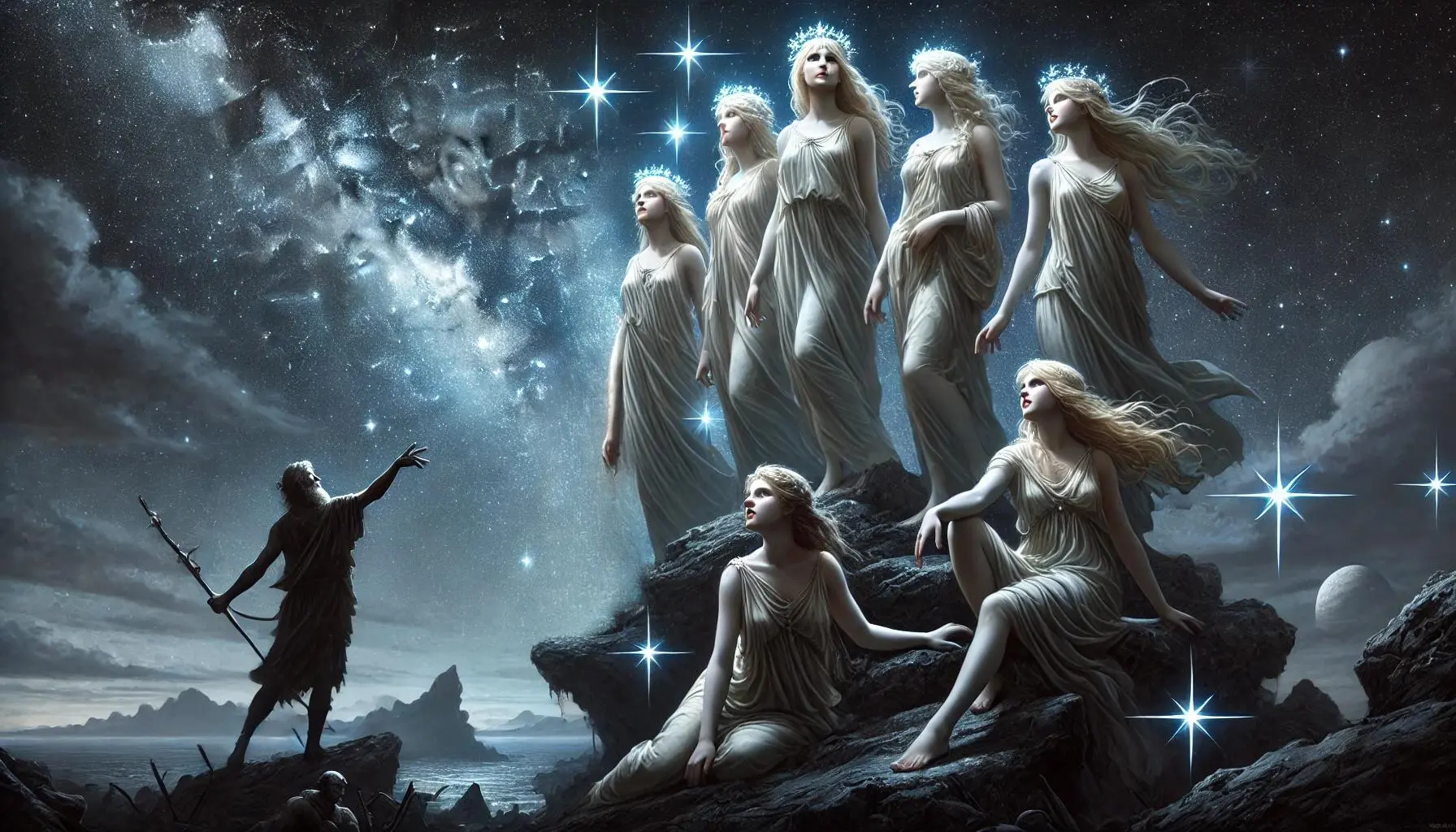
The Pleiades, known as the Seven Sisters, are the daughters of the Titan Atlas and the ocean nymph Pleione. In Greek mythology, the hunter Orion falls in love with the sisters and pursues them.
To protect them, Zeus turns the sisters into stars and places them in the sky. They continue to flee from Orion, who chases them across the heavens. While the cluster contains seven stars, only six are usually visible.
The seventh star may represent the lost sister Merope, who marries a mortal, or it may simply be faint.
Location and Viewing Tips
The Pleiades are visible from late fall through winter in the Northern Hemisphere. They are one of the easiest star clusters to spot, appearing as a small, misty patch of stars.
To find the Pleiades, look near the constellation Taurus, often above Orion in the night sky. On clear nights, you can see six stars with the naked eye, but under perfect conditions, a seventh star may appear. Binoculars reveal many more stars, enhancing the view of this beautiful cluster.
Symbolism and Interpretation
The Pleiades symbolize family, unity, and protection. The myth shows the sisters’ close bond and Zeus’s effort to protect them from Orion. Their ongoing flight across the sky represents an eternal chase, symbolizing the idea of pursuit and unattainable desires.
In many cultures, the Pleiades also mark important agricultural seasons, emphasizing their role in both myth and daily life. The cluster’s visibility in different parts of the world has made it a symbol of connection and continuity across cultures.
Hercules: The Mighty Hero
Greek Myths About the Stars: Hercules
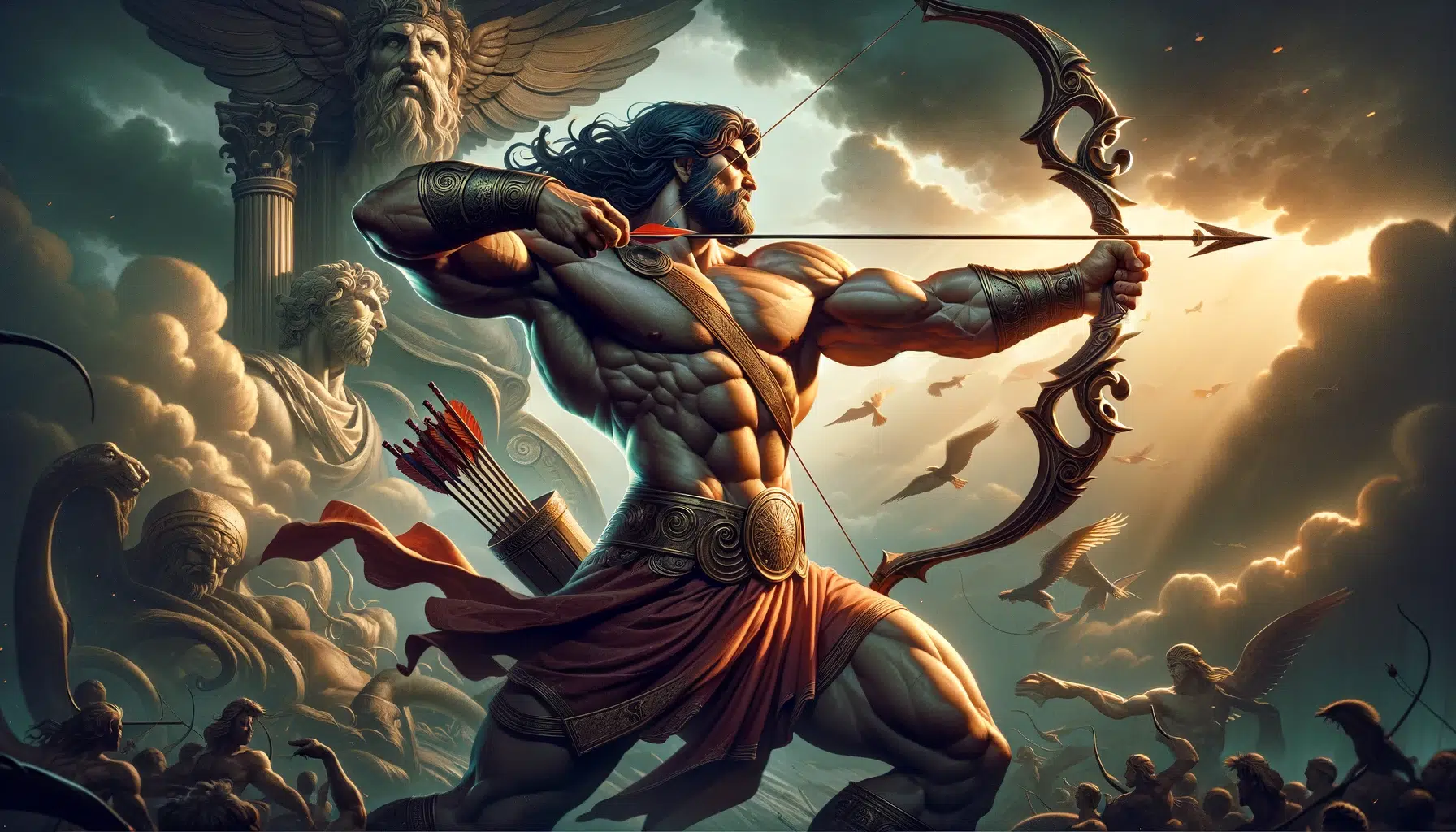
Hercules, known as Heracles in Greek mythology, is one of the greatest heroes. He is the son of Zeus and a mortal woman, Alcmene.
Famous for his incredible strength, Hercules completes the Twelve Labours, a series of near-impossible tasks. These labours include slaying the Nemean Lion, capturing the Golden Hind, and cleaning the Augean stables in a single day.
After his death, the gods reward Hercules by placing him among the stars as a constellation, where he stands in a heroic pose, forever a symbol of bravery and strength.
Location and Viewing Tips
The Hercules constellation is visible in the Northern Hemisphere from spring through early autumn.
It lies between the bright stars Vega in the constellation Lyra and Arcturus in Boötes. The most recognizable feature of Hercules is the Keystone, a trapezoid-shaped asterism that forms the torso of the hero.
The constellation is best viewed in June and July when it is highest in the sky. Although Hercules doesn’t have very bright stars, the Keystone is a good starting point for finding it.
Symbolism and Interpretation
Hercules symbolizes strength, courage, and perseverance. His myth teaches that even the greatest challenges can be overcome with determination and divine support. The Twelve Labours represent the trials that one must face in life, and Hercules’s success shows the rewards of resilience.
The constellation of Hercules serves as a reminder of the hero’s incredible feats and his enduring place in both mythology and the night sky. It also symbolizes the idea that true heroes live on through their deeds and the stories told about them.
Draco: The Celestial Dragon
Greek Myths About the Stars: Draco
Draco, the dragon, is one of the most ancient constellations in the night sky.
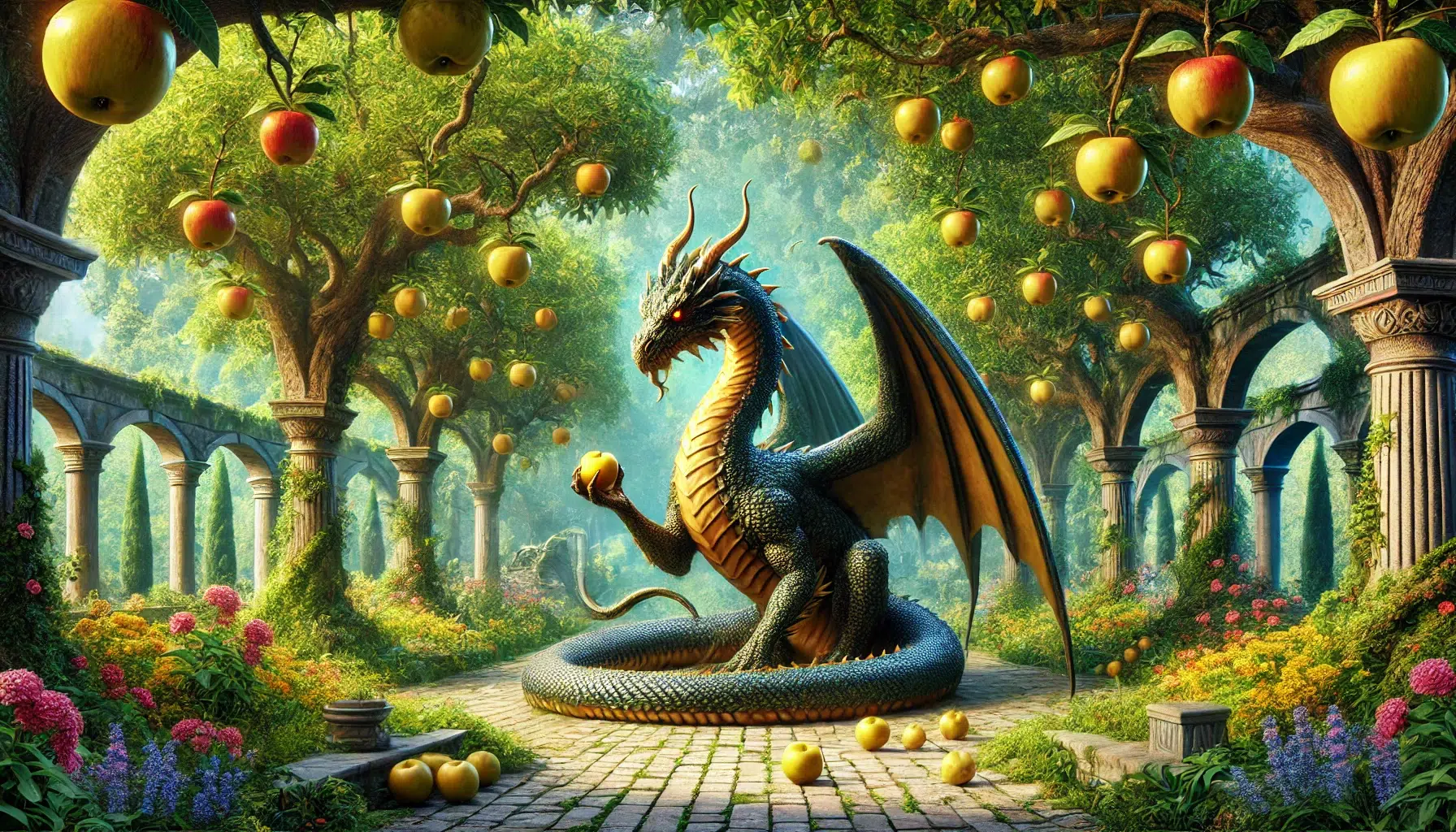
In Greek mythology, Draco represents Ladon, a fierce dragon who guards the golden apples in the Garden of the Hesperides. These apples grant immortality, and the dragon’s role is to prevent anyone from stealing them.
Hercules, during his Twelve Labours, is tasked with retrieving these apples. To complete this task, he slays Ladon.
As a reward for his service, Hera, who values the dragon’s loyalty, places Draco in the sky as a constellation, where it coils around the northern celestial pole.
Location and Viewing Tips
Draco is visible year-round in the Northern Hemisphere and is a circumpolar constellation, meaning it never sets below the horizon.
It lies between the Big Dipper and Little Dipper, winding around the Little Dipper’s handle. Draco’s head forms a quadrilateral of stars, while its body curves in a long, snakelike pattern.
The best time to view Draco is during July, when it is high in the evening sky. Although it doesn’t have very bright stars, its distinctive shape makes it recognizable.
Symbolism and Interpretation
Draco symbolizes vigilance, protection, and the power of guardianship. The dragon’s role in guarding the golden apples represents the idea of safeguarding valuable or sacred things. Hercules’s defeat of Ladon shows the triumph of heroism and the overcoming of obstacles.
As a constellation, Draco’s presence near the celestial pole also symbolizes stability and endurance, as it remains visible throughout the year. The myth of Draco reminds us of the importance of dedication and the protective nature of guardians.
Aquila: The Eagle of Zeus
Greek Myths About the Stars: Aquila
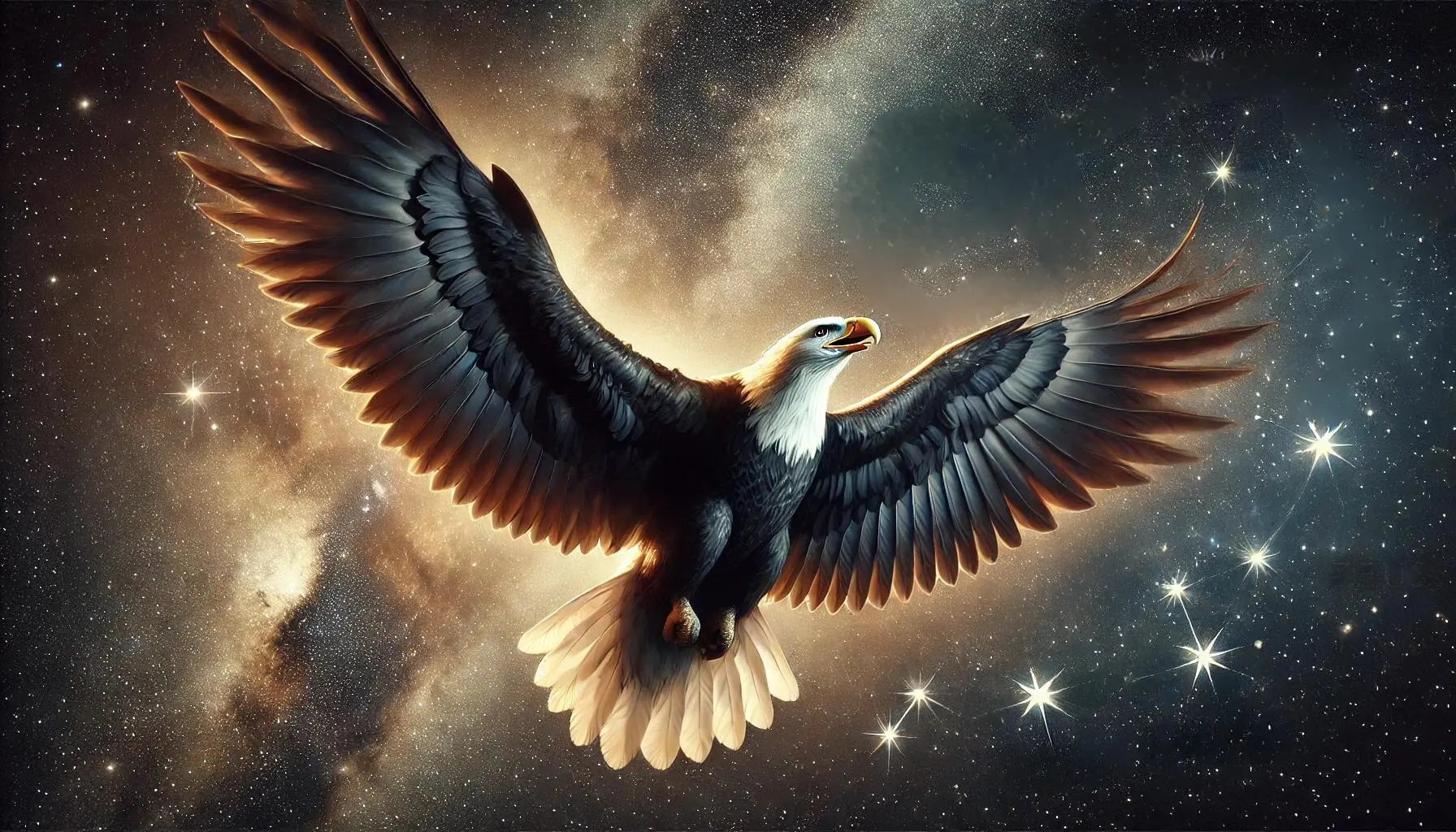
Aquila, the celestial eagle, is closely associated with Zeus, the king of the Greek gods.
In mythology, Aquila serves Zeus by carrying his thunderbolts and acting as his loyal messenger.
One of the most famous myths involving Aquila is the story of Ganymede, a beautiful mortal prince. Zeus, enamoured by Ganymede, sends Aquila to bring him to Mount Olympus. There, Ganymede becomes the cupbearer of the gods.
As a reward for his service, Zeus places Aquila among the stars, where it soars high in the sky as a constellation.
Location and Viewing Tips
Aquila is visible in the Northern Hemisphere during the summer and early autumn months.
The constellation is easily found by locating the bright star Altair, which forms the head of the eagle.
Altair is part of the Summer Triangle, along with the stars Vega in Lyra and Deneb in Cygnus. Aquila’s wings stretch out on either side of Altair, forming a distinctive pattern that resembles a flying eagle.
The best time to view Aquila is in July and August, when it is high in the evening sky.
Symbolism and Interpretation
Aquila represents strength, loyalty, and divine favour. The eagle, as a symbol of Zeus, embodies the power and authority of the king of the gods.
The constellation also symbolizes the idea of service and dedication, as Aquila faithfully serves Zeus by carrying out his commands. In a broader sense, Aquila’s role in the story of Ganymede represents the connection between the mortal and divine realms.
The constellation reminds us of the virtues of loyalty and the honour that comes from serving a higher purpose.
Conclusion
Greek constellation myths offer a unique window into the beliefs and values of ancient Greece.
By connecting the stars to their gods, heroes, and creatures, the Greeks created a rich tapestry of stories that have endured for millennia.
These myths not only helped explain the mysteries of the universe but also provided moral lessons, reflecting the timeless themes of heroism, sacrifice, and the human condition.
As we look up at the night sky, these ancient stories remind us of our shared history and the enduring power of mythology to connect us to the cosmos.