Maximize Accuracy: Choosing Crossbow Scopes
Crossbow scopes are precision optical devices mounted on crossbows to enhance accuracy at various distances.
Integral to the hunting and sport shooting experience, these scopes provide a clear aim point, often equipped with reticles calibrated for estimating range, windage, and elevation adjustments.
With advances in technology, modern crossbow scopes offer features such as illuminated reticles and range
finding capabilities, significantly improving shot precision.
Understanding the scope’s mechanics and choosing the right one is crucial as it can be the determining factor between a successful and a missed shot. A well-suited crossbow scope is not just an accessory;
it is a fundamental component for any archer aiming to maximize their accuracy and efficiency.
The Crucial Role of Magnification in Crossbow Scopes
Magnification in crossbow scopes is paramount for enhancing target visibility at various distances.
A scope’s magnification power dictates how much closer the target appears compared to the naked eye.
Low magnification is suitable for close-range shooting, offering a wider field of view and faster target acquisition.
On the contrary, high magnification settings can significantly improve aim on distant targets, albeit at the expense of a narrower field of view. It’s crucial for crossbow hunters to choose a scope with the right magnification level, balancing between the need for detail and the ability to react swiftly to moving targets.
Selecting the appropriate magnification contributes vastly to achieving high-level accuracy with every shot.
Understanding Reticle Types: What’s Best for Your Crossbow?
When selecting a crossbow scope, understanding the different reticle types is crucial. Reticles are the aiming points or patterns seen within the scope, and each type offers unique advantages.
- Red Dot: There is no magnification. It provides a simple point of aim and is ideal for quick target acquisition.
- Multi-Reticle: Has multiple horizontal lines at predetermined yardages which assist in shooting at varying distances.
- Illuminated Reticle: Offers better visibility in low light conditions, with either red or green illumination.
- Ballistic Reticle: Incorporates holdover points that help estimate arrow drop over distance. This is beneficial for long-range accuracy.
Choosing the right reticle for a crossbow largely depends on the hunting conditions and personal preference.
Consider the terrain, typical shooting distance, and lighting when deciding.
Illuminated vs. Non-Illuminated Scopes: Brightening Your Aim
Choosing between illuminated and non-illuminated crossbow scopes hinges on lighting conditions and personal preference.
Illuminated scopes feature battery-powered reticles with adjustable brightness levels, offering clarity in low-light situations.
This makes targeting more intuitive at dawn or dusk, when many game animals are most active.
Conversely, non-illuminated scopes rely on natural light, providing a traditional sighting experience without the potential for battery failure.
These are often lighter and less expensive. However, they may be less visible in dim conditions, potentially impacting accuracy. Assess your hunting environment and comfort with technology to decide which suits your crossbow best.
The Importance of Eye Relief in Crossbow Scopes for Comfortable Shooting
Eye relief is a critical consideration for ensuring comfort and safety while shooting with a crossbow scope.
It is the distance from the rear lens to the shooter’s eye that allows for a full field of view without loss of sight picture.
Adequate eye relief helps to:
- Prevent injury from recoil, especially important with powerful crossbows that can generate significant kickback.
- Reduce eye strain, as shooters can maintain a natural and comfortable head and neck position.
- Enhance accuracy by allowing for consistent positioning of the eye in relation to the scope.
Selecting a crossbow scope with the appropriate eye relief ensures a safer and more comfortable shooting experience, contributing to better overall performance.
Durability Features: Weatherproofing and Shock Resistance
Choosing the perfect crossbow scope requires attention to its durability, especially in challenging environments.
Key features to consider include:
- Weatherproofing: A high-quality crossbow scope should be fully sealed and nitrogen purged to prevent internal fogging. Look for scopes that boast waterproof and fog-proof capabilities, ensuring clarity in any weather condition.
- Shock Resistance: Crossbows produce significant recoil, which can impact a scope’s zero and accuracy. A well-built scope will have robust construction to withstand shocks and vibrations. Opt for models with reinforced body tubes and tested shock resistance to maintain precision shot after shot.
Adjustability: Elevation and Windage Knobs Explained
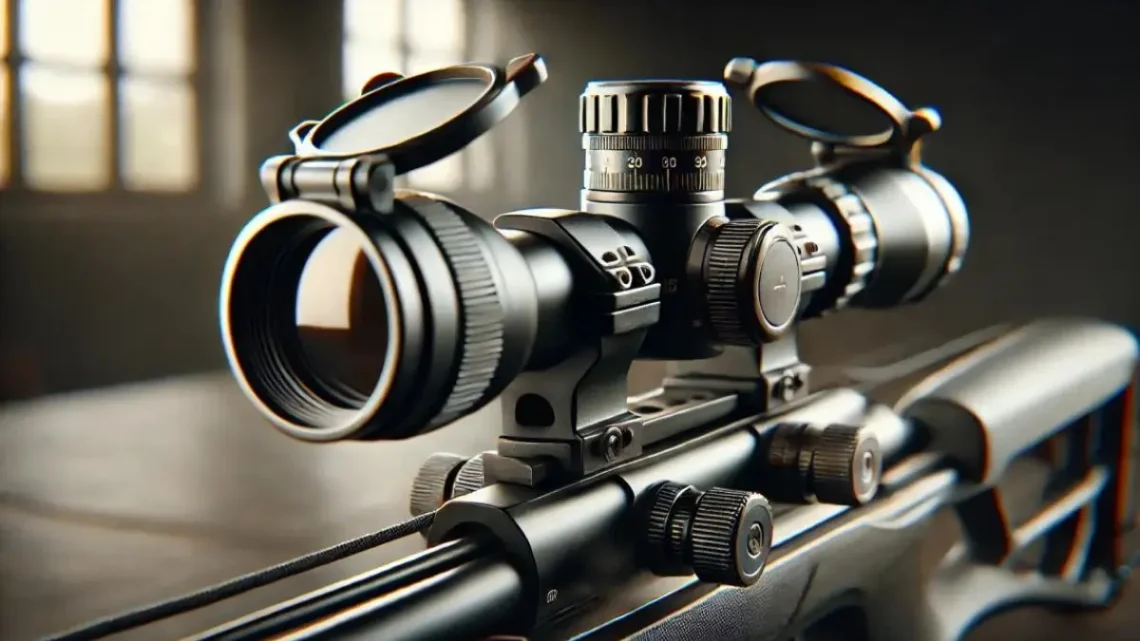
When aiming for precision shooting with a crossbow scope, understanding the function of elevation and windage knobs is crucial. These components are integral for fine-tuning a crossbow scope’s aim:
- Elevation Knob: Located at the top of the scope, the elevation knob adjusts the up and down aiming point. This is essential when shooting at different ranges, as it compensates for the drop in the arrow’s trajectory.
- Windage Knob: Found on the side of the scope, the windage knob corrects the aiming point left or right. This adjustment accounts for crosswind effects that can push the arrow off course laterally.
Both knobs typically click as they are adjusted, allowing for precise and repeatable settings. Proper use of these knobs ensures that the crossbow can be dialed in to hit the target accurately, regardless of range or weather conditions.
Learn more about: Archery Wind Reading Skills: Mastering the Elements
Scope Mounting Options: Ensuring a Secure and Compatible Fit
When selecting a crossbow scope, it’s crucial to consider mounting options that ensure a secure and compatible fit with your crossbow.
Here are key points to remember:
- Rail Type Match: Make sure the scope mount is compatible with the rail type on your crossbow – Picatinny and Weaver rails are common.
- Ring Size: Choose the correct ring size for your scope tube’s diameter—common sizes include 1 inch or 30mm.
- Materials: Opt for durable materials such as aircraft-grade aluminum for reliable performance and reduced weight.
- Recoil Consideration: Ensure the mount can handle the specific recoil level of your crossbow to maintain zero.
- Mounting System: Decide between a fixed or quick-detach mounting system based on your need for flexibility and speed during use.
Always cross-verify your crossbow’s specifications with the mounting system to prevent compatibility issues and maintain accuracy.
Optical Quality and Lens Coatings for Enhanced Clarity
Selecting a crossbow scope with superior optical quality is paramount for accuracy.
High-quality glass offers remarkable clarity and brightness, which are crucial in low-light conditions.
A prime lens system can greatly impact a shooter’s ability to pinpoint the target precisely.
Multi-coated lenses are a must, as they reduce glare and increase light transmission, providing a crisper image.
Anti-reflective coatings and water-repellent finishes enhance visibility by mitigating the effects of external elements.
Consider scopes with:
- Fully multi-coated lenses
- Anti-reflective coatings
- Hydrophobic or oleophobic coatings
- Scratch-resistant finishes
These lens enhancements work together to guarantee a clear line of sight, ensuring every shot counts.
Size and Weight Considerations for the Nimble Hunter
When selecting a crossbow scope, the nimble hunter must consider both size and weight meticulously.
A lightweight, compact scope enhances maneuverability and reduces fatigue during extended periods of stalking prey.
Heavier, larger scopes, though often more feature-rich, can impede quick movements and stealth necessary for a successful hunt.
Balancing magnification needs with the physical constraints of the scope ensures a harmonious addition to the crossbow setup.
Hunters should strive for a scope that offers the best clarity and range possible within a manageable size and weight profile to uphold their agility in the field.
Price vs. Performance: Finding the Balance for Your Budget
Choosing the perfect crossbow scope is a balance between cost and features. Price can heavily influence quality and accuracy, but that doesn’t mean a smaller budget can’t find good value. Here are key considerations:
- Determine your needs: Define what you require from your scope for your typical shooting conditions. Night vision? Range estimation? These features cost more.
- Set a budget: Decide on a spending limit. This helps narrow down options and find scopes that provide the best value for money.
- Research and compare: Look at reviews and compare the performance of scopes within your budget. Some mid-priced scopes can offer high-end features.
- Quality over bells and whistles: Aim for a durable scope that performs consistently rather than one with extra features that may not improve your accuracy.
Finding the right scope within your budget requires careful consideration of both its price and how well it performs the tasks you need it for.
Top Crossbow Scopes in the Market: Features Comparison
When choosing the perfect crossbow scope, discerning hunters and archers look for key attributes that enhance accuracy, usability, and durability. Here’s a comparative glance at some top scopes available:
- Magnification Range: Higher magnification offers better target detail at long range, while lower magnification provides a wider field of view for close shots.
- Reticle Design: Illuminated reticles improve low-light visibility, and multiple aiming points facilitate distance shooting without manual adjustments.
- Lens Quality: Coated lenses reduce glare and improve light transmission for a clearer image, even in dim conditions.
- Construction: Waterproof and fog-proof features are essential for reliability in diverse weather.
- Eye Relief: A comfortable eye relief minimizes strain and allows for quick targeting.
- Adjustments: Precise windage and elevation adjustments are critical for fine-tuning shot accuracy.
- Compatibility: Crossbow scopes must be compatible with the crossbow’s speed for optimal performance.
Crossbow enthusiasts must carefully compare these features to find a scope that aligns with their specific needs and preferences.
Conclusion: Integrating Features for the Ultimate Crossbow Experience
To enhance the crossbow experience, integrating key features in a scope is vital. Precision is paramount, thus choosing a scope with the following can make all the difference:
- Magnification suitable for the intended range of use
- Reticle type that offers clear aiming points at various distances
- Coated optics for greater clarity and light transmission
- Scope adjustment capabilities for windage and elevation precision
- Build quality to withstand the rigors of the outdoors
Selecting a scope with a harmonious blend of these attributes will ensure an accurate and enjoyable crossbow hunt or target shooting session.