
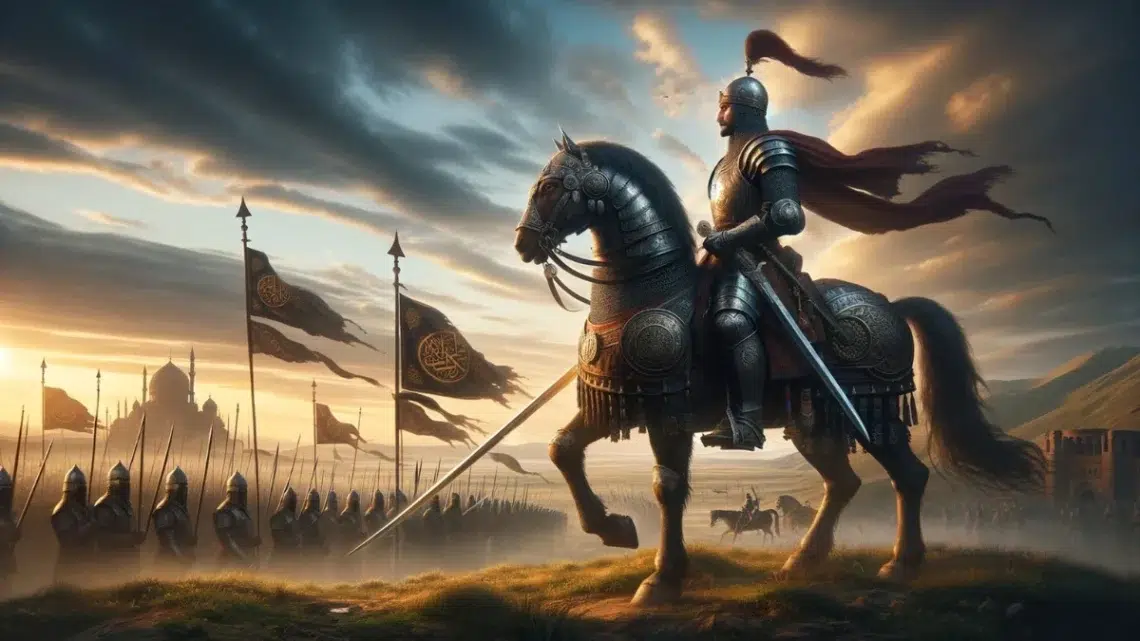
Alp Arslan: Historical Conquests and Legacy
Introduction to Alp Arslan and the Seljuk Empire
Alp Arslan, which means “Heroic Lion” in Turkish, was the second sultan of the Seljuk Empire, heralding his reign from 1063 to 1072.
Under his leadership, the Seljuk Turks expanded their territory exponentially, becoming a formidable force in the medieval Islamic world.
The empire, initially founded in 1037 by Tughril Beg, Alp Arslan’s uncle, thrived as a political and military powerhouse, influencing regions far beyond its Central Asian origins.
It stretched across the Iranian plateau and parts of Anatolia, presenting a significant challenge to the Byzantine Empire and impacting the socio-political dynamics of the Middle East for centuries.
Alp Arslan’s most notable achievement was his victory at the Battle of Manzikert in 1071, which paved the way for Turkish settlement in Anatolia.
The Early Life of Alp Arslan

Born in 1029, Alp Arslan, which means “Heroic Lion,” was a member of the Seljuk dynasty.
His birth name was Muhammad bin Dawud Chaghri, and he was the second son of Chaghri Beg, the deputy governor of Khorasan.
His early life signified a grooming process for future dominance:
- He was steeped in the art of war and politics from a tender age, under the tutelage of competent mentors.
- Alp Arslan accompanied his father and uncle, Tughril Beg, on military campaigns, acquiring skills and knowledge critical for leadership.
- He swiftly displayed prowess in military and political affairs, cultivating alliances and demonstrating strategic acumen.
- By 1063, upon his uncle’s death, Alp Arslan ascended as the Sultan of the Seljuk Empire, ready to expand his domain and carve his name into history.
The Byzantine-Seljuk Wars: Prelude to Manzikert
In the mid-11th century, the Byzantine Empire encountered a formidable new foe: the Seljuk Turks.
These skilled warriors had rapidly expanded their territory, infringing upon Byzantine lands in Anatolia.
The initial clashes, defined by border skirmishes and raids, escalated into full-blown warfare as Seljuk ambition grew.
Byzantine efforts to repel the incursions met with mixed success, leading to a series of confrontations that exposed the Empire’s military vulnerabilities.
This period of conflict set the stage for the Battle of Manzikert in 1071, a pivotal encounter that would dramatically alter the balance of power in the region and herald the rise of Alp Arslan.
Turning Point of Medieval Warfare
On August 26, 1071, the Battle of Manzikert marked the decline of Byzantine power and heralded the rise of the Seljuk Turks.
Byzantine Emperor Romanos IV Diogenes faced the Seljuk Sultan Alp Arslan in a conflict that shifted the balance of power in Anatolia.
Despite superior numbers, the Byzantines suffered a catastrophic defeat, largely due to treachery and poor military tactics.
Key consequences of the battle included:
- Capture of Emperor Romanos IV, undermining Byzantine authority.
- Accelerated Turkish settlement in Anatolia, diluting Byzantine control.
- Set the stage for the Crusades by weakening the Byzantine Empire, prompting calls for Western support.
- Initiated military and cultural changes that resonated throughout the Middle Ages.
The Battle of Manzikert stands as a pivotal moment, reshaping the geopolitical landscape of the medieval world.
Learn more: Journey of Archery from Combat to Recreation
Expansion of the Seljuk Empire under Alp Arslan
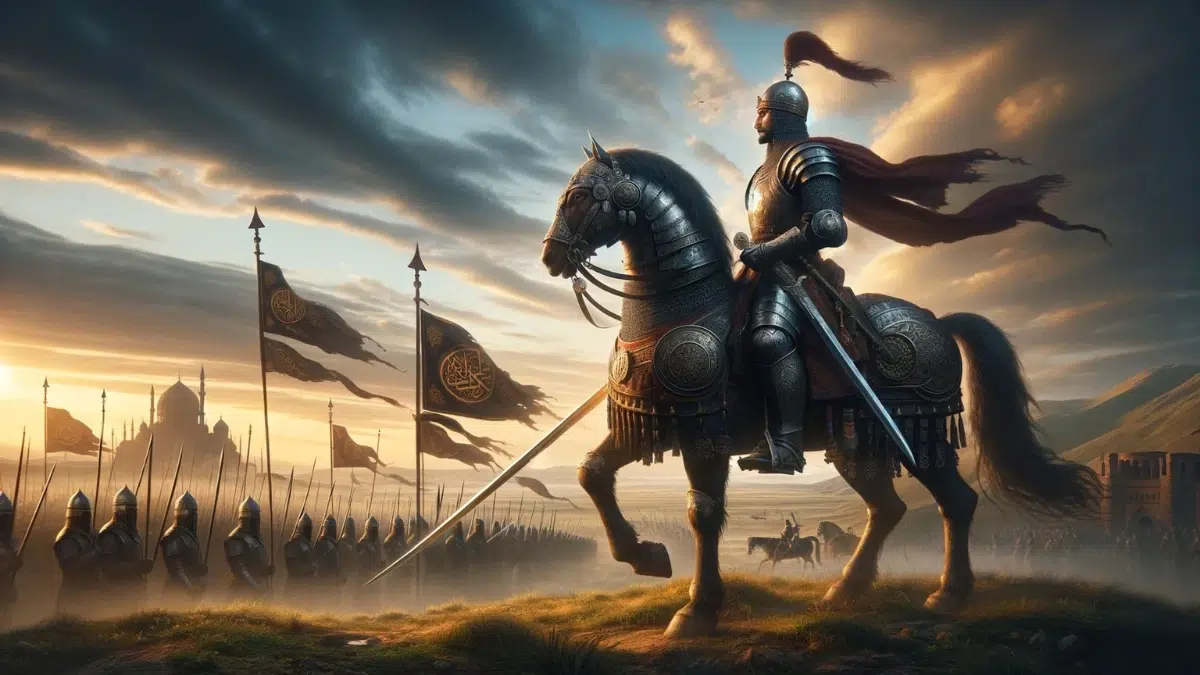
Upon ascending the throne, Alp Arslan initiated a series of military campaigns that significantly broadened the Seljuk territory.
Notably, he conquered:
- Armenia and Georgia, extending his domain to the Caucasus.
- Parts of Anatolia, marking the beginning of Turkish influence in the region.
Alp Arslan’s most prolific victory occurred at the Battle of Manzikert in 1071, where he decisively defeated the Byzantine Empire, leading to:
- The capture of the Byzantine Emperor Romanos IV Diogenes.
- Opening the gates for the Turkic settlement of Anatolia.
Under his rule, the Seljuk Empire’s borders expanded eastward and included parts of Central Asia, reinforcing Silk Road control.
This territorial expansion not only demonstrated military prowess but also increased trade and cultural exchange, solidifying the Seljuk Empire’s role as a nexus between East and West.
A Blend of Persian and Turkic Traditions
Alp Arslan’s administration represented a critical juncture in which traditional Turkic governance structures met the sophisticated Persian bureaucratic system.
Key facets included:
- Emphasis on a strong, centralized rule, with Alp Arslan positioning himself as a sovereign leader simultaneously embodying Turkic warrior ethos and Persian royal authority.
- Integration of Persian administrative practices, such as the divan system, with the existing tribal framework of the Seljuq Turks.
- Adoption of Persian court culture and practices, which appealed to the existing administrative elite and facilitated smoother governance across diverse regions.
- Preservation of Turkic military organization and nomadic traditions among the Seljuq clans, maintaining their distinct identity and martial prowess.
- Encouragement of cultural and religious intellectuals, promoting an environment wherein Islamic scholarship flourished alongside Persian literature and arts.
This synergetic approach not only solidified Alp Arslan’s hold on power but also set a precedent for a cultural and administrative paradigm that would shape the region for centuries.
Diplomacy and Relations with Neighbouring States
Alp Arslan, the Seljuk Sultan, adeptly combined military conquests with diplomatic strategies.
His tenure saw the expansion of influence over various neighboring states through both fear and respect.
Significant events under his rule include:
- Establishing vassal states through conquests, which expanded the Seljuk realm substantially.
- Strategic marriages to consolidate power and secure alliances, as customary in medieval statecraft.
- Negotiations resulting in the pivotal Treaty of Manzikert with Byzantium in 1071.
- Forging tactical alliances with neighboring Muslim states to unify the Islamic front.
His diplomatic endeavors often turned rivals into allies, laying a foundation for the prosperity of the Seljuk Empire.
Cultural and Religious Impact of Alp Arslan’s Reign
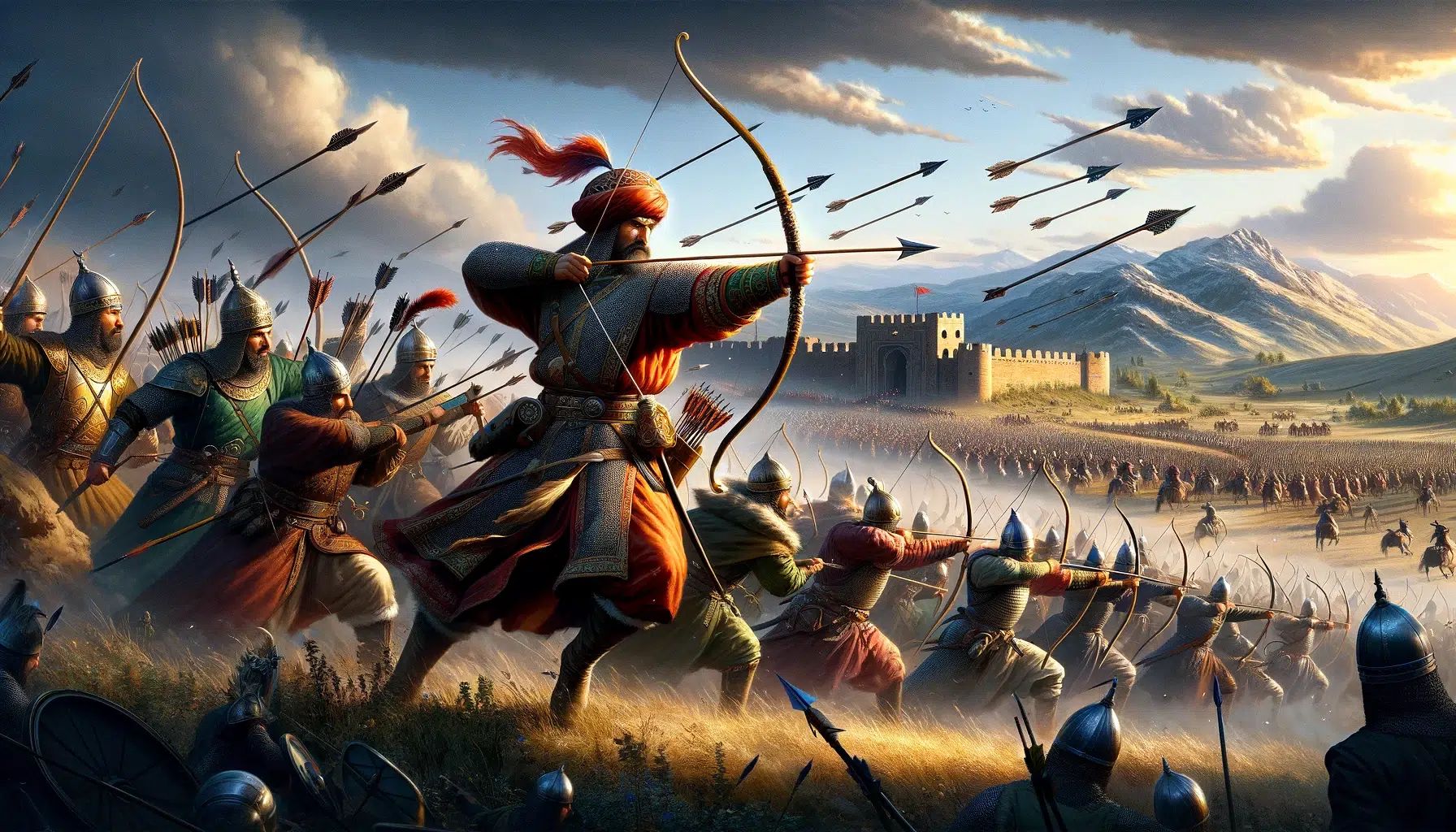
Alp Arslan’s reign marked a significant period in the evolution of Middle Eastern culture and the Islamic faith.
His military conquests facilitated the spread of Islamic cultural and religious norms across a vast territory that included parts of the Byzantine Empire and Central Asia.
- The victory at the Battle of Manzikert in 1071 against the Byzantines represented an essential shift, paving the way for Turkish expansion into Anatolia. This led to the cultural Turkification and Islamization of the region.
- His support for Sunni Islam helped solidify the Seljuk Dynasty’s religious foundations and contributed to the development of religious institutions and education, including the construction of mosques and madrasas.
- Alp Arslan’s patronage of the arts and architecture bore the fruits of a distinctive Seljuk style, influencing subsequent Islamic and even non-Islamic cultures.
- The encounter with various cultures during his conquests led to an exchange of knowledge and traditions, enriching the intellectual and cultural life within his empire.
His policies and military triumphs thus had profound implications for the religious and cultural landscape of the region that can still be discerned today.
Military Innovations and Tactical Genius of Alp Arslan
Alp Arslan is widely recognized for revolutionizing warfare during his reign.
By integrating swift cavalry tactics with traditional infantry maneuvers, he created a formidable force that confounded his adversaries. His strategic use of reconnaissance and surprise enabled him to defeat larger armies, most notably at the Battle of Manzikert in 1071.
This victory against the Byzantine Empire was largely due to his innovative approach to warfare, including feigned retreats and encirclement strategies that became hallmarks of Turkish military doctrine.
His utilization of nomadic horse-archers altered the landscape of combat, emphasizing mobility over sheer numbers.
Succession and the Future of the Seljuk Dynasty Post-Alp Arslan
When Alp Arslan passed away in 1072, the future of the expansive Seljuk realm he had cultivated was uncertain. His son, Malik Shah I, inherited a well-established dominion, benefitting from the administrative framework his father had instituted.
- Malik Shah’s reign saw the continuation of Alp Arslan’s policies, solidifying the dynasty’s hold over their territories.
- The Nizam al-Mulk, a brilliant vizier under both rulers, played a pivotal role in the smooth transition and governance.
- The dynasty faced internal divisions and external threats, testing the resilience of Alp Arslan’s legacy.
- Nonetheless, Malik Shah managed to maintain the unity and prosperity of the Seljuk Empire for the majority of his reign.
- The period also witnessed an intellectual flourishing, marked by the establishment of the renowned Nizamiyya madrasas.
s successors ensured the persistence of the Seljuk’s political and cultural influence across the Middle East.
Alp Arslan’s Legacy in Literature and Popular Memory
Alp Arslan, the Seljuk Sultan, occupies a revered place in historical narratives and popular culture.
The literary tributes to his valor are numerous, with his persona frequently featuring in Turkish and Persian epics and poetry.
He is hailed for his prowess in the Battle of Manzikert (1071). This an event that has become synonymous with heroism in Muslim chronicles.
Alp Arslan’s enduring legacy is also preserved through folk tales and sayings, underscoring his impact beyond the battlefield. From novels to television, his character continues to inspire. Thus cementing his status as an emblematic figure of courage and leadership.
Evaluating Alp Arslan’s Place in History
Alp Arslan holds a significant role in history as the Sultan who expanded the Seljuk Empire. He paved the way for the cultural and political landscape of the Middle East.
His military successes, most notably at the Battle of Manzikert, not only underscore his prowess as a leader and warrior but also set the stage for the rise of Turkish influence in the region.
Alp Arslan’s legacy is indelibly marked by his contributions to the Seljuk dynasty and the precedent he set for successive leaders.
His reign is a cornerstone in the annals of history. Thus reflecting a period of remarkable transformation and the enduring might of a remarkable ruler.